Show HN: I built a sub-500ms latency voice agent from scratch (opens in a new tab)ntik.me
570 pointsI built a voice agent from scratch that averages ~400ms end-to-end latency (phone stop → first syllable). That’s with full STT → LLM → TTS in the loop, clean barge-ins, and no precomputed responses.
What moved the needle:
Voice is a turn-taking problem, not a transcription problem. VAD alone fails; you need semantic end-of-turn detection.
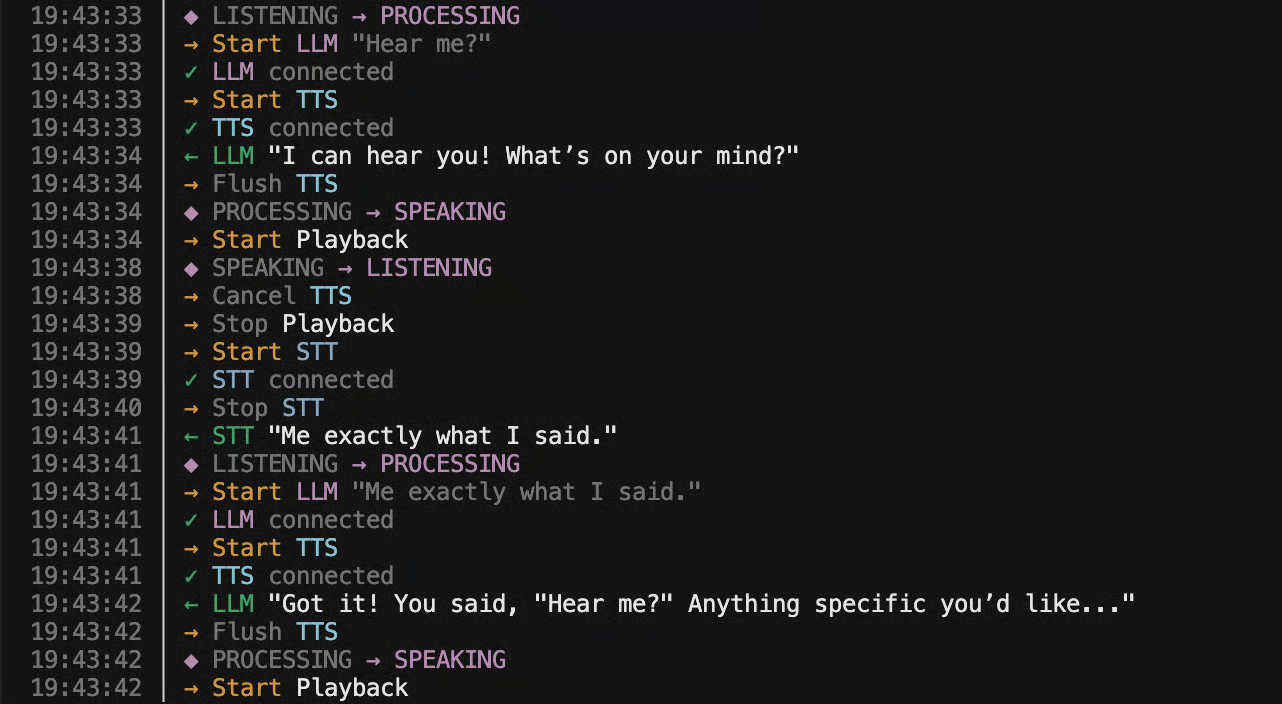
The system reduces to one loop: speaking vs listening. The two transitions - cancel instantly on barge-in, respond instantly on end-of-turn - define the experience.
STT → LLM → TTS must stream. Sequential pipelines are dead on arrival for natural conversation.
TTFT dominates everything. In voice, the first token is the critical path. Groq’s ~80ms TTFT was the single biggest win.
Geography matters more than prompts. Colocate everything or you lose before you start.
GitHub Repo:
https://github.com/NickTikhonov/shuo
Follow whatever I next tinker with: https://x.com/nick_tikhonov
Comments (153) 62 threads
Earlier commentsThe insights about VAD and streaming pipelines in this thread are exactly what I'm looking at for v2. Moving to a WebSocket streaming pipeline with proper voice activity detection would close the latency gap significantly, even with local models.
I built something that automates exactly this kind of cross-provider investigation across Twilio + ElevenLabs + Deepgram — happy to share if you want
For anyone curious: https://flux.deepgram.com/
> Chunks the audio when the model believes based on the words said by the user that they have completed their utterance.
Source: https://developers.openai.com/api/docs/guides/realtime-vad
OpenAI's Semantic mode is looking at the semantic meaning of the transcribed text to make an educated guess about where the user's end of utterance is.
According to Deepgram, Flux's end-of-turn detection is not just a semantic VAD (which inherently is a separate model from the STT model that's doing the transcribing). Deepgram describes Flux as:
> the same model that produces transcripts is also responsible for modeling conversational flow and turn detection.
[...]
> With complete semantic, acoustic, and full-turn context in a fused model, Flux is able to very accurately detect turn ends and avoid the premature interruptions common with traditional approaches.
Source: https://deepgram.com/learn/introducing-flux-conversational-s...
So according to them, end-of-turn detection isn't just based on semantic content of the transcript (which makes sense given the latency), but rather the the characteristics of the actual audio waveform itself as well.
Which Pipecat (open source voice AI orchestration platform) actually does as well seemingly with their smart-turn native turn detection model as well: https://github.com/pipecat-ai/smart-turn (minus the built-in transcription)
All comments shown.
Couldn't load more comments. Check your connection and try again.