Show HN: I built a sub-500ms latency voice agent from scratch (opens in a new tab)ntik.me
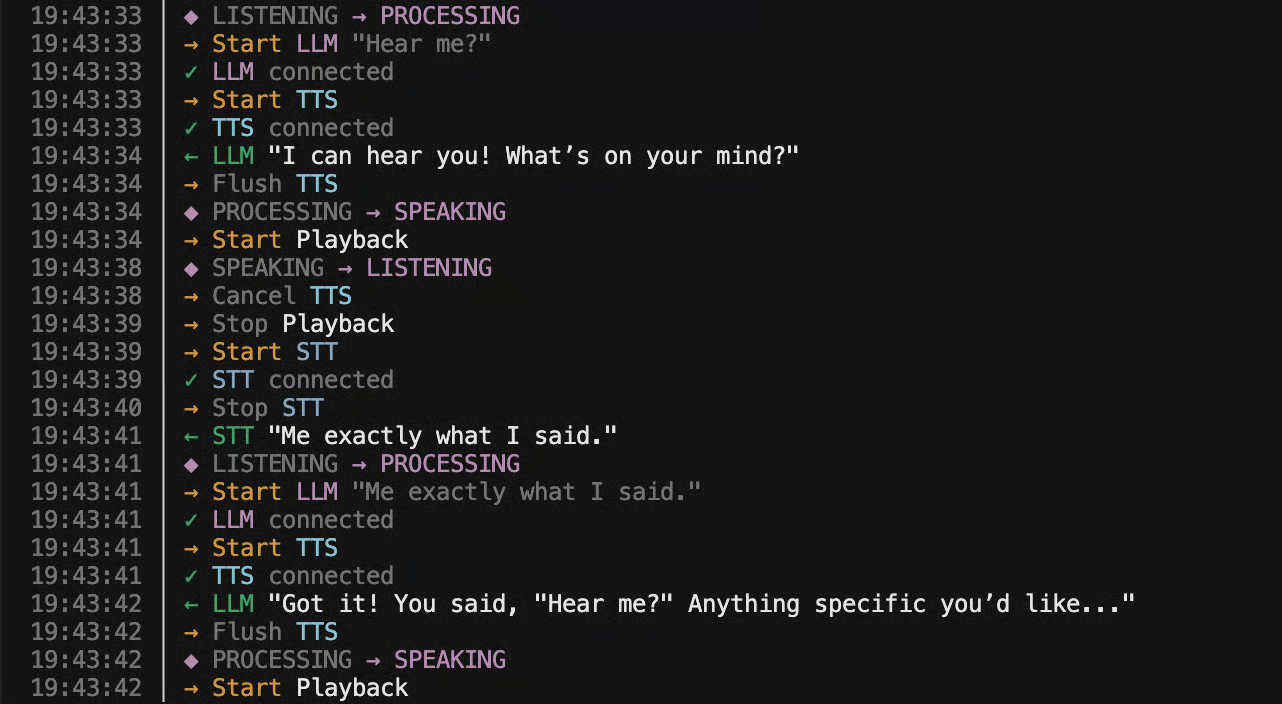
570 pointsI built a voice agent from scratch that averages ~400ms end-to-end latency (phone stop → first syllable). That’s with full STT → LLM → TTS in the loop, clean barge-ins, and no precomputed responses.
What moved the needle:
Voice is a turn-taking problem, not a transcription problem. VAD alone fails; you need semantic end-of-turn detection.
The system reduces to one loop: speaking vs listening. The two transitions - cancel instantly on barge-in, respond instantly on end-of-turn - define the experience.
STT → LLM → TTS must stream. Sequential pipelines are dead on arrival for natural conversation.
TTFT dominates everything. In voice, the first token is the critical path. Groq’s ~80ms TTFT was the single biggest win.
Geography matters more than prompts. Colocate everything or you lose before you start.
GitHub Repo:
https://github.com/NickTikhonov/shuo
Follow whatever I next tinker with: https://x.com/nick_tikhonov
Comments (153) 62 threads
Earlier commentsCurious about your semantic end-of-turn detection: are you using a separate lightweight model for that, or is it baked into the main LLM inference? That seems like the hardest part to get right without adding latency.
1. I wonder if it could be optimised more by just having a single language, and
2. How do we get around the problem of interference, humans are good at conversation discrimination ie listing while multiple conversations, TV, music, etc are going on in the background, I've not had too much success with voice in noisy environments.
https://news.ycombinator.com/item?id=46946705
All comments shown.
Couldn't load more comments. Check your connection and try again.