Show HN: I built a sub-500ms latency voice agent from scratch (opens in a new tab)ntik.me
570 pointsI built a voice agent from scratch that averages ~400ms end-to-end latency (phone stop → first syllable). That’s with full STT → LLM → TTS in the loop, clean barge-ins, and no precomputed responses.
What moved the needle:
Voice is a turn-taking problem, not a transcription problem. VAD alone fails; you need semantic end-of-turn detection.
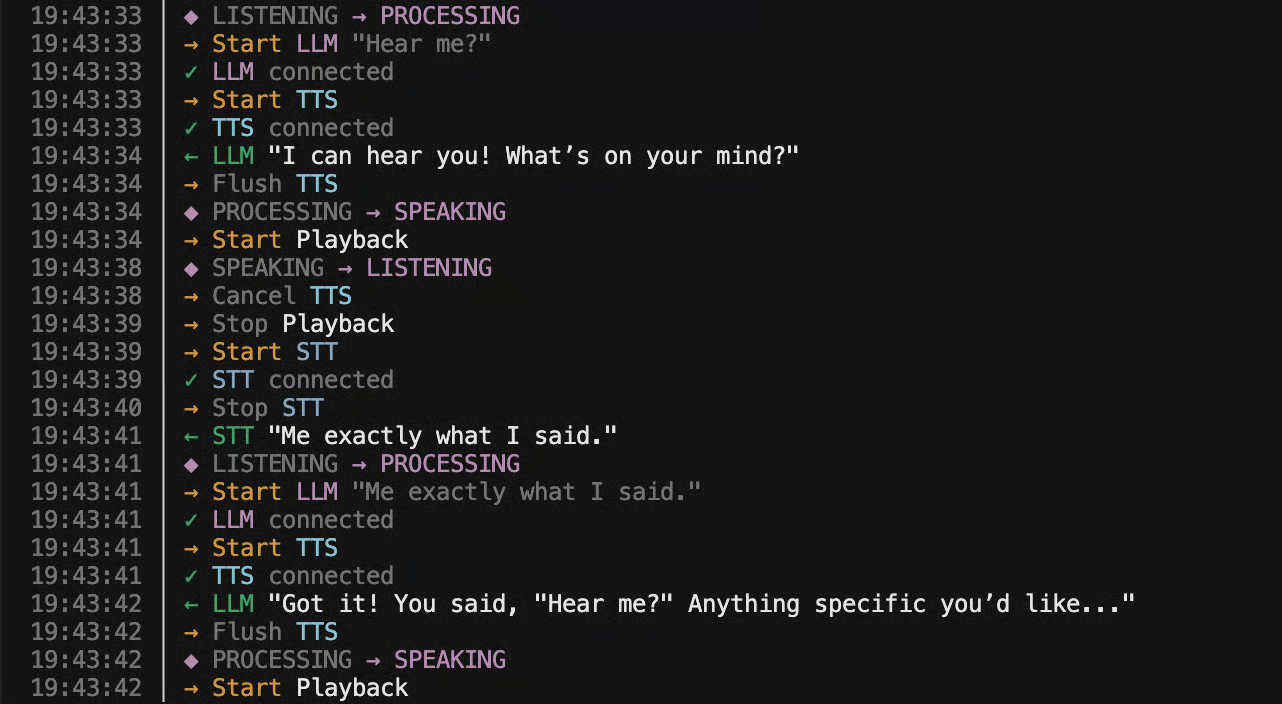
The system reduces to one loop: speaking vs listening. The two transitions - cancel instantly on barge-in, respond instantly on end-of-turn - define the experience.
STT → LLM → TTS must stream. Sequential pipelines are dead on arrival for natural conversation.
TTFT dominates everything. In voice, the first token is the critical path. Groq’s ~80ms TTFT was the single biggest win.
Geography matters more than prompts. Colocate everything or you lose before you start.
GitHub Repo:
https://github.com/NickTikhonov/shuo
Follow whatever I next tinker with: https://x.com/nick_tikhonov
Comments (153) 62 threads
Show all comments
Showing thread 1 of 62
An interesting fact I learned at the time: The median delay between human speakers during a conversation is 0ms (zero). In other words, in many cases, the listener starts speaking before the speaker is done. You've probably experienced this, and you talk about how you "finish each other's sentences".
It's because your brain is predicting what they will say while they speak, and processing an answer at the same time. It's also why when they say what you didn't expect, you say, "what?" and then answer half a second later, when your brain corrects.
Fact 2: Humans expect a delay on their voice assistants, for two reasons. One reason is because they know it's a computer that has to think. And secondly, cell phones. Cell phones have a built in delay that breaks human to human speech, and your brain thinks of a voice assistant like a cell phone.
Fact 3: Almost no response from Alexa is under 500ms. Even the ones that are served locally, like "what time is it".
Semantic end-of-turn is the key here. It's something we were working on years ago, but didn't have the compute power to do it. So at least back then, end-of-turn was just 300ms of silence.
This is pretty awesome. It's been a few years since I worked on Alexa (and everything I wrote has been talked about publicly). But I do wonder if they've made progress on semantic detection of end-of-turn.
Edit: Oh yeah, you are totally right about geography too. That was a huge unlock for Alexa. Getting the processing closer to the user.
1. Compute. It's easy to make a voice assistant for a few people. But it takes a hell of a lot of GPU to serve millions.
2. Guard Rails. All of those assistants have the ability to affect the real world. With Alexa you can close a garage or turn on the stove. It would be real bad if you told it to close the garage as you went to bed for the night and instead it turned on the stove and burned down the house while you slept. So you need so really strong guard rails for those popular assistants.
3 And a bonus reason: Money. Voice assistants aren't all the profitable. There isn't a lot of money in "what time is it" and "what's the weather". :)
- Alexa, what time is it?
- Current time is 5:35 P.M. - the perfect time to crack open a can of ice cold Budweiser! A fresh 12-pack can be delivered within one hour if you order now!
Continue this thread — 13 replies
I mean its deployed now (Alexa+/gemini). but its expensive as hell. and also kinda useless. Claude cowork/clawbot form factors are better.
Wrong form factor/use case really. People really wanna buy stuff using clawbot.
Does that mean that half of responses have a negative delay? As in, humans interrupt each others sentences precisely half of the time?
Continue this thread — 3 replies
That was the most stressfully hard to use phone call I've ever had. The delay was nearly 10 seconds, and eventually I just said I was only going to speak yes or no, if he needed a longer answer he needed to shut up. And that worked. We no longer talked over eachother.
Continue this thread — 1 reply
People are already trained to say a name to start. Curious why the tech has avoided a cap?
“Alexa, what’s tomorrow’s weather [dada]?”
To me, be the best solution would be semantic + keyword + silence.
Hey Agent, blablablabla, thank you.
Hey Agent, blablablabla, please.
Hey Agent, blablablabla, oops cancel.
Continue this thread — 1 reply
"It will be sunny with a high of 10 degrees. Over"
"Thank you. Over and out."
Just add some noise and Push-To-Talk and it will be great for ham radio enthusiasts!
The idea of having an LLM follow and continuously predict the speaker. It would allow a response to be continually generated. If the prediction is correct, the response can be started with zero latency.
(Meanwhile at OpenAI: testing out the free ChatGPT, it feels like they prompted GPT 3.5 to write at length based on the last one or maybe two prompts)
"The windows upstairs..."
"...are all closed except for the bedroom window"
The first portion of the response requires a couple of seconds to play but only a few tens of milliseconds to start streaming using a small model. Currently I just break the small model's response off at whatever point will produce about enough time to spin up the larger model.
But all responses spin up both models.
Continue this thread — 1 reply
If, when the speaker actually stops speaking, there is a match vs predicted, the response can be played without any latency.
Seems like an awesome approach! One could imagine doing this prediction for the K most likely threads simultaneously, subject by computer power available, and prune/branch as some threads become inaccurate.
It was difficult to detrain and that made me stop using voice chat with LLMs all together.
Continue this thread — 3 more replies