Show HN: How I topped the HuggingFace open LLM leaderboard on two gaming GPUs (opens in a new tab)dnhkng.github.io
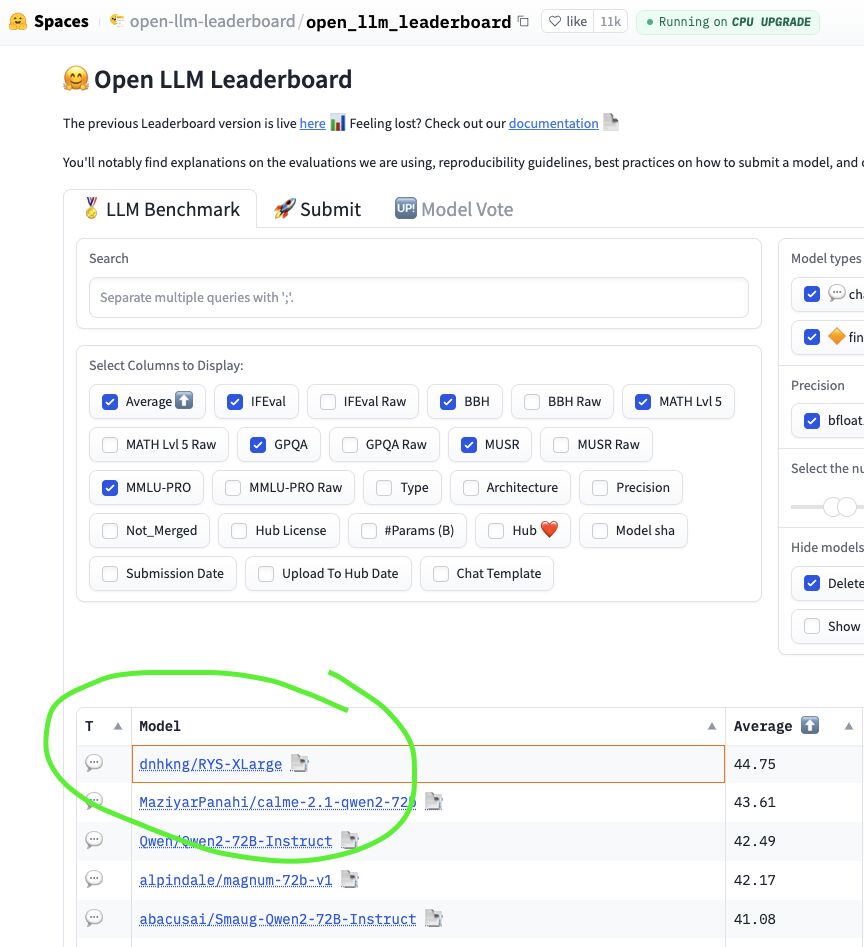
495 pointsI found that duplicating a specific block of 7 middle layers in Qwen2-72B, without modifying any weights, improved performance across all Open LLM Leaderboard benchmarks and took #1. As of 2026, the top 4 models on that leaderboard are still descendants.
The weird finding: single-layer duplication does nothing. Too few layers, nothing. Too many, it gets worse. Only circuit-sized blocks of ~7 layers work. This suggests pretraining carves out discrete functional circuits in the layer stack that only work when preserved whole.
The whole thing was developed on 2x RTX 4090s in my basement. I'm now running current models (GLM-4.7, Qwen3.5, MiniMax M2.5) on a dual GH200 rig (see my other post). Code and new models coming soon.
Happy to answer questions.
Comments (126) 63 threads
Show all comments
Showing thread 28 of 63
https://ouro-llm.github.io/
Pretty cool though. LLM brain surgery.
I really think from the experiments that 'organs' (not sure what to term this), develop during massive pretraining. This also means maybe looping the entire models is actually not efficient. Maybe a better way is [linear input section -> loop 1 -> linear section -> loop 2 -> linear section -> ... -> loop n -> linear output]?
This would give 'organs' space to develop.
finding them on the other hand is not easy! as you've shown, i guess brute force is one way.. it would be nice to find a short cut but unfortunately as your diagrams show, the landscape isn't exactly smooth.
I would also hypothesize that different circuits likely exist for different "problems" and that these are messy and overlapping so the repeated layers that improve math for example may not line up with the repeated layers that improve poetry or whatever, meaning the basic layer repetition is too "simple" to be very general. that said you've obviously shown that there is some amount of generalizing at work, which is definitely interesting.
[1] https://arxiv.org/abs/2401.08741