I like the approach of running everything locally. I'm strongly of the opinion that the privacy angle for local models is going to keep getting stronger and more relevant. The amount of articles that come out about accidents happening because of people handing too much context to cloud models the more self reinforcing this will become.
local is best for privacy, but i personally think you don't need to go local.
anthropic, google, openai etc, decided that their consumer ai plans would not be private. partly to collect training data, the other half to employ moderators to review user activity for safety. we trust that human moderators will not review and flag our icloud docs, onedrive or gmail, or aggregate such documents into training data for llms. it became the norm that an llm is somehow not private. it became a norm that you can't opt out of training, even on paid plans (see meta and google); or if you can opt out of training, you can't opt out of moderation. cloud models with a zero retention privacy policy are private enough for almost everyone, the subscriptions, google search, ai search engines are either 'buying' your digital life or covering themselves for legal reasons. you can and should have private cloud services, and if legal agreement is not enough, cryptographic attestation is already used in compute, with AWS nitro enclaves and other providers.
I personally think everyone should default to using local resources. Cloud resources should only be used for expansion and be relatively bursty rather than the default.
For about two years I experimented with writing local apps using local LLMs, but I often had to blend in a commercial web search API to make my little experiments useful.
I pay $13/month for Proton’s Lumo+ private chat LLM that contains an excellent built-in web search tool. I use it for everything non-technical, even just simple searching for local businesses, etc.
As an enthusiastic reader of books like Privacy is Power and Surveillance Capitalism, it feels good to have a private tool that is ready at hand.
do you have any provider recommendations? I've experimented with this on runpod serverless, but I've been meaning to dig deeper before I feel comfortable with personal data.
I saw a service named Phala, which claims to be actually no-knowledge to server side (I think). It was significantly more expensive, but interesting to see it's out there. My thought was escaping the data-collection-hungry consumer models was a big win.
> anthropic, google, openai etc, decided that their consumer ai plans would not be private. partly to collect training data, the other half to employ moderators to review user activity for safety.
That's two halves of "why", sure. Another interesting half would be that those companies have US military officers on their boards, and LLMs are the ultimate voluntary data collection platform, even better trojan horses than smartphones. Yet another "half" could be how much enterprise value might be found by datamining for a minute or two... may I suggest reading a couple of Martha Wells books.
The other thing, is encrypted inferencing a thing/service currently? I want to run my own models locally just because if I'm going to be chatting to it about my day to day life why send it to a server in plaintext.
encrypted inferencing, meaning homomorphic encryption: no, it's not solved.
cryptographic confirmation of zero knowledge: yes. the latter, based on trust in the hardware manufacturer and their root ca. so, encrypted if you trust intel/nvidia to sign it. there are a few services, phala, tinfoil, near ai, redpill is an aggregator of those
It's only half of the solution though. If the models are trained in a closed way, they can prioritize values encoded during training even if that's not what you want (example: ask the open Chinese models about Tiananmen). It's not beyond imagining that these models would e.g. try to send your data to authorities or advertisers when their training says so, even if you run them locally.
So the full solution would be models trained in an open verifiable way and running locally.
Many Chinese models are being caught doing this (it's also required by law in China) but there was not much hassle.
Having said that Id easily trade some censorship about Chinese affairs I don't care about for the prudishness of American models. Though I generally get the abliterated versions of both.
Another angle is when you're passing untrusted content to the AI service, e.g. anything from using it to crawl websites to spam-detection on new forum user posts.
You can trigger the the service's ToS violation or worse, get tipped off to law enforcement for something you didn't even write.
> I like the approach of running everything locally. I'm strongly of the opinion that the privacy angle for local models is going to keep getting stronger and more relevant.
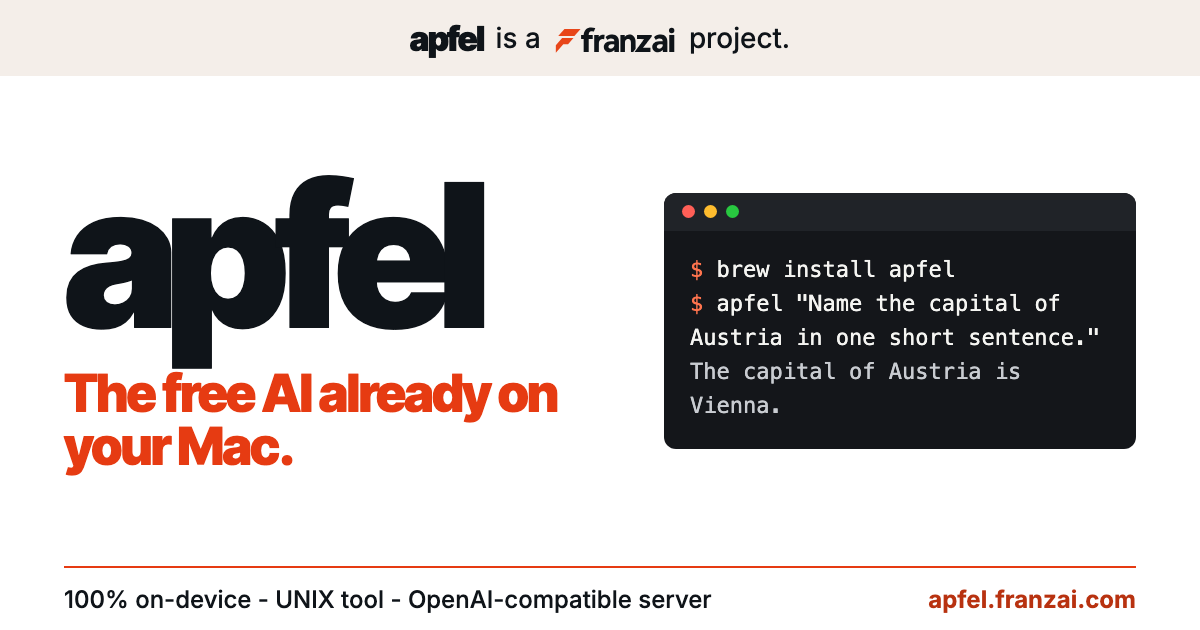
I’ve seen several projects like this that offer a network server with access to these Apple models. The danger is when they expose that, even on a loop port, to every other application on your system, including the browser. Random webpages are now shipping with JavaScript that will post to that port. Same-origin restrictions will stop data flow back to the webpage, but that doesn’t stop them from issuing commands to make changes.
Some such projects use CORS to allow read back as well. I haven’t read Apfel’s code yet, but I’m registering the experiment before performing it.
Isn't there a CORS preflight check for this? In most cases. I guess you could fashion an OG form to post form fields. But openai is probably a JSON body only.
The default scenario should be secure. If the local site sends permissive CORS headers bets may be off. I would need to check but https->http may be a blocker too even in that case. Unless the attack site is http.
There is a CORS preflight check for POST requests that don't use form-encoding. It would be somewhat surprising if these weren't using JSON (though it wouldn't be that surprising if they were parsing submitted JSON instead of actually checking the MIME-type which would probably be bad anwyay)
FWIW this was the status quo (webpage could ping arbitrary ports but not read data, even with CORS protections) - but it is changing.
This is partially in response to https://localmess.github.io/ where Meta and Yandex pixel JS in websites would ping a localhost server run by their Android apps as a workaround to third-party cookie limits. Chrome 142 launched a permission dialog: https://developer.chrome.com/blog/local-network-access Edge 140 followed suit: https://support.microsoft.com/en-us/topic/control-a-website-... And Firefox is in progress as well, though I couldn't find a clear announcement about rollout status: https://fosdem.org/2026/schedule/event/QCSKWL-firefox-local-... So things are getting better! But there was a scarily long time where a rogue JS script could try to blindly poke at localhost servers with crafty payloads, hoping to find a common vulnerability and gain RCE or trigger exfiltration of data via other channels. I wouldn't be surprised if this had been used in the wild.
They offer it as an option but default it to false! This is still a --footgun option but it’s the least unsafe version I’ve seen yet! Well done, Apfel authors.
With the Claude bug, or so it is known, burning through tokens at record speed, I gave alternative models a try and they're mostly ... interchangeable. I don't know how easy switching and low brand loyalty and fast markets will play out. I hope that local LLMs will become very viable very soon.
Yeah I don’t think the models are meaningfully differentiated outside of very specific edge cases. I suspect this was the thinking behind OpenAI and Facebook and all trying to lean hard into presenting their chatbots as friends and romantic partners. If they can’t maintain a technical moat they can try to cultivate an emotional one.
Saw a comment here yesterday referencing the Attention Is All You Need paper title in a tongue in cheek way. Kinda fun to imagine the friend/romance angle is just a bunch of socially awkward folk at OpenAI misinterpreting the original paper
Mathematics is hardly an edge case, but SOTA models differ wildly in their ability to write proofs for unsolved problems. Models also differ wildly in tasks like decompilation for reverse engineering. Also, so far, the only model I've found which can competently write PTX for SM100 CUDA devices is GPT-5.4pro, but I'm willing to admit that this is more of an edge case than the aforementioned. AFAICT, the extent to which someone finds models interchangeable is inversely proportional to the novelty of their work.
The big question is whether Apple can keep shipping new models constantly.
AFAIK the current model is on par with with Qwen-3-4B, which is from a year ago [0]. There's a big leap going from last year Qwen-3-4B to Qwen-3.5-4B or to Gemma 4. Apple model is nice since you don't need to download anything else, but I'd rather use the latest model than to use a model from a year ago. https://machinelearning.apple.com/research/apple-foundation-...
I’m not sure why that’s a question, it’s just a downloaded file. You can even watch it download separately when you enable Apple Intelligence (it’s not tied to OS updates from what I can tell).
Of course I imagine Apple is not going to be the fastest mover in this regard. I’m not even sure they believe the product will be widely impactful anymore and may keep it relegated to a small list of popular use cases like photo touch ups and quick questions to Siri. For me the most useful parts of Apple’s AI don’t even require me to enable Apple Intelligence.
Comments (157) 80 threads
if you are happy with off-prem then the llm is ok too, if you need on-prem this is when you will need local.
The private thing is the prompt.
But also, a local LLM opens up the possibility of agentic workflows that don't have to touch the Internet.
anthropic, google, openai etc, decided that their consumer ai plans would not be private. partly to collect training data, the other half to employ moderators to review user activity for safety.
we trust that human moderators will not review and flag our icloud docs, onedrive or gmail, or aggregate such documents into training data for llms. it became the norm that an llm is somehow not private. it became a norm that you can't opt out of training, even on paid plans (see meta and google); or if you can opt out of training, you can't opt out of moderation.
cloud models with a zero retention privacy policy are private enough for almost everyone, the subscriptions, google search, ai search engines are either 'buying' your digital life or covering themselves for legal reasons.
you can and should have private cloud services, and if legal agreement is not enough, cryptographic attestation is already used in compute, with AWS nitro enclaves and other providers.
I personally think everyone should default to using local resources. Cloud resources should only be used for expansion and be relatively bursty rather than the default.
As an enthusiastic reader of books like Privacy is Power and Surveillance Capitalism, it feels good to have a private tool that is ready at hand.
I saw a service named Phala, which claims to be actually no-knowledge to server side (I think). It was significantly more expensive, but interesting to see it's out there. My thought was escaping the data-collection-hungry consumer models was a big win.
That's two halves of "why", sure.
Another interesting half would be that those companies have US military officers on their boards, and LLMs are the ultimate voluntary data collection platform, even better trojan horses than smartphones.
Yet another "half" could be how much enterprise value might be found by datamining for a minute or two... may I suggest reading a couple of Martha Wells books.
cryptographic confirmation of zero knowledge: yes.
the latter, based on trust in the hardware manufacturer and their root ca. so, encrypted if you trust intel/nvidia to sign it.
there are a few services, phala, tinfoil, near ai, redpill is an aggregator of those
So the full solution would be models trained in an open verifiable way and running locally.
Continue this thread — 1 reply
Having said that Id easily trade some censorship about Chinese affairs I don't care about for the prudishness of American models. Though I generally get the abliterated versions of both.
What I'm more interested in is that if you give it a tool to access Wikipedia, will it censor its answer even then?
You can trigger the the service's ToS violation or worse, get tipped off to law enforcement for something you didn't even write.
In HN circles perhaps. Average Joes don’t care.
So many people I know say “I only use Signal to talk to you”, it’s like I’m the awkward one for not using Facebook.
Some such projects use CORS to allow read back as well. I haven’t read Apfel’s code yet, but I’m registering the experiment before performing it.
The default scenario should be secure. If the local site sends permissive CORS headers bets may be off. I would need to check but https->http may be a blocker too even in that case. Unless the attack site is http.
This is partially in response to https://localmess.github.io/ where Meta and Yandex pixel JS in websites would ping a localhost server run by their Android apps as a workaround to third-party cookie limits.
Chrome 142 launched a permission dialog: https://developer.chrome.com/blog/local-network-access
Edge 140 followed suit: https://support.microsoft.com/en-us/topic/control-a-website-...
And Firefox is in progress as well, though I couldn't find a clear announcement about rollout status: https://fosdem.org/2026/schedule/event/QCSKWL-firefox-local-...
So things are getting better! But there was a scarily long time where a rogue JS script could try to blindly poke at localhost servers with crafty payloads, hoping to find a common vulnerability and gain RCE or trigger exfiltration of data via other channels. I wouldn't be surprised if this had been used in the wild.
With the Claude bug, or so it is known, burning through tokens at record speed, I gave alternative models a try and they're mostly ... interchangeable. I don't know how easy switching and low brand loyalty and fast markets will play out. I hope that local LLMs will become very viable very soon.
Mathematics is hardly an edge case, but SOTA models differ wildly in their ability to write proofs for unsolved problems.
Models also differ wildly in tasks like decompilation for reverse engineering.
Also, so far, the only model I've found which can competently write PTX for SM100 CUDA devices is GPT-5.4pro, but I'm willing to admit that this is more of an edge case than the aforementioned.
AFAICT, the extent to which someone finds models interchangeable is inversely proportional to the novelty of their work.
AFAIK the current model is on par with with Qwen-3-4B, which is from a year ago [0]. There's a big leap going from last year Qwen-3-4B to Qwen-3.5-4B or to Gemma 4.
Apple model is nice since you don't need to download anything else, but I'd rather use the latest model than to use a model from a year ago.
https://machinelearning.apple.com/research/apple-foundation-...
Of course I imagine Apple is not going to be the fastest mover in this regard. I’m not even sure they believe the product will be widely impactful anymore and may keep it relegated to a small list of popular use cases like photo touch ups and quick questions to Siri. For me the most useful parts of Apple’s AI don’t even require me to enable Apple Intelligence.
All comments shown.
Couldn't load more comments. Check your connection and try again.