Saw this in an another thread previously and immediately installed it.
I have a new prompt to test LLMs much like simonw's pelican test. "What is 9:30am Taiwan time in US, Pacific?" For some reason, the answers are quite inconsistent but all wrong.
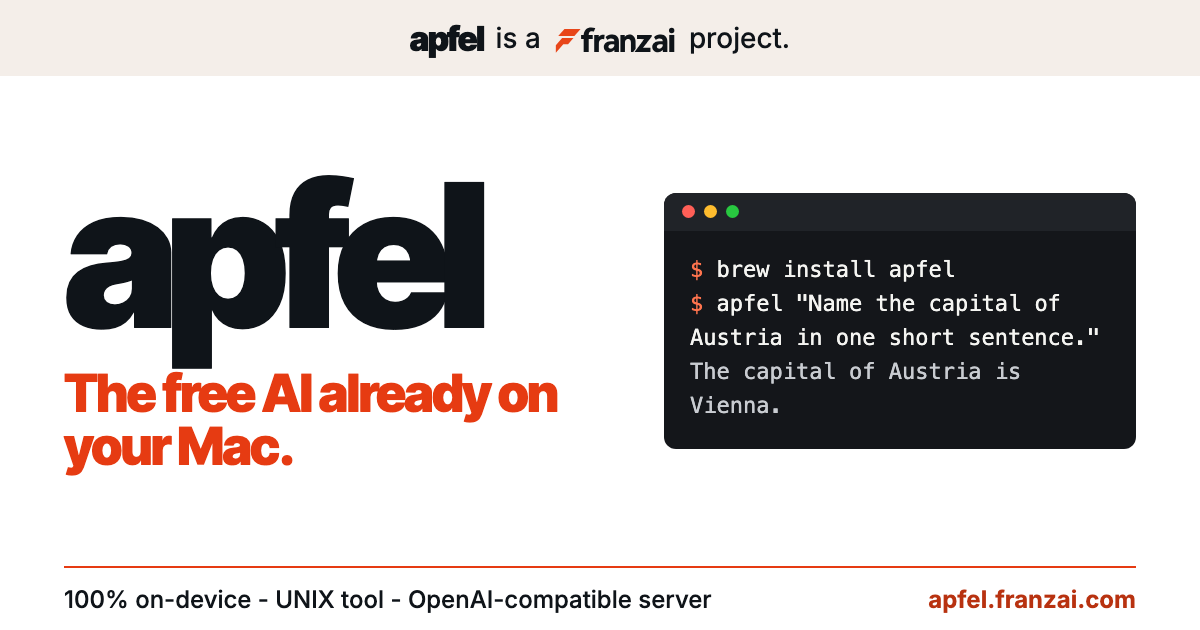
  ./apfel "what is 9:30am Taiwan time in US, Pacific?"
  Taiwan is 12 hours ahead of the Pacific Time Zone. Therefore, 9:30 AM Taiwan time would be 9:30 PM Pacific Time.
  Taiwan is 13 hours ahead of the Pacific Time Zone. Therefore, 9:30 AM in Taiwan is 10:30 PM in the Pacific Time Zone.
  Taiwan is in the China Standard Time (CST) zone, which is 12 hours ahead of the Pacific Standard Time (PST) zone. Therefore, 9:30 AM in Taiwan is 9:30 PM in the Pacific.
  Taiwan is typically 11 hours ahead of the Pacific Time Zone. Therefore, 9:30 AM in Taiwan is 8:30 PM in the Pacific Time Zone.
  Taiwan is 13 hours ahead of the Pacific Time Zone. Therefore, 9:30 AM in Taiwan is 10:30 PM the previous day in the Pacific Time Zone.
What a neat LLM question! Most of my results were the same as what you posted except for the first time I asked it which resulted in this pretty interesting answer:
Taiwan is in the Taiwan Standard Time (TST) zone, which is UTC+8, while the Pacific Time (PT) zone is UTC-7.
To convert 9:30 AM Taiwan time to Pacific Time: 1. Subtract 15 hours (since 8 hours ahead is 15 hours behind). 9:30 AM - 15 hours = 6:30 AM PT. So, 9:30 AM Taiwan time is 6:30 AM Pacific Time. Never thought to use an llm for time zone stuff. Seems like it struggles as much as a normal person, which makes some sense given what they're trained with.
Started using this earlier this week. I built a backtesting benchmark tool to compare a mix of frontier and open-source models on a fairly heavy data analysis workflow I’d been running in the cloud.
The task is basically predicting pricing and costs. Apple’s model came out on top—best accuracy in 6 out of 10 cases in the backtest. That surprised me. It also looks like it might be fast enough to take over the whole job. If I ran this on Sonnet, we’re talking thousands per month. With DeepSeek, it’s more like hundreds. So far, the other local models I’ve tried on my 64GB M4 Max Studio haven’t been viable - either far too slow or not accurate enough. That said, I haven’t tested a huge range yet.
I'm interested to hear what ends up happening. Going from thousands (is that dollars?) per month to something local is significant and I'm not sure the m4 can really make up the gap. Cloud can scale speed whereas you're limited to one computer.
If it works, can it compete in speed, performance AND accuracy? If it can, that would be a real game changer for local analytics when the entire dataset can be loaded onto a single computer.
I'm a Linux user who wanted exactly this but for Linux — so I ended up building it myself. It's called TalkType, it runs Whisper locally for offline speech-to-text. The privacy angle was a big reason I went local from the start — I didn't want my voice being sent to anyone's server. Nice to see the same idea getting traction on Mac.
Comments (157) 80 threads
Earlier commentsI have a new prompt to test LLMs much like simonw's pelican test.
"What is 9:30am Taiwan time in US, Pacific?" For some reason, the answers are quite inconsistent but all wrong.
To convert 9:30 AM Taiwan time to Pacific Time:
1. Subtract 15 hours (since 8 hours ahead is 15 hours behind).
9:30 AM - 15 hours = 6:30 AM PT.
So, 9:30 AM Taiwan time is 6:30 AM Pacific Time.
Never thought to use an llm for time zone stuff. Seems like it struggles as much as a normal person, which makes some sense given what they're trained with.
The task is basically predicting pricing and costs.
Apple’s model came out on top—best accuracy in 6 out of 10 cases in the backtest. That surprised me.
It also looks like it might be fast enough to take over the whole job. If I ran this on Sonnet, we’re talking thousands per month. With DeepSeek, it’s more like hundreds.
So far, the other local models I’ve tried on my 64GB M4 Max Studio haven’t been viable - either far too slow or not accurate enough. That said, I haven’t tested a huge range yet.
If it works, can it compete in speed, performance AND accuracy? If it can, that would be a real game changer for local analytics when the entire dataset can be loaded onto a single computer.
https://developer.apple.com/documentation/Updates/Foundation...
They released an official python SDK in March 2026:
https://github.com/apple/python-apple-fm-sdk
All comments shown.
Couldn't load more comments. Check your connection and try again.