Show HN: boringBar – a taskbar-style dock replacement for macOS (opens in a new tab)boringbar.app
520 pointsI recently switched from a Fedora/GNOME laptop to a MacBook Air. My old setup served me well as a portable workstation, but I’ve started traveling more while working remotely and needed something with similar performance but better battery life. The main thing I missed was a simple taskbar that shows the windows in the current workspace instead of a Dock that mixes everything together.
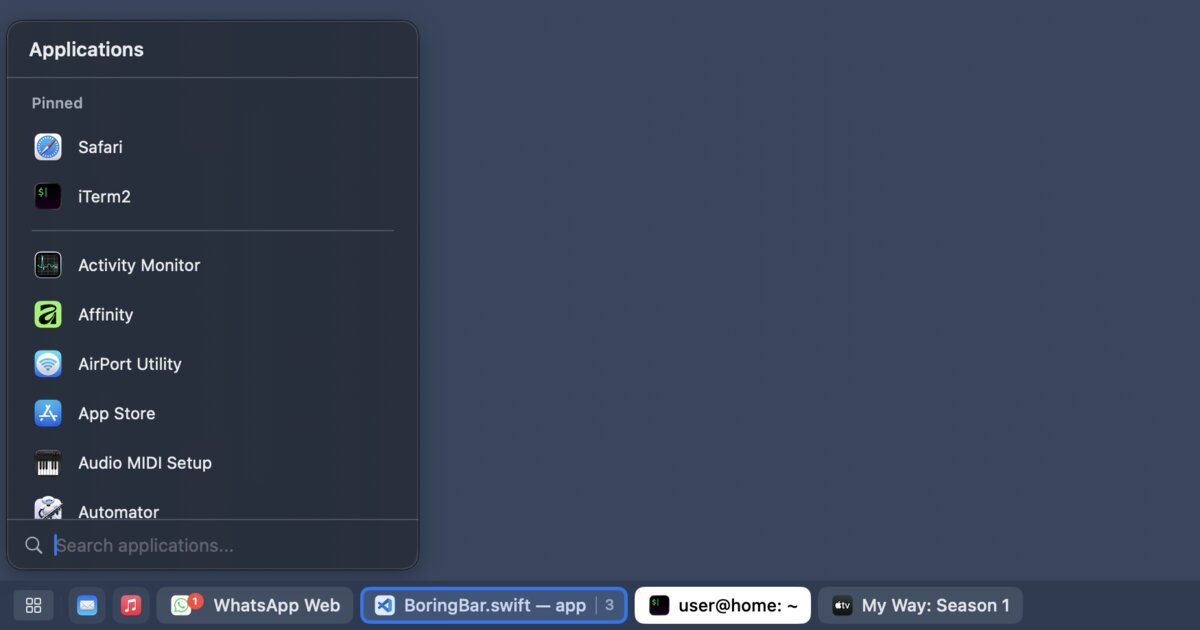
I built boringBar so I would not have to use the Dock. It shows only the windows in the current Space, lets you switch Spaces by scrolling on the bar, and adds a desktop switcher so you can jump directly to any Space. You can also hide the system Dock, pin apps, preview windows with thumbnails, and launch apps from a searchable menu (I keep Spotlight disabled because for some reason it uses a lot of system resources on my machine).
I’ve been dogfooding it for a few months now, and it finally felt polished enough to share.
It’s for people who like macOS but want window management to feel a bit more like GNOME, Windows, or a traditional taskbar. It’s also for people like me who wanted an easier transition to macOS, especially now that Windows feels increasingly user-hostile.
I’d love feedback on the UX, bugs, and whether this solves the same Dock/Spaces pain for anyone else.
P.S. It might also appeal to people who feel nostalgic for the GNOME 2 desktop of yore. I started my Linux journey with it, and boringBar brings back some of that feeling for me.
Comments (308) 131 threads
Show all comments
Showing thread 1 of 131
A subscription for a menu bar, though, kills it for me. I have apps on Macs that are over 20 years old. Some of those companies don’t exist anymore. I’m not going to risk paying $100 for a decade of your app and hope that your company, or your goodwill, stays around that long.
But the main reason I wouldn't install it despite being happy customizing linux is that it's yet another black box I need to trust and that knows way too much. It's really insane how much you need to compromise your security on macos to have a decent developer experience.
My thinking is pretty simple: most people will probably choose the basic 2-device plan, which works out to about $0.85 per month. For an app like this, I think that is a reasonable price.
Another reason is that a lot of Mac apps charge a one-time fee upfront, but then require paid upgrades later. In practice, that often ends up being similar to paying for a few years of ongoing support anyway.
I also think a low-cost subscription sets a clearer expectation that the app will continue to be maintained and kept working as macOS changes. For software like this, where OS updates can easily break things, that felt like the more honest model.
I just hate managing subscriptions.
If you gave me the option to require manual subscription renewal, rather than auto-renewal, I would 100% buy this right now. Basically allow me to purchase for 1 year then click a button to confirm that I'm still getting value out of the product. If I don't click that button then you should assume I'm no longer interested and cancel my subscription.
(I don't like using my mac but sometimes I have to use it for work, and I wish I had this.)
Continue this thread — 11 replies
Low cost subscriptions as the only options can also give multiple vibes, not just one intended one, as well. The one you highighlight is somewhat optimistic takeaway "the publisher is fair with this price and I only need to pay for however much I actually use - what a great guarantee this will be good for the long run".
Another valid takeaway is basically the opposite "It's not clear if the publisher is committed to this software. The only payment option they think they can sell is for just $10 and are only showing commitment in being around for up to just 1 year - are they really confident in the product or value"? Even more doubtful are those suspicious of new dealings "It's fair enough now but do I really want to get used to it for a year and then the price is jacked up by renewal?" (this can be solved with more than a non-subscription option too. E.g. longer term subscriptions, only if you truly are trying to advertise "years of support to come" can help provide the feeling of commitment).
Even in the case one wants to start/stick with the subscription having a lifetime and/or versioned option only adds more to all of the things you listed as reasons for offering a subscription alone. E.g. seeing that "lifetime is equal to at least x years" or "y year term subscription" and then the user going with the 1 year subscription is strictly better signaling to them than just having a 1 year subscription.
The only thing suspicious from your comment is the current subscription option is 1 year, the ask was for longer/perpetual options, and the justification given was the price per month seems great. Other than the absolute value of the price per month is lower and sounds easier to defend, there doesn't seem to be anything about your product, the subscription for it, or the context made the cost per month the relevant interval for a user to consider the value.
> For an app like this, I think that’s a reasonable price.
Except that it’s not a price, it’s an access fee, and those are very different. If it were a price I’d have the thing I paid for — a binary to use as a like. Instead what I have is a token that you can revoke at any time for any reason, including you getting hit by a car or getting bored with the app.
> a low-cost subscription sets a clearer expectation that the app will continue to be maintained …
Forgive the bluntness, but it does no such thing. This app just launched. No one has reason to believe the little business behind it will still exist in 12 months. Death rate for products like this is very high. A subscription from me is a bet that you will still be around in a year, and you have zero track record.
I've taken the feedback here and added a perpetual personal license for 2 devices at $40 - it includes 2 years of updates and the app will keep on working after that.
Not people who are outraged by that concept.
------
OP here - based on the feedback, I’ve switched boringBar to a perpetual license for personal use: https://boringbar.app
It’s now $40 for 2 devices and includes 2 years of updates. After that, you can keep using the version you have, or choose to pay for updates again later.
For businesses, I’m keeping the existing annual pricing.
A lot of the comments on pricing were fair, and I appreciate people being direct about it. I still care a lot about long-term maintenance for an app like this, but I think this is a better balance.
https://news.ycombinator.com/item?id=47743992
defensibility nowadays is app support and development. the more work you pour into it the more defensible it will be.
I personally would gladly pay to have app constantly polished and improved. What I would not use is some vibe-coded alternative that was slopped with AI in a day and pushed to github with a tweet "i made a free X alternative" and then abandoned.
Continue this thread — 9 replies
People will replicate it, sure, but supporting it regularly is another thing. I guess the majority wanted a perpetual license - so it's a win for the masses.
Personally, I dare not replace the Dock with Windows-style task bar for fear that my OLED display might have burn-in on it. Yet, when I need an alternative, I would rather make an APP for my own.
At home, I have a Mac Studio[0] set up in my office with my music stuff, and I'm writing this on my MacBoor Air[1] here on my lap in the living room. I also have a work laptop, although it's safely tucked away in my backback right now. My wife has an MBA, too, but that's hers and I don't mess with it. So I'm elbow-deep in Macs that are used solely by me, and I bounce between them regularly.
The 2-device limit is a dealbreaker for me. It's where I stop reading. I don't care if it cures cancer: I won't buy an app that makes me pick and choose which of the devices in my care I can use it on. I'm sympathetic to why vendors pick that limit. I get that you don't want me to buy a single license and spread it around my friends and work circles. That's completely reasonable and understandable. And yet, it completely breaks my use case. I bet I'm far from alone in this.
[0]A previous job let me keep it when I left.
[1]I bought to hack on personal projects instead of using [0], which was work-owned at the time.
Continue this thread — 1 reply
Continue this thread — 1 reply
There is a model that worked for decades: If you spent a _significant_ amount of work enhancing an existing tool you'd release a new major version. The would be a discount for license holders of the old version. Why reinvent the world over and over again?
Not saying that was OPs motivation but that's obviously why the shift happened.
Continue this thread — 2 more replies
Continue this thread — 1 more reply
Continue this thread — 6 more replies