Show HN: boringBar – a taskbar-style dock replacement for macOS (opens in a new tab)boringbar.app
520 pointsI recently switched from a Fedora/GNOME laptop to a MacBook Air. My old setup served me well as a portable workstation, but I’ve started traveling more while working remotely and needed something with similar performance but better battery life. The main thing I missed was a simple taskbar that shows the windows in the current workspace instead of a Dock that mixes everything together.
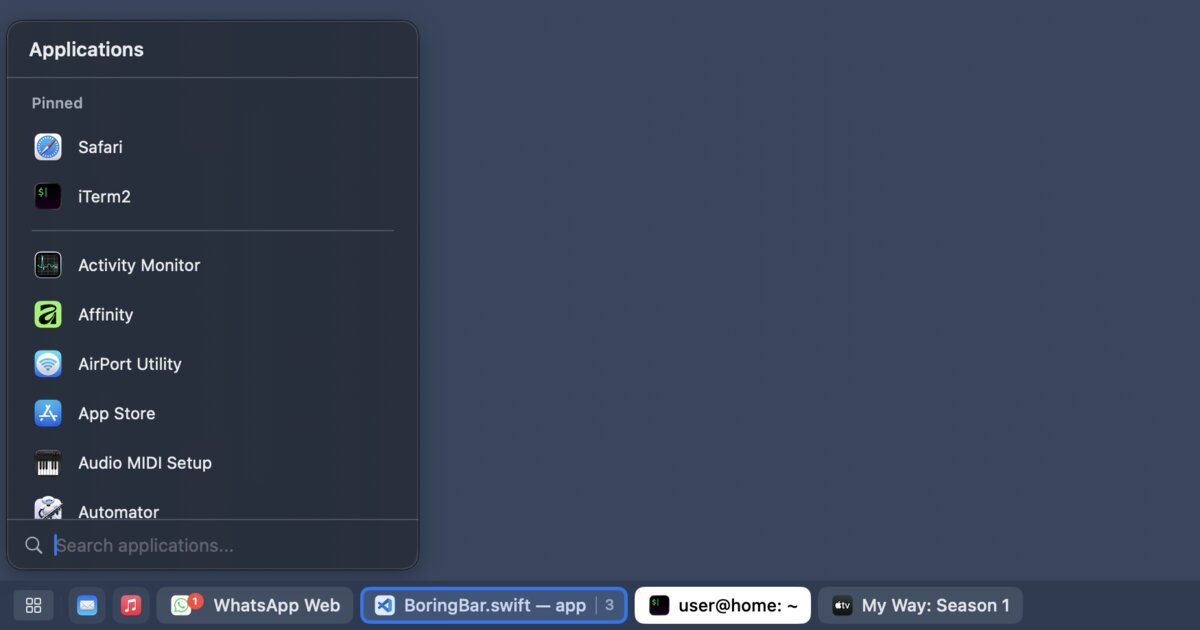
I built boringBar so I would not have to use the Dock. It shows only the windows in the current Space, lets you switch Spaces by scrolling on the bar, and adds a desktop switcher so you can jump directly to any Space. You can also hide the system Dock, pin apps, preview windows with thumbnails, and launch apps from a searchable menu (I keep Spotlight disabled because for some reason it uses a lot of system resources on my machine).
I’ve been dogfooding it for a few months now, and it finally felt polished enough to share.
It’s for people who like macOS but want window management to feel a bit more like GNOME, Windows, or a traditional taskbar. It’s also for people like me who wanted an easier transition to macOS, especially now that Windows feels increasingly user-hostile.
I’d love feedback on the UX, bugs, and whether this solves the same Dock/Spaces pain for anyone else.
P.S. It might also appeal to people who feel nostalgic for the GNOME 2 desktop of yore. I started my Linux journey with it, and boringBar brings back some of that feeling for me.
Comments (308) 131 threads
Show all comments
Showing thread 73 of 131
- Clicking things in the Dock or elsewhere keep taking me off my current Space. There's a setting that supposedly stops this (disable "When switching to an application, switch to a Space with open windows for that application"), but that only affects affirmative clicking in the Dock. If you try to open a file it will still seek out an existing instance of that app and take you to another Space if it finds it there.
- Spaces are named "Desktop 1", "Desktop 2", etc. I need to give them custom names that represent the actual work I do in them.
This is by no means a complete list. My overall impression is that Spaces and their various settings are a bolt-on, with requirements built by committee to resolve the tension between the users who want virtual desktops and the users who want nothing to change.
@OP, here are my suggested improvements based on a morning's worth of use:
1. If you have clicked on the Applications button to raise that menu, clicking on the button again should collapse it. Right now it just re-raises it.
2. Let's say one of my apps is a messaging app like Slack or Signal, and there's a new incoming message. In KDE Plasma or GNOME, the taskbar or docked representation of the app will visually change (as does your chip) but more importantly there's a toast-style an on-screen notification. I'm actually not sure what happens on the Mac by default when you're using the Dock. Regardless, I'm finding I'm missing incoming messages because I'm not scanning boringBar for the visual indicator that a new message has come in.
3. Allow us to give our own names to the Spaces/Desktops.
4. Provide an option for rendering the Space/Desktop switcher as an array of chips so we can switch with one click, rather than the current two clicks (one to raise the pop-up menu, two to choose the desktop). The lack of (3) and (4) has me sticking with "Deskspace" for now, but also because Deskspace parks the desktop switcher in the menu bar, which is similar to how I have it working on KDE Plasma.
5. As another user pointed out, the bar is... dark. Changing on/off Frosted Glass isn't sufficiently changing the visual appearance.