Lurker News
Hi all! TikZ is a widely-used LaTeX package for drawing figures in papers. It uses commands like \draw[->] (0,0) -- (1,2); to draw lines, shapes, text, etc. Academics usually code up their figures by hand, so there is lots of twiddling around with the coordinates and recompiling until things look nice. I guess it’s a bit like SVG, but it’s more code than markup, for example it has loops with \foreach.

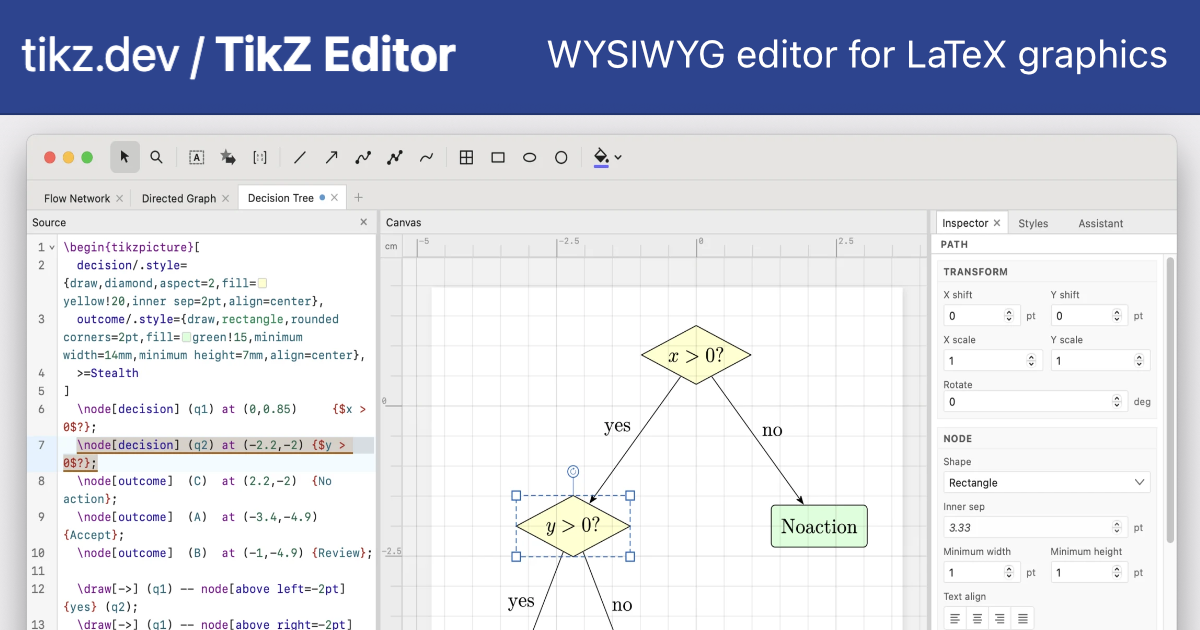
I built an open-source WYSIWYG TikZ editor (available for web and desktop) that allows you to edit your TikZ source code visually by dragging and resizing elements. It simultaneously shows the source code and the rendered figure, and lets you edit either one while the two views stay in sync. I’m not aware of any other editors that are simultaneously source editors and WYSIWYG (even for editing SVG or HTML), and I’m quite pleased with how well the combination works.
The way the app is implemented is by parsing the TikZ code, and at all times keeping track of the exact source location of each object. Thereby, when a user drags an element to a new position, the app can override just the numbers in the coordinate without changing anything else in the code (such as line breaks or indentation).
This approach essentially required reimplementing a large fraction of TikZ, which is the kind of task that no human would ever want to do. I think building software that doesn’t exist yet because it would be impossibly tedious to code up is one of the great new possibilities thanks to coding agents, and it’s worth brainstorming for other examples. (This app was built almost entirely by Codex.)
Implementing the app came with lots of fun side quests, including building converters from SVG / pptx / ipe to TikZ, re-implementing the LaTeX hyphenation and line-breaking algorithm to support multi-line nodes, and making a color picker that uses the red!20!black color mixing notation used in LaTeX papers.
Comments (74) 48 threads

Earlier comments
GL26#
All STEM students and researches from the world thank you
Littice1 reply#
The killer feature for me is not drawing TikZ visually, but being able to touch old TikZ without turning the source into generated-looking soup.
DominikPeters#
Exactly, I wanted to avoid that. In contrast, if you open an SVG in (for example) Inkscape and make a minimal change and save, the resulting file has little to do with the original.
mcswell1 reply#
I'm running Linux Mint (xfce version), and I installed the .deb version (TikZ.Editor_0.4.0_amd64.deb). It's very odd...for example, when I open it or do File/New, many (but not all) of the grid cells are rectangles, not squares. Am I doing something wrong, like installing the wrong version? Or maybe misinterpreting what the faint grey lines are?
mcswell#
I think the web version looks correct, although the grid lines are so faint there that it's hard to tell. I'll paste some screenshots to that link--thanks for the work!
delta_p_delta_x1 reply#
This is superb. Will you consider adding support for pgfplots[1]? When I was a student I was long considering writing a native application for real-time TikZing.

[1]: https://ctan.org/pkg/pgfplots?lang=en

DominikPeters1 reply#
I think pgfplots should in principle be possible. I've postponed it thus far because pgfplots is GPL licensed, while the editor is MIT licensed, so I would need to distribute pgfplots support as a separate add-on. But in due course, putting in add-on infrastructure could make sense, because it would also allow adding support for stuff like tikzcd and CircuiTikZ (or tikzpingus!).
hmenke1 reply#
I don't think generating pgfplots graphics counts as a derived work, as long as you are not distributing parts of the pgfplots source code. Otherwise every document that uses pgfplots would automatically be GPL-3.0-or-later, which is probably not what the author intended.

Source: I have a tiny bit of copyright on pgfplots, https://github.com/pgf-tikz/pgfplots/commits?author=hmenke

DominikPeters#
Hi Henri, thanks for all your work on pgf, and congrats on the recent push on CI etc. The reason I think that GPL-3 would bite is that adding support would require more or less translating the pgfplots source to javascript, so that the app can parse and then correctly render the code, and that would definitely be a derived work. But I think the add-on route should be okay.

Load more comments