Show HN: I trained a 125M model to autocomplete piano on-device (opens in a new tab)simedw.com
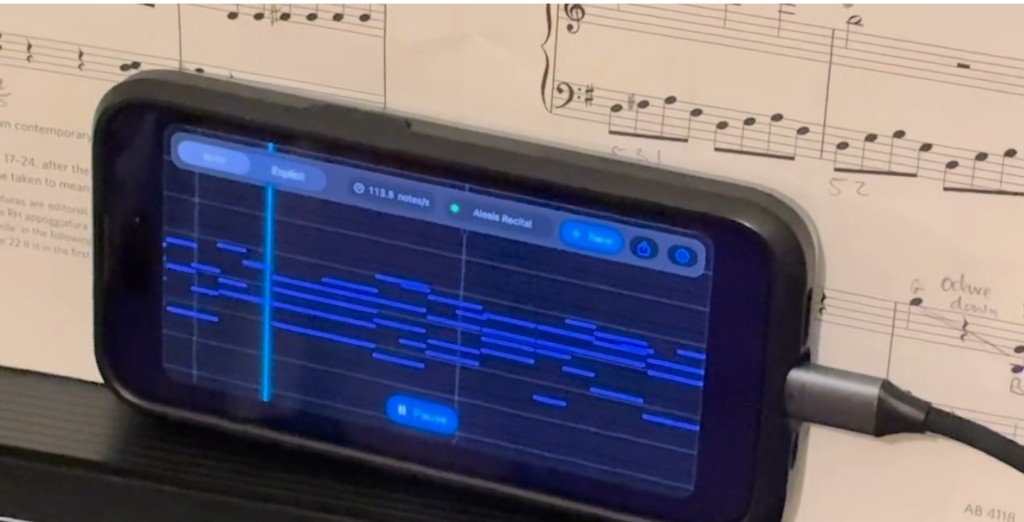
598 pointsI trained a 125M-parameter transformer to autocomplete piano performances in real time (~108 notes/sec on an iPhone 15).
The idea is basically GitHub Copilot or Tabnine, except instead of prompting it with code, you prompt it by playing a few notes on a MIDI piano. The model then continues what you played, entirely on-device.
The app is free if anyone wants to try it. Happy to answer questions about the model, training, Core ML, or the many things that didn't work.
Comments (117) 65 threads
Show all comments
Showing thread 8 of 65
I think one of the great, early, joys of learning a piano is gaining the following intuitions: The seemingly harder path of learning sheet is actually faster. Your mind _should_ learn to think in two dimensions Spatial — where fingers go — and Time — pitch and tempo – ** when learning. The _internalization_ of Space and Time queues guide the fingers in a dance that is vastly satisfying. This skill leads you to the final part of the journey that is improvisation and the one more exciting than what i am on now.
---
**
Space: Your finger placement on keys right, e.g. knowing how to go from landmark/anchor notes(mid-c, G, F etc) and then go to the others above and below it. Crudely this is some what like typing from your landmark f and j qwerty keyboard
Time: The out singing/verbalizing of the notes/beats on a time measure as you play them(per the time measure). e.g. you can say out loud 1-2-3-4 for 4/4 measure, if the measure has quarter notes say out loud. And `1-e-and-a-2-e-and-a-3-e-and-a-4-e-and-a` for a 4/4 with 1/16th note granularity. Do this as you play the notes and you get a sense of tempo.
you could always do the discipline you liked before for self fulfillment purposes, and you can still do it for self fulfillment purposes now
unless they're actually serfs again and won't have bills to pay, but no access to anything outside of the fiefdom that they maintain all day