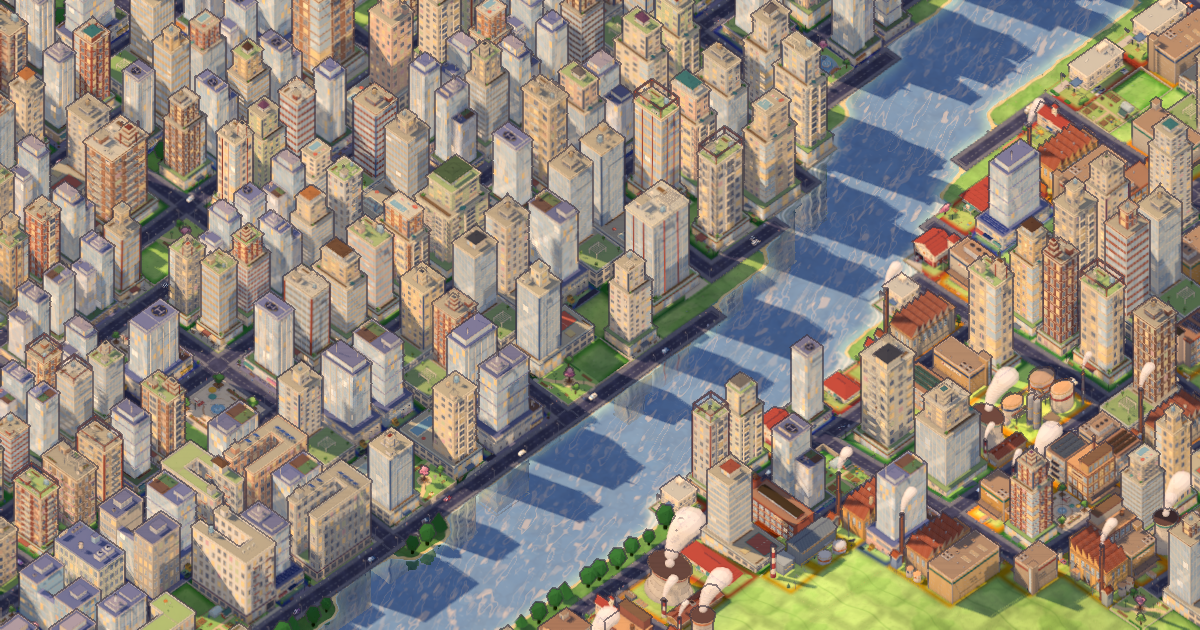
I haven't tried the game, but this is slightly hilarious and awesome.
I've often wondered about this kind of thing. When I go to an airport, it seems strange to me that each one is different with some of them having elaborate train systems, or multiple runways. The engineer in me says "surely there is an optimal solution, so why are they all so different?". Is there a simulator? Sim City was a fantastic simulation from the stand point of a game, but I'm curious; if you build a city simulator and let it grow organically (game of life style) can you put in sufficient regulation/parameters that get you to where we are today? And if so, is there a simulation that shows us a way to get us to a better tomorrow?
> The engineer in me says "surely there is an optimal solution, so why are they all so different?". Is there a simulator?
Optimistically, because each one has a different optimal solution given all the unique constraints for each airport project. Also, airports aren't just built and then done. Often the cities around them will grow and the airports will need to expand and adapt to new constraints, sometimes many decades after they were first built.
Every airport is different because every local geography, existing land use, and weather pattern is different.
Seattle has generally ether north or south winds depending on season, and the airport is located on the only buildable flat plateau for miles around, so has 3 runways all going the same direction, N/S. https://wrcc-archive.dri.edu/cgi-bin/wea_windroseclim.pl?laK... Denver built an all-new airport way outside of town where there was unlimited buildable land. Their winds are highly variable even within one season, so they have 6 runways in a crossing configuration. https://wrcc-archive.dri.edu/cgi-bin/wea_windroseclim.pl?laK...
The optimal airport has two parallel runways, 9,000 feet apart, that align with prevailing wind. If a location has variable strong winds, another set can be built at a 90° angle. It's possible to add more runways at 9,000 intervals, but you're usually better off building an airport somewhere else.
Most airports were built during or before WWII, so few are designed to most efficiently accommodate modern usage. Maybe in the future we can better handle closer runways in low visibility, but first we'll have to figure out how to have two computers communicate directly with each other, instead of having one computer generate routes that get read out load by a human, transmitted over an analog radio, listened to by another human, then typed into another computer.
> but first we'll have to figure out how to have two computers communicate directly with each other, instead of having one computer generate routes that get read out load by a human, transmitted over an analog radio, listened to by another human, then typed into another computer.
That just makes it computer -> person -> computer -> computer -> person -> computer
We need something where a control center computer that issues clearances can radio them directly into an aircraft's flight management computer. This wouldn't disallow ATC from reviewing the routes before transmitting them, or the flight crew from reviewing them before accepting them, but without people manually copying over the information, there's a lot less potential to insert errors in the first place.
Comments (428) 76 threads
Show all comments
Showing thread 3 of 76
I've often wondered about this kind of thing. When I go to an airport, it seems strange to me that each one is different with some of them having elaborate train systems, or multiple runways.
The engineer in me says "surely there is an optimal solution, so why are they all so different?". Is there a simulator?
Sim City was a fantastic simulation from the stand point of a game, but I'm curious; if you build a city simulator and let it grow organically (game of life style) can you put in sufficient regulation/parameters that get you to where we are today?
And if so, is there a simulation that shows us a way to get us to a better tomorrow?
Optimistically, because each one has a different optimal solution given all the unique constraints for each airport project.
Also, airports aren't just built and then done. Often the cities around them will grow and the airports will need to expand and adapt to new constraints, sometimes many decades after they were first built.
Seattle has generally ether north or south winds depending on season, and the airport is located on the only buildable flat plateau for miles around, so has 3 runways all going the same direction, N/S.
https://wrcc-archive.dri.edu/cgi-bin/wea_windroseclim.pl?laK...
Denver built an all-new airport way outside of town where there was unlimited buildable land. Their winds are highly variable even within one season, so they have 6 runways in a crossing configuration.
https://wrcc-archive.dri.edu/cgi-bin/wea_windroseclim.pl?laK...
Most airports were built during or before WWII, so few are designed to most efficiently accommodate modern usage. Maybe in the future we can better handle closer runways in low visibility, but first we'll have to figure out how to have two computers communicate directly with each other, instead of having one computer generate routes that get read out load by a human, transmitted over an analog radio, listened to by another human, then typed into another computer.
Tada! https://en.wikipedia.org/wiki/Controller%E2%80%93pilot_data_...
We need something where a control center computer that issues clearances can radio them directly into an aircraft's flight management computer. This wouldn't disallow ATC from reviewing the routes before transmitting them, or the flight crew from reviewing them before accepting them, but without people manually copying over the information, there's a lot less potential to insert errors in the first place.
Continue this thread — 1 reply
https://en.wikipedia.org/wiki/Traffic_collision_avoidance_sy...