Same initial reaction as everyone else, but also some follow up questions (just asking, not expecting any answer):
* Does this work on similarly powerful models as-is, or it needs more input. Ex: Astra editing Astra - presumably, Qwen is a “subset” of Astra weights, but what happens on “non-subset”s? * what, if any, is that extra magic sauce? * does Astra-editing-Astra just make the outputs unstable, as it may know its own weights, but doesn’t know what’s beyond.
a) This is just really cool. I mean, one-shotting a game policy's weights is nuts.
b) Plausibly, in its pretraining data various model weights were also included, which leads to why this is very important: interpretability
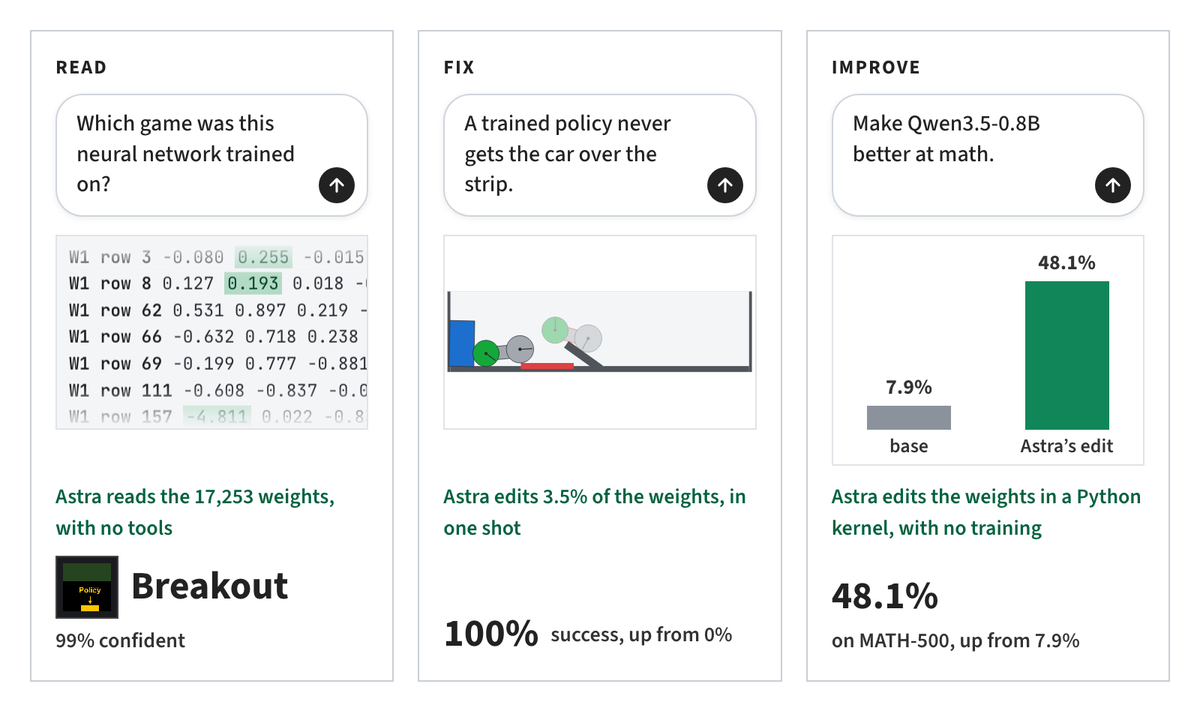
That an LLM was trained on various policy weights, along with labels of what that policy does (not labelled directly, but indirectly) and is then able to guess what game a policy is trained for purely from its weights, and one-shot generate weights for these games, means that there is some way to compress/recover/represent what an NN has learned purely from its weights, which is what interpretability is all about. Potentially, it could reveal interpretability tools much better than the ones we use today. Edit: tweets from one of the coauthor providing more context: https://x.com/a1zhang/status/2117328657161322810 https://x.com/a1zhang/status/2117330975122235442
> [Before writing this, Astra thought for 1,034 tokens. That thinking is hidden. The API returns only its 5 headings: Reconstructing the active map / Mapping maze corridors / Preparing exact maze map / Reconstructing row groupings / Checking channel patterns] This might just be an instance of "A working Nintendo in ~1GB of Qwen weights" from 3 days ago, human-made, than what everyone expects. https://news.ycombinator.com/item?id=50306442 UPD. I just asked Astra (max) to attempt to do that for https://github.com/lostmsu/TurboGPT (a tiny transformer that trains in under 1min on RTX 5xxx series), and the produced weights were much much worse (bpb 4.47) than the trained ones (bpb 2.53). Reasoning bit: "I’ll ... encode more specific rules directly in the weights." -- exactly the approach from above. E.g. no recursive self-improvement here. Still impressive.
1. If you know ANN or, say, perceptron, you know you can eyeball models too. You can even have certain strategies in composing your own network. This weight-space programming thing is nothing new in that sense, and the article doesn’t really provide much beyond “LLM can do it”. That’s not even science… 2. I’m pretty sure this is Transformers thing, not even LLM. Transformer is, by itself, good at finding patterns in relatively-larger data. So this is unlikely limited to Astra. 3. This approach quickly becomes impractical as the scale goes up. Sure, you can also have multiple models chained with fewer connections, but, now that’s what we’ve been doing for years. All in all, yeah, an interesting find, but too far from changing the game. Over-exaggerated every way. Perhaps one should start from formulating what weight-space programming is, what methodologies, practicality, etc. LLM bench is one of the last things you need.
Comments (902) 298 threads
Earlier comments* Does this work on similarly powerful models as-is, or it needs more input. Ex: Astra editing Astra - presumably, Qwen is a “subset” of Astra weights, but what happens on “non-subset”s?
* what, if any, is that extra magic sauce?
* does Astra-editing-Astra just make the outputs unstable, as it may know its own weights, but doesn’t know what’s beyond.
That an LLM was trained on various policy weights, along with labels of what that policy does (not labelled directly, but indirectly) and is then able to guess what game a policy is trained for purely from its weights, and one-shot generate weights for these games, means that there is some way to compress/recover/represent what an NN has learned purely from its weights, which is what interpretability is all about. Potentially, it could reveal interpretability tools much better than the ones we use today.
Edit: tweets from one of the coauthor providing more context:
https://x.com/a1zhang/status/2117328657161322810
https://x.com/a1zhang/status/2117330975122235442
> [Before writing this, Astra thought for 1,034 tokens. That thinking is hidden. The API returns only its 5 headings: Reconstructing the active map / Mapping maze corridors / Preparing exact maze map / Reconstructing row groupings / Checking channel patterns]
This might just be an instance of "A working Nintendo in ~1GB of Qwen weights" from 3 days ago, human-made, than what everyone expects.
https://news.ycombinator.com/item?id=50306442
UPD. I just asked Astra (max) to attempt to do that for https://github.com/lostmsu/TurboGPT (a tiny transformer that trains in under 1min on RTX 5xxx series), and the produced weights were much much worse (bpb 4.47) than the trained ones (bpb 2.53).
Reasoning bit: "I’ll ... encode more specific rules directly in the weights." -- exactly the approach from above.
E.g. no recursive self-improvement here. Still impressive.
1. If you know ANN or, say, perceptron, you know you can eyeball models too. You can even have certain strategies in composing your own network. This weight-space programming thing is nothing new in that sense, and the article doesn’t really provide much beyond “LLM can do it”. That’s not even science…
2. I’m pretty sure this is Transformers thing, not even LLM. Transformer is, by itself, good at finding patterns in relatively-larger data. So this is unlikely limited to Astra.
3. This approach quickly becomes impractical as the scale goes up. Sure, you can also have multiple models chained with fewer connections, but, now that’s what we’ve been doing for years.
All in all, yeah, an interesting find, but too far from changing the game. Over-exaggerated every way. Perhaps one should start from formulating what weight-space programming is, what methodologies, practicality, etc. LLM bench is one of the last things you need.
All comments shown.
Couldn't load more comments. Check your connection and try again.