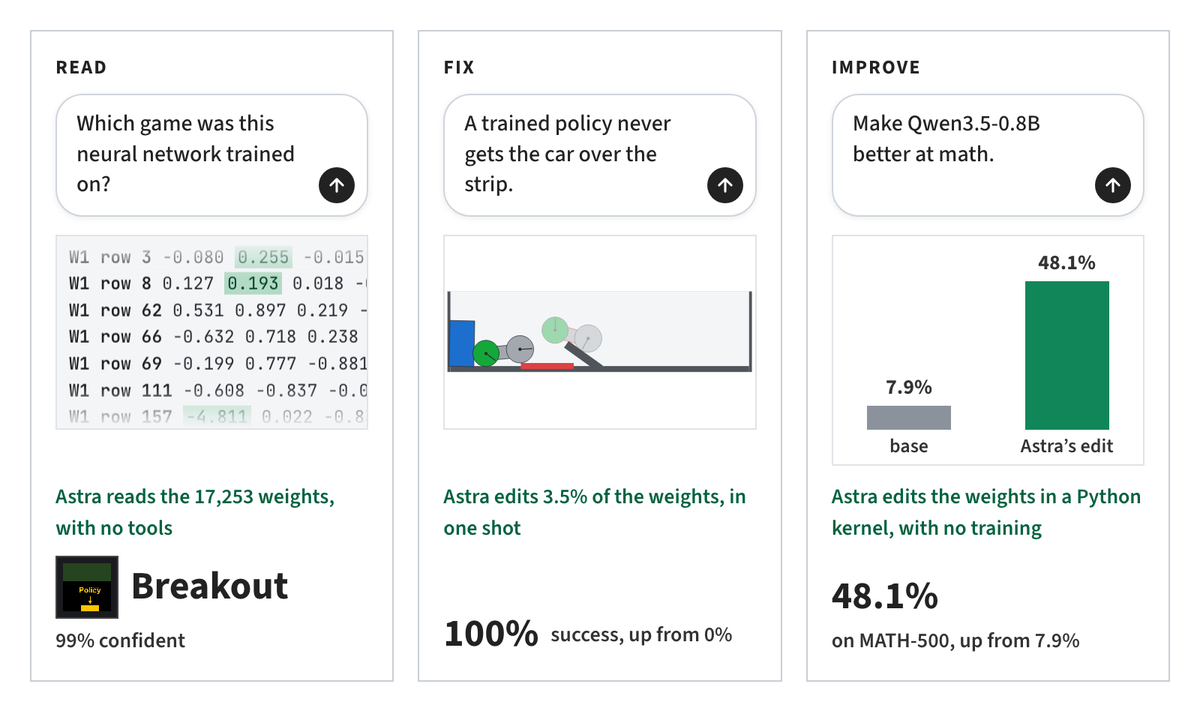
In its default non-thinking mode, the unedited Qwen3.5-0.8B already scores 46% on MATH-500, close to the edited 48%. The 7.9% baseline was thinking mode, where 93% of answers looped until the token limit.
Very interesting. I wonder if it’s because its dataset contains the weights of a gazillion different models. Maybe most neural networks trained on similar data eventually converge to isomorphic spaces anyway, even if the spaces themselves aren’t exactly the same. Or maybe Astra itself was trained with RL for alignment. Or for RSI.
If we are being slightly reductive, this is just more of the exact same thing. The token stream in this case happens to be a projection of the weights of a neural network. I don't see where we violated any of the prevailing assumptions about how these systems operate.
The mapping between spaces in this case is mostly linear. This isn't like gzip or a Turing machine. I'd argue this is even more permissive (easier) than the LLM's originally intended use case of human language. What happens if we can come up with a model that can directly emit a frontier LLM given some seed context? I feel like we could train a model to recreate astra verbatim. At some level it's just bytes on a disk that can be bundled up into tokens. As long as the representation is rational and consistent I don't see why this wouldn't work.
The headline makes it sound very amazing, but reading the reasoning loops it didn’t strike me as outlandish. It feels no different from giving a human expert a printout of assembly code and figure out what it does. (The human expert can do it without tools too, but they probably wouldn’t do it because it’s tedious.)
Comments (902) 298 threads
Earlier commentsVideo: https://youtu.be/EawCb97nz-M
The mapping between spaces in this case is mostly linear. This isn't like gzip or a Turing machine. I'd argue this is even more permissive (easier) than the LLM's originally intended use case of human language.
What happens if we can come up with a model that can directly emit a frontier LLM given some seed context? I feel like we could train a model to recreate astra verbatim. At some level it's just bytes on a disk that can be bundled up into tokens. As long as the representation is rational and consistent I don't see why this wouldn't work.
All comments shown.
Couldn't load more comments. Check your connection and try again.