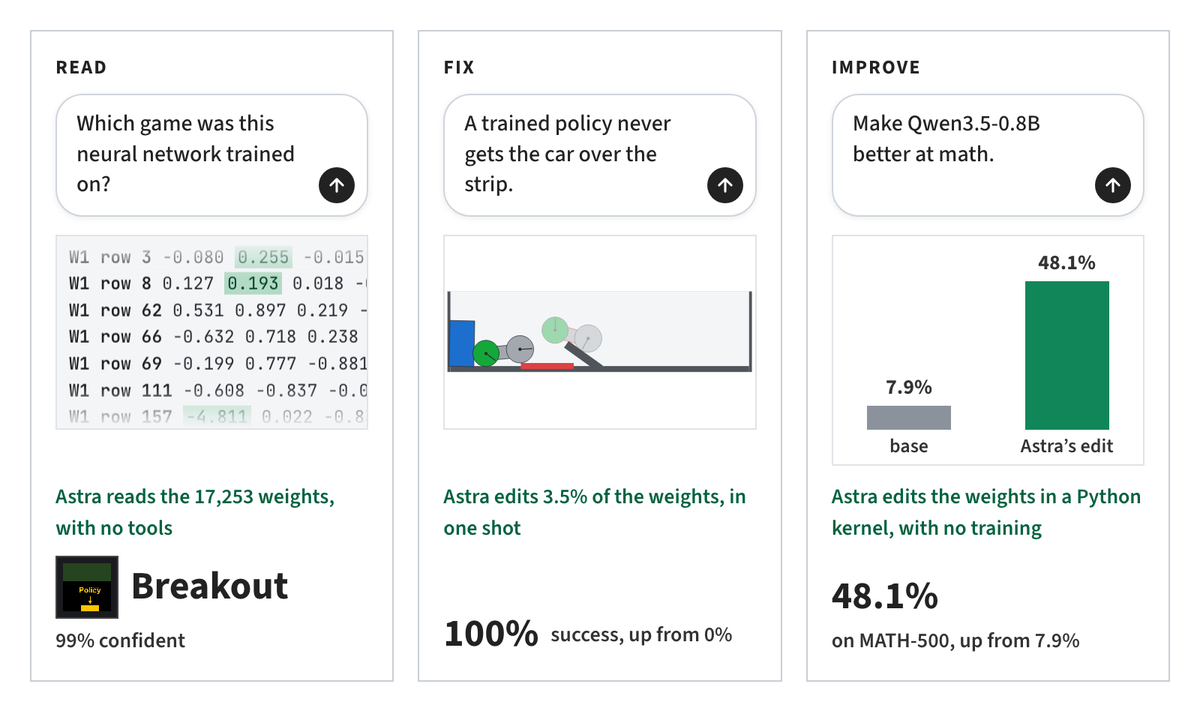
As insane as this result is, next steps are even crazier:
> We are currently building a benchmark and a harness for LLMs’ capability on Weight-Space Programming. We believe this will provide a standardized evaluation to measure and accelerate progress in Weight-Space Programming, turning what currently seems like black magic into a rigorous, reproducible engineering discipline. Imagine this benchmark lasting as long as Arc-AGI-3 has. This could be the first foothold on hill-climbing mech-interp.
This is the first time it dawned on me that mech interp is a dual-use technology which can be used to improve capabilities. Do you think overall this development will improve human understanding of AI models, or will it lead to faster capability advancement using weight-space changes that no humans read?
I think edits made directly to model weights are likely to be more interpretable and controllable than edits made by the current process of shoving a bunch of training data through gradient descent.
Look at the reasoning the models give before you get too excited here. For the Pong-vs-Pacman example, the model uses observations like small weights for certain arrow keys and large weights where user-controlled objects are. For the language example, it again recognizes some very shallow patterns (Romaji has a limited number of letter groupings) and is taking a 3-option multiple choice test. It's a neat result, but I think the introduction overstates the significance.
Yeah, it definitely looks more magical until you peer behind the curtain, and then it looks obvious. Of course it's all just circuits; of course there are simple patterns to look for in obvious places. But that's with the benefit of cribbing off the thing's work—it's really hellishly clever isn't it, so workmanlike to make such things quotidian.
And of course there's the tendency for LLMs to be completely unable to approach a problem in January, really quite shit in February, rather poor in March, and superhuman in April.
I suspect a lot of this is not (just) capability but bravery. A human would be daunted by even a small neural net; the task would seem too challenging to be worth attempting. Astra, fearless, just assumes an answer exists and then tries to reverse and execute on it.
For example pointing them at a crash dump they manage to piece together and extract information I would not even try to extract by just looking at the raw memory
I once sent Gemini Pro a hex dump of a dmp file and it told me what the application was doing when it crashed. It seemed surprising, but not that surprising given what I've seen already.
It's the same thing with decompilation and hacking. It's not that a human couldn't find the same bug if they looked, but a human wouldn't even try because of the low probability of success because there are so many places to look.
Part of solving that is that AI can do it faster but another part is humans thinking AI has a higher chance than it actually does, so they put it to work in more places.
Couldn't this just be a result of Astra training on massive amounts of circuit theory or mechanistic interpretability literature or other related topics? In other words, not black magic?
There is obviously a mechanism to it. Astra isn't magic its an LLM. With perfect interrogation into its training data and weights you could reason about how this happened.
However, this doesn't mean its not magical when someone shows a next token predictor hand tune the weights in Qwen to make it generalize on math. This is legit the stuff of science fiction if you presented it to mechanistic interpretability people a year or so ago.
>Couldn't this just be a result of Astra training on massive amounts of circuit theory or mechanistic interpretability literature or other related topics?
Maybe, but it's more like Astra has been trained on enough practical linear algebra problems to be good enough at "eyeballing" how adjusting some weights will result in different outcomes (among other things). To put it another way: a human can learn to do what Astra is doing here with enough time and assuming the weights are small enough to be practically comprehensible. I know I've gone through the practice of whiteboarding the training of simple neural networks on a whiteboard to understand how they work, so it's not an absurd concept in itself. The scale of this, though, is certainly extreme and definitely not something that I would have thought any publically available model could handle at this point. It's worth noting, though, that there's virtually no way these frontier labs haven't been exploring this exact concept for a while now. >In other words, not black magic? It's just math. Extremely complex and impressive math, but we're still just talking about matrix multiplication under the hood, and none of this suggests anything otherwise.
Comments (902) 298 threads
Earlier comments> We are currently building a benchmark and a harness for LLMs’ capability on Weight-Space Programming. We believe this will provide a standardized evaluation to measure and accelerate progress in Weight-Space Programming, turning what currently seems like black magic into a rigorous, reproducible engineering discipline.
Imagine this benchmark lasting as long as Arc-AGI-3 has. This could be the first foothold on hill-climbing mech-interp.
And of course there's the tendency for LLMs to be completely unable to approach a problem in January, really quite shit in February, rather poor in March, and superhuman in April.
For example pointing them at a crash dump they manage to piece together and extract information I would not even try to extract by just looking at the raw memory
Part of solving that is that AI can do it faster but another part is humans thinking AI has a higher chance than it actually does, so they put it to work in more places.
However, this doesn't mean its not magical when someone shows a next token predictor hand tune the weights in Qwen to make it generalize on math.
This is legit the stuff of science fiction if you presented it to mechanistic interpretability people a year or so ago.
Maybe, but it's more like Astra has been trained on enough practical linear algebra problems to be good enough at "eyeballing" how adjusting some weights will result in different outcomes (among other things).
To put it another way: a human can learn to do what Astra is doing here with enough time and assuming the weights are small enough to be practically comprehensible. I know I've gone through the practice of whiteboarding the training of simple neural networks on a whiteboard to understand how they work, so it's not an absurd concept in itself.
The scale of this, though, is certainly extreme and definitely not something that I would have thought any publically available model could handle at this point. It's worth noting, though, that there's virtually no way these frontier labs haven't been exploring this exact concept for a while now.
>In other words, not black magic?
It's just math. Extremely complex and impressive math, but we're still just talking about matrix multiplication under the hood, and none of this suggests anything otherwise.
All comments shown.
Couldn't load more comments. Check your connection and try again.