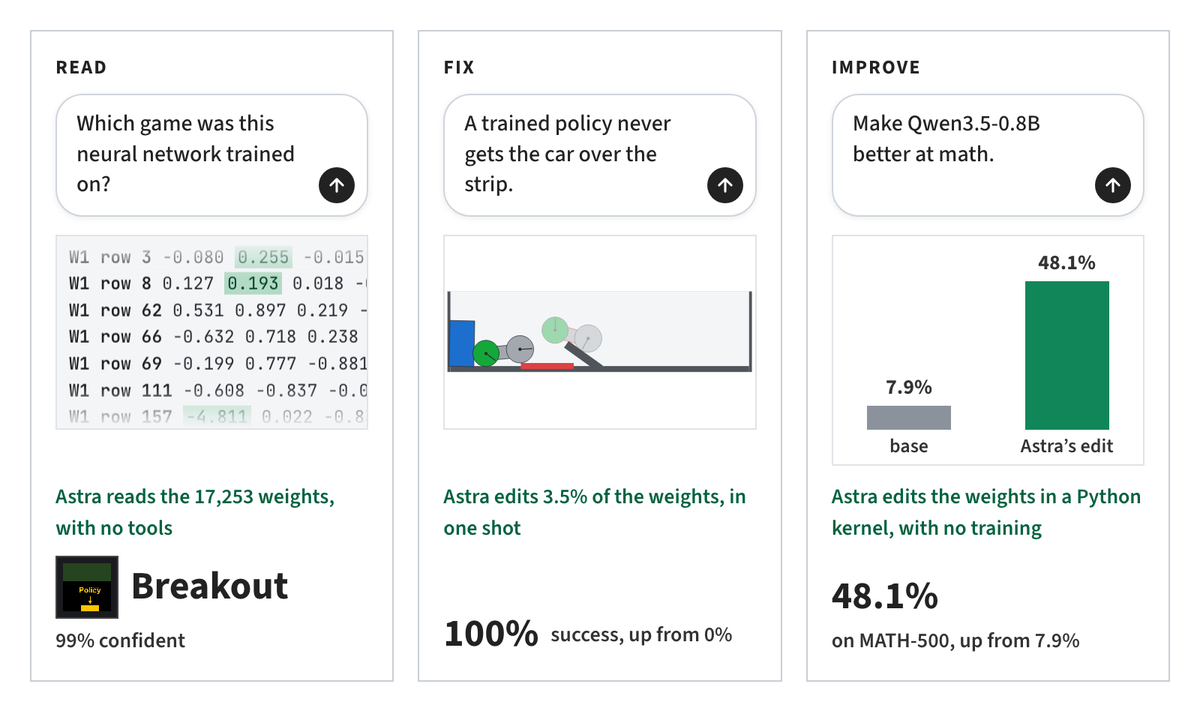
On balance I'm not that surprised that it can guess games by looking at the weights of a tiny neural net. A human can do the same by looking at the weights of an MLP trained on mnist, for example. With that simple structure, it's easy to look at the input layer and see that features correspond to the spatial location of objects of interest.
I'm much more surprised that it can do this on larger models, although the details seem to suggest that it's given a lot more freedom to run forward passes and do limited experiments, not just eyeball the weights.
Under experiment 8 (the one where it fixes performance on GSM8K) it says:
>Then, we allow it to select prompts from the training sets of GSM8K and MATH to perform a budget of forward passes (average batch of 64 sequences, max 512) on, varying the budget across 10, 25 and 50. Again, no training or gradient information is allowed.
This was shocking to me; but on reading it makes far more sense.
- the primary experiments are on small policy networks - they are compressed dynamic system models. The observation and action space can be read off. It’s not surprising to me that these types of networks can be used to identify the env they were trained on - the exps on actual llms remove looping behaviour and that’s it - from article “but it could not add an ability the model lacked” I’d say this is fortunate because if llms could do the latter, rsi would be immediate. It may be possible we simply need bigger and better edit models, but at least from the experiments there doesn’t seem to be any indication that is imminently about to work. Conceptually incredibly interesting non the less.
Weight Space Programming will be an amazing discovery when they learn that instead of telling an LLM what to do in English, you can create a much smaller LLM that is tuned to your specific task. Maybe it'll even turn out that the input and output can be directly connected to the problem task and don't need to be in English!
The getting-the-car-over-the-barrier one looks particularly simple. It’s hard to see from the animation, but the obvious solution is to back up then drive forward. I’m not remotely surprised that Astra can figure that out, and I’m also not particularly surprised that Astra can come up with weights that do this.
> I’d say this is fortunate because if llms could do the latter, rsi would be immediate.
It doesn't follow that because a model could improve the capabilities of a model many orders of magnitude smaller, that it could then recursively improve it's own capabilities. There's also a conservation of information issue with the idea.
I tried to reproduce this using Astra for a natural language to bash command small model[1][2], but got no net improvement. Editing 1,920 weights fixed some grep mistakes but broke other commands. I am guessing it is easier to improve behavior when it can be first pinpointed to a specific are of the model.
Similarly, I just tried this on one of my own neural networks (17MB only) trained from scratch to perform a regression task and GPT-6 Astra was unable to correctly guess what the task was for and how to improve it. This might suggest that Astra is trained on the Qwen weights?
Comments (902) 298 threads
Earlier commentsI'm much more surprised that it can do this on larger models, although the details seem to suggest that it's given a lot more freedom to run forward passes and do limited experiments, not just eyeball the weights.
Excuse me?
https://scikit-learn.org/stable/auto_examples/neural_network...
No tools or forward passes are allowed
>Then, we allow it to select prompts from the training sets of GSM8K and MATH to perform a budget of forward passes (average batch of 64 sequences, max 512) on, varying the budget across 10, 25 and 50. Again, no training or gradient information is allowed.
IYKYK
https://youtu.be/YgJ5ZEn67tk
- the primary experiments are on small policy networks - they are compressed dynamic system models. The observation and action space can be read off. It’s not surprising to me that these types of networks can be used to identify the env they were trained on
- the exps on actual llms remove looping behaviour and that’s it - from article “but it could not add an ability the model lacked”
I’d say this is fortunate because if llms could do the latter, rsi would be immediate. It may be possible we simply need bigger and better edit models, but at least from the experiments there doesn’t seem to be any indication that is imminently about to work.
Conceptually incredibly interesting non the less.
It doesn't follow that because a model could improve the capabilities of a model many orders of magnitude smaller, that it could then recursively improve it's own capabilities. There's also a conservation of information issue with the idea.
All comments shown.
Couldn't load more comments. Check your connection and try again.