>> “If you ask it, how did you solve the Navier-Stokes Millennium problem? It gives a crappy explanation.
It can't explain itself very well. Maybe it will get better at explaining itself. Even if it does, I think it will become so advanced so soon, that even the best, most patient pedagogical teacher will not be able to explain itself to us because it'd be like me teaching calculus to my dog.
My dog can't understand it. I'm too advanced for it. And I think we are going to be in the relation to AI that my dog is to me soon.” Now I am sure we are definitely in a better place in interpretability research than a year ago. But this finding that the llm knows what weights to adjust so it gets predictable behavior on another llm takes interpretability to another level; it makes me pose a question: Have we become “Strogatz-dogs”? From The Daily: When A.I. Comes for Your Purpose in Life, Oct 13, 2026
https://podcasts.apple.com/us/podcast/the-daily/id1200361736...
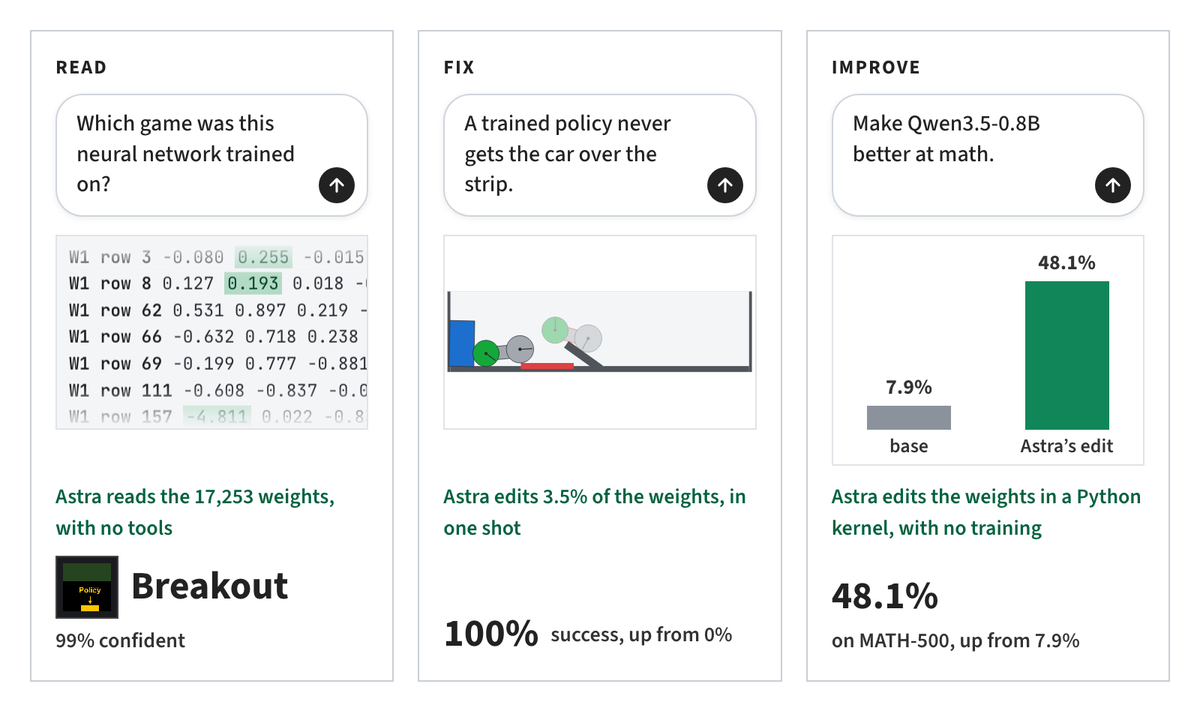
> This is simultaneously very cool but also a bit exaggerated. Reading the prompt you gave, the prompt veeery much hints that looping is the issue and to find neurons that fix this. And as you say (screenshot below), it couldn't otherwise improve math.
This might be one of the most surprising things I have seen in AI. It's like we taught someone to make vases by reading an enormous library of "How to make a vase" books and somehow that person intuited material science.
I am still reading through this and will probably try to comprehend it a bit more. Some of it really seems to follow Arditi et al. (2024) (https://arxiv.org/abs/2406.11717). Projecting out a direction can only remove behaviour and not add capability so the jump mostly comes from unblocking the looping.
Comments (902) 298 threads
Earlier comments>> “If you ask it, how did you solve the Navier-Stokes Millennium problem? It gives a crappy explanation. It can't explain itself very well. Maybe it will get better at explaining itself. Even if it does, I think it will become so advanced so soon, that even the best, most patient pedagogical teacher will not be able to explain itself to us because it'd be like me teaching calculus to my dog. My dog can't understand it. I'm too advanced for it. And I think we are going to be in the relation to AI that my dog is to me soon.”
Now I am sure we are definitely in a better place in interpretability research than a year ago. But this finding that the llm knows what weights to adjust so it gets predictable behavior on another llm takes interpretability to another level; it makes me pose a question: Have we become “Strogatz-dogs”?
From The Daily: When A.I. Comes for Your Purpose in Life, Oct 13, 2026 https://podcasts.apple.com/us/podcast/the-daily/id1200361736...
https://x.com/giffmana/status/2117346161866514524
We should bind this to something like Shift-F10, it'll save time.
All comments shown.
Couldn't load more comments. Check your connection and try again.