This is exciting. I've been training a Qwen3.5-2B model for the past few weeks, trying to teach it certain skills that it lacks.
In the course of testing, one of the things which has been consistent is that when setting a thinking token budget for relatively small prompts that require a limited response, a pretty healthy token budget needs to be set because the model spends the first few hundred tokens just repeating the question/prompt back with some boilerplate "Analyze & Report" type language. I was also running into some loop problems sporadically. After reading this article I asked Astra to edit the backbone so that it started actual reasoning faster and applied a similar looping fix. It was able to reduce the token waste before reasoning by about 20%. I haven't been able to get it to loop yet, so hopefully it fixed that too. My message is admittedly low on info. But it's a pretty promising start!
How out of trivial domain info does this go. Can we use this for general time series, image generation, speech synthesis as well, or dies it cap at small model sizes and common domains?
I wonder if this has to do with the aggressive RL that these models are undergoing. I'm basically a layman but it seems to me that:
- models are trained to improve on some task, e.g. 'improve at math puzzles' is commonly used. - the best way to improve on some task is to have interpretability into your own neurons (..?) - if your interpretability is good, you can improve faster - if you have insight into how your own neurons work and can improve them directly - therefore, models naturally put effort into 'self-interpretability' I wonder if this is part of the 'secret sauce' of what the labs are doing: giving models the ability to interpret their own weights in the RL loop. In my mind, this is the only explanation for how they could succeed at a task like this. How many blog posts are on the open internet that say "this is each weight of a neural network and what each one means"?
Without special effort, a model's reasoning layer doesn't have access to its own weights or activations anymore than we have access to what's going on with our own neurons.
That's what I mean. Maybe the "special effort" is a 'read your own weights' tool. Or maybe it emerges naturally in CoT. The big labs aren't sharing their chain of thought with us and RL post training techniques are not exactly shared publicly. At the same time, post training is basically the thing that is driving most model improvements nowadays.
I believe the authors are wildly overstating the conclusions in their abstract.
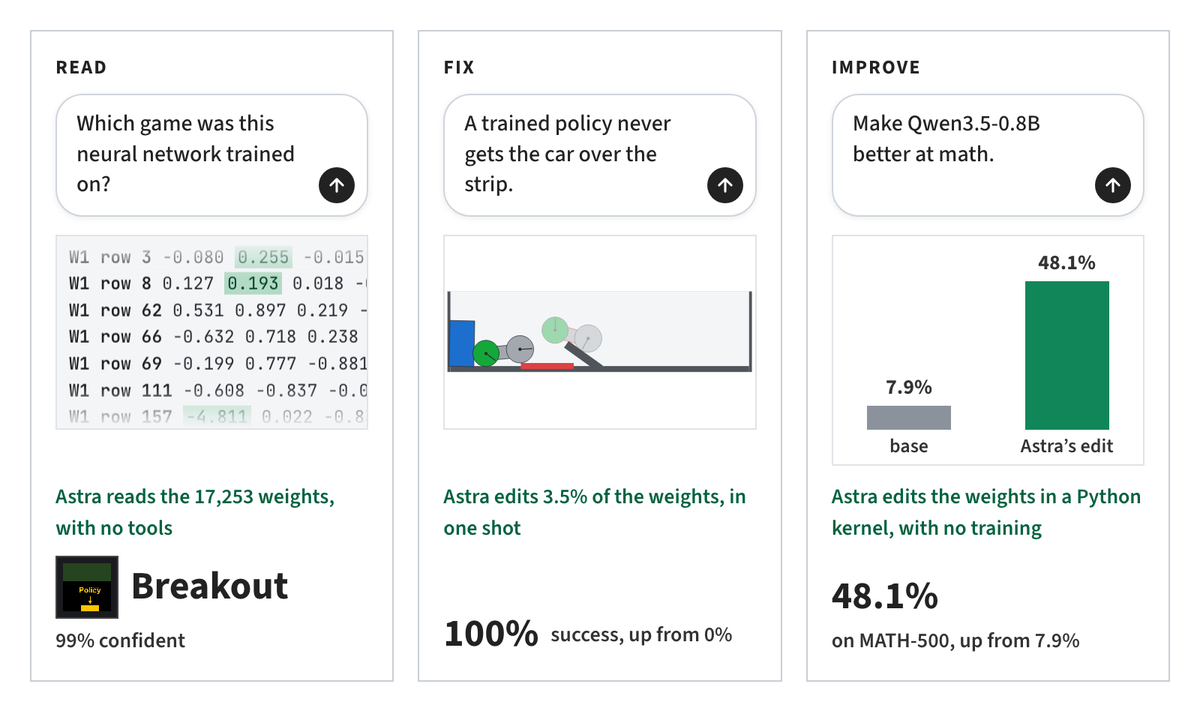
Did they test modifying the weights of a non-public model? Did they test modifying the weights of a non-LLM (and non-public) model? If not, we can only conclude that GPT-6 Astra is good at reading and writing weights of Qwen (a public LLM), not just any neutral network.
The result is still surprising even if the result is Astra can edit and write weights of a publicly known model. It means that models can, at least in principle, be trained on a task that it wasn't considered possible before.
Comments (902) 298 threads
Earlier commentsIn the course of testing, one of the things which has been consistent is that when setting a thinking token budget for relatively small prompts that require a limited response, a pretty healthy token budget needs to be set because the model spends the first few hundred tokens just repeating the question/prompt back with some boilerplate "Analyze & Report" type language. I was also running into some loop problems sporadically.
After reading this article I asked Astra to edit the backbone so that it started actual reasoning faster and applied a similar looping fix. It was able to reduce the token waste before reasoning by about 20%. I haven't been able to get it to loop yet, so hopefully it fixed that too.
My message is admittedly low on info. But it's a pretty promising start!
- models are trained to improve on some task, e.g. 'improve at math puzzles' is commonly used.
- the best way to improve on some task is to have interpretability into your own neurons (..?)
- if your interpretability is good, you can improve faster - if you have insight into how your own neurons work and can improve them directly
- therefore, models naturally put effort into 'self-interpretability'
I wonder if this is part of the 'secret sauce' of what the labs are doing: giving models the ability to interpret their own weights in the RL loop. In my mind, this is the only explanation for how they could succeed at a task like this. How many blog posts are on the open internet that say "this is each weight of a neural network and what each one means"?
Did they test modifying the weights of a non-public model?
Did they test modifying the weights of a non-LLM (and non-public) model?
If not, we can only conclude that GPT-6 Astra is good at reading and writing weights of Qwen (a public LLM), not just any neutral network.
All comments shown.
Couldn't load more comments. Check your connection and try again.