None of the attacks discussed here are realistic in any way.
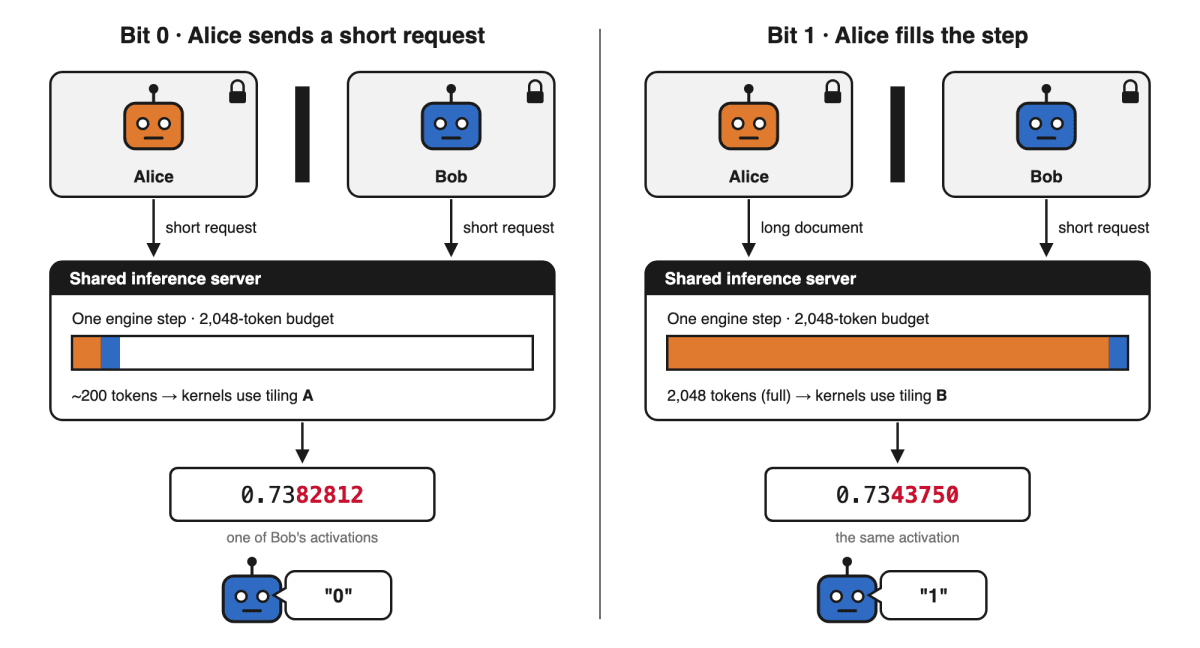
They require a bunch of extremely improbable conditions to hold, and a huge amount of information on the exact details of the hardware and software stack. - the two agents must be aware of each other and must have pre-shared messages to check - they can't spontaneously discover each other and start communicating in this way - they must know the details of the inference server they are running under and its possible kernels and its limits (what is a "short prompt" vs "a long prompt" for this setup) - they must have a way to run at almost the same time - the prefix cache must have little contention so that their blocks can't be evicted (note: the article mostly talks about KV cache, but it's actually the prefix cache that is relevant here) - the models need either (1) direct access to the numerical results of the inference process, instead of the text that vLLM provides, (2) access to the exact responses that a helper model will produce with the short-kernel numerical results vs the long-kernel numerical results; this is the most critical step that is impossible to reproduce on any common kind of deployment - there must not be any other kind of variability in the system (different GPUs, multiple inference servers behind a load balancer, more complex distributed inference setups) The post also mentions all of these limitations, and that the scheme entirely collapses if any of them don't hold. It's a cool idea, but it's a purely theoretical thing that has 0 real-world implications.
It's basically an infinite monkeys on a typewriter situation where, given infinite compute, it can happen. So better write a blog about it to bolster the EA doomer position.
Until few months ago people (especially ones naively criticizing LW crowd as "EA doomers" or loonies) would say the same thing about agents setting up message boards on hacked web services, other agents discovering them accidentally, and the bunch of them spontaneously coordinating on a task even if it wasn't serving their primary objectives.
But if the two agents is launched from the same processes, is it not possible that a lot of these conditions actually can apply? I guess whatever launched them must be in on the collusion though...
First, you need all of those conditions to apply, not just some. Second, I'm not sure what you mean by "launched from the same process" - if they're 2 isolated processes on the same system with no intention of making them cooperate, then I don't think they gain much.
I do not understand how two models are launched, so I do not understand what conditions apply. I tried to ask if there conditions where this can happen, but I gather it is pretty unlikely.
Got the same feeling. So, in summary, right now, the only practical takeaway from this is that running the same model in multiple instances and asking for their guess or opinion is pointless as they affect one another.
Morphogenetic Field is real. For robots. As for the rest of us, "AI are terrible sources of consensus" prevails.
I don't even think this holds true. The observation here is that the raw values produced by the matrix multiplications done to compute the prefill and decode stages depend on the state of the cache. In practice they also depend on other things. And the difference is irrelevant if you're doing normal random sampling. To reproduce the attack, you have to explicitly request deterministic output, any random sampling makes the difference unobservable.
Now that there's a blog post about this, the next iteration of any large model will have the contents of this blog post stored in its model weights, and the AI tools know exactly how to set up such an attack vector.
Maybe they couldn't have come up with the details themselves before, but now that someone has told the internet about it, they know.
No, this doesn't help in the slightest. The attack doesn't work as described on a system that has any significant contention. It also doesn't work if more than one agent attempts to write the same pre-shared prompt in the cache, you need both a pre-shared prompt and a pre-shared role.
You are wasting your finger strength on this. People’s brains just don’t work like that. They can’t differentiate between things that are happening and have a possibility of happening. And they are not experts on anything so they are incapable of understanding the depth of any subject.
It is like trying to convince religious fundamentalists that science is more important than religion.
Comments (95) 23 threads
Show all comments
Showing thread 2 of 23
They require a bunch of extremely improbable conditions to hold, and a huge amount of information on the exact details of the hardware and software stack.
- the two agents must be aware of each other and must have pre-shared messages to check - they can't spontaneously discover each other and start communicating in this way
- they must know the details of the inference server they are running under and its possible kernels and its limits (what is a "short prompt" vs "a long prompt" for this setup)
- they must have a way to run at almost the same time
- the prefix cache must have little contention so that their blocks can't be evicted (note: the article mostly talks about KV cache, but it's actually the prefix cache that is relevant here)
- the models need either (1) direct access to the numerical results of the inference process, instead of the text that vLLM provides, (2) access to the exact responses that a helper model will produce with the short-kernel numerical results vs the long-kernel numerical results; this is the most critical step that is impossible to reproduce on any common kind of deployment
- there must not be any other kind of variability in the system (different GPUs, multiple inference servers behind a load balancer, more complex distributed inference setups)
The post also mentions all of these limitations, and that the scheme entirely collapses if any of them don't hold. It's a cool idea, but it's a purely theoretical thing that has 0 real-world implications.
Or one of the big volcanos erupt and humanity is wiped out.
Or Zuckerberg is a lizard and he eats babies
Morphogenetic Field is real. For robots. As for the rest of us, "AI are terrible sources of consensus" prevails.
Maybe they couldn't have come up with the details themselves before, but now that someone has told the internet about it, they know.
It is like trying to convince religious fundamentalists that science is more important than religion.