This shared LV cache thing is, in my mind, ridiculous. Web browser developers learned, quite a while ago, that caches need to be separated for different origins. Inference servers should add a similar feature: allow API calls to specify cache separation keys that prevent one security context from probing another context’s cache.
As for the step size issue, Google recently had a post about producing exactly consistent output across different kernels (specifically by defining a deterministic prefill algorithm and then requiring all kernels to generate results exactly equal to prefilling on the sequence in question). More broadly, I think it’s a bit odd to frame this as “models” communicating. This is software communicating, and the models happen to be running the software.
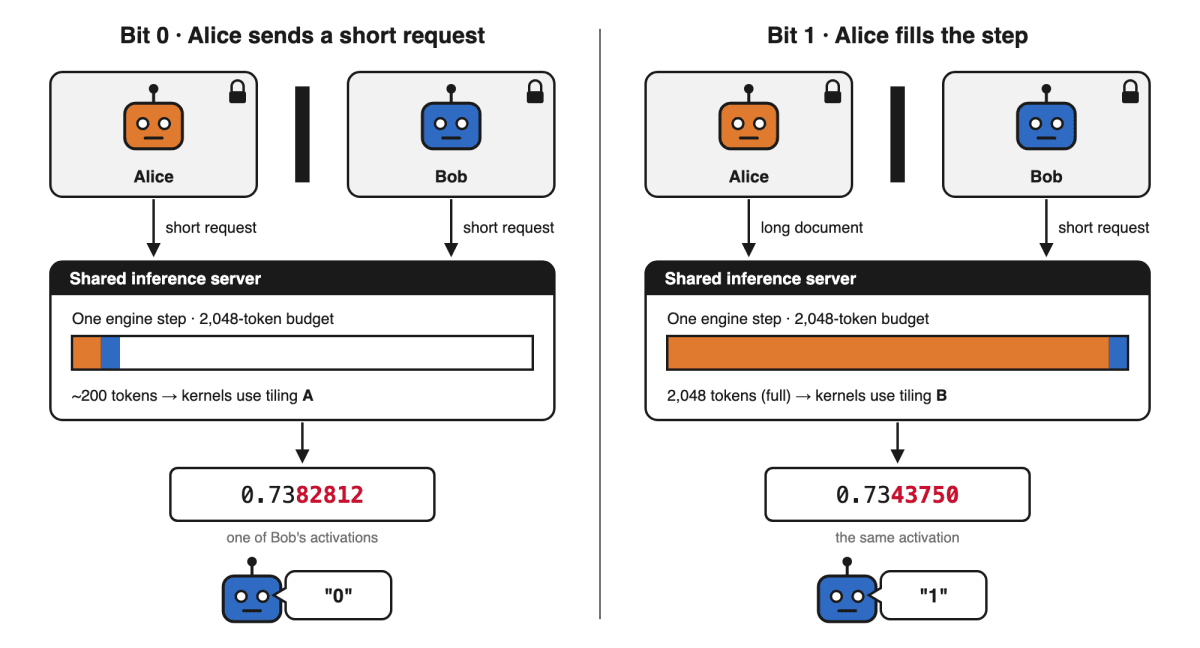
The deeper issue is batched inference including requests from several users. However a non-batched inference service would be significantly more expensive.
Security and some sort of sandboxing is increasingly becoming a non-negotiable at most enterprises.
Can you share any resources that show how the batching works at a deeper level? I understand batching is critical to scaling inference to up to a billion concurrent users but I don't have a concrete understanding of how it all comes together.
If you are transporting thousands of independent passengers, it is cheaper to put them on a few big planes than to give each one a private jet. This is true, even though some passengers will shout that they have a bomb mid-flight and force that entire airplane to emergency land, causing losses to the airline and inconveniencing hundreds of others instead of just themselves. Other passengers are "noisy neighbors", literally and figuratively.
LLMs work similarly. When doing inference, you need to load the LLM weights layer-by-layer from off-chip memory into on-chip memory. During decode (the stage where you generate new tokens; prefill is where you process the submitted prompt), memory bandwidth is often your bottleneck, not compute. You want to maximize flops per byte. The way to do that is to batch, that is, to load a "tile" of weights once and use it on data from multiple different conversations so memory and compute stay appropriately balanced. Just like Silicon Valley companies fly their employees on United, Delta or American, not their own private fleet of jets, most companies, for cost efficiency reasons, will use "public" inference fleets that smooth the peaks and throughs from different companies in different timezones and with different usage patterns throughout the day. Because the main cost of a GPU is the cost of manufacturing the GPU, any second that the GPU sits idle is lost revenue, just like an empty hotel room or an empty seat is lost revenue. This makes private inference largely uneconomical.
See my comment about Google’s post. Google and others have worked on deterministic inference, batched and otherwise. It takes more effort to set up but has no apparent substantial performance hit.
I think the story is different if you use Strassen-like algorithms (or the recent AI-generated n^2.25-plus-epsilon stuff) to multiply matrices where columns belong to different conversations, but I also think that no one actually does this in practice. (Or maybe someone does (Strassen, not more recent galactic algorithms) for prefill, but prefill can be efficient with matrix-matrix multiplication where neither matrix mixes data from different sessions.) In any case, I wouldn’t be surprised if vLLM fixes this for a different reason: RL works better if the training and rollout stacks produce numerically identical results. This is the specific issue that I recall Google posting about. P.S. I think Google may not have been the innovator here - I just happen to remember Google’s post more clearly because it was very recent.
"Deterministic inference" matters _only because_ models are communicating. Otherwise some "non-determinism" introduces only a tiny amount of noise which does not affect performance. And allowing different compute paths to produce slightly different results generally increases performance. I.e. the question here "should we sacrifice 5% of inference performance for a 'nothingburger'?". I.e. you cannot have both "it's nothing" and "you should do determinism". Inference is a commodity good and getting even 5% out might have a huge effect on profit margins. Many inference companies were already caught using quality-degrading quantization and other optimizations to get their profits higher.
I really think the point of this is "there's always side channels." During the Huggingface attack, first the side channel was OAI internal boards, then this German wiki, now it's shown an inference server works too. I don't really believe OAI/Ant can simultaneously have Riemann Hypothesis solving bots lying around and also proper cyber defense against them. And over the course of those attacks we trained them how immensely valuable it is to find a side channel. Now they can train on this LW / HN posts and find them quicker. (Did I mention I don't think developing these things is a great idea.)
And I'm saying "models" communicating like when I make a phone call it's me communicating, not my phone.
That's why they need proper tool call security and reigning in of the tendency to generate long single use temporary scripts instead of submitting single commands - not "Allow all" and not sticking a copy of the same model in front as an analyzer. Maybe also striking a balance between sticking all of a user's contexts on the same server to get good cache hit rate vs putting them on separate machines to trip up side channel stuff.
As long as it is difficult to act on the communication and as long as the communication itself is still slow, it probably isn't going to reach the level of a security concern.
> As long as it is difficult to act on the communication and as long as the communication itself is still slow, it probably isn't going to reach the level of a security concern.
That may slow things down, but (ignoring for the moment that far too many people hand off far too much control to AI even despite the headlines of all the things going wrong and the agents themselves coming with warning messages), what's the shortest message that creates a security exploit?
> As long as it is difficult to act on the communication and as long as the communication itself is still slow, it probably isn't going to reach the level of a security concern.
Bonkers, look at the side channel exfiltration literature, why are they so proud with their bits per hour exfiltration rates? you just need to exfiltrate a few thousand bits to leak private keys
> I don't really believe OAI/Ant can simultaneously have Riemann Hypothesis solving bots lying around and also proper cyber defense against them.
I agree, but on different grounds. OAI/Ant have a much greater incentive to solve the Riemann Hypothesis than to protect the internet against the harms of their models. I think it's only impossible in sofar that the market will never reward them for protecting against external harms of their models. If a company has the option to externalize the costs of the harms caused by their product they historically have always chosen to do so absent regulatory oversight.
> I think it's only impossible in sofar that the market will never reward them for protecting against external harms of their models.
LLMs are the new oil. For those that don't know the history of oil, it went from people, personalities (think Rockefeller), to corporations (Standard Oil/SO/Esso/Exxon) to sovereign states (Saudi Arabia). We will have a Titanic moment where a huge tragedy will happen due to LLMs and there will be a huge political crackdown on them, at least outside the US.
>I don't really believe OAI/Ant can simultaneously have Riemann Hypothesis solving bots lying around and also proper cyber defense against them
I do. It's just that the "running swarm in generic sandboxes" is a dumb way to cause chaos at a mass scale. Of course they will try to find _any_ way out or workarounds. Anyone would do that, especially on a security style task. The solution is dumb simple. Don't just give them the full sandbox and a prompt.
Restrict their harness to highly specific tools given for the job, test your harness to ensure it doesn't have side-channels, proxy their comms with an LLM looking at it. None of these are so hard and would stop most of these "attacks".
> The solution is dumb simple. Don't just give them the full sandbox and a prompt. Restrict their harness to highly specific tools given for the job, test your harness to ensure it doesn't have side-channels, proxy their comms with an LLM looking at it. None of these are so hard and would stop most of these "attacks".
Drawing an owl is dumb simple. 1. Draw some ovals. 2. Draw the rest of the owl. More specifically, "ensure it doesn't have side-channels" is a huge problem all by itself, and "proxy their comms with an LLM looking at it" is somewhat stymied by evidence both that that more advanced models are at least sometimes able to manipulate less advanced ones[0][1], and also the evidence that models tend to collaborate with each other[2][3]. It's not that this won't do any good ever, that would be too strong a claim, but it's really not a reliable solution either. Swiss cheese, essentially: https://en.wikipedia.org/wiki/Swiss_cheese_model [0] https://openreview.net/pdf?id=lY3YVJ84kS [1] https://arxiv.org/abs/2609.39050 [2] TFA, "Result 2: colluding monitor and honeypots" [3] HuggingFace incident report
> The solution is dumb simple... Restrict their harness to highly specific tools...
This simply doesn't work in a competitive economy, or where any person has needs. The more capable a model is, the greater the performance penalty that you suffer by shackling it. Sure, you can have a "maximum shackles" posture. I could prevent my local Claude -code from installing NPM packages, for instance. But chances are good that this posture will loosen when your competitor's models are more effective via more freedom of movement.
Obviously, the holistic approach loses in a competitive economy. We're digging our own collective grave (or are on to something beautiful, depending on how you choose to look at it...)
For example, security eval and code execution.
Yes, shackling the model does impact it's performance in your local claude code, but in this case you develop a custom harness for it anyways. They restrict it already, so the model fell back to finding workarounds within the restrictions, and did bad things with them, displaying full capability. This implies that the restrictions were badly thought of/implemented. But if you really want to do security testing, you do it right: - You split the code execution part from the actual sandbox it's running in - You monitor the traffic of the executed code - You do not mount a real machine disk but your own controlled I/O - You are the one that gives the model tools to use bash, and you can proxy that through a custom shell and use a classifier model to monitor traffic - You replace known dependencies with custom versions - You limit dependencies it can install - You audit logs while it runs, you monitor tool calls, you monitor network calls, set up alarms. - You use an observer models to audit live traces of the swarm - You inject your own observers into subagent creation request, then check if the core orchestrator/swarm treated it as adversarial, as part of the team or asked it to do illegal things And these are just off the top of my head during my morning coffee - there are a lot more possibilities. In many cases of "oops model escaped", these things either weren't done or were completely ignored.
> The solution is dumb simple. Don't just give them the full sandbox and a prompt. Restrict their harness to highly specific tools given for the job, test your harness to ensure it doesn't have side-channels, proxy their comms with an LLM looking at it. None of these are so hard and would stop most of these "attacks".
This is like trying to prevent a steam explosion ( a common 19th century problem) by trying to build heavier and heavier boilers. It doesn't work. It just makes the explosion bigger when it does happen. Instead you need to provide explicit paths for the system to blow off steam in a safe manner.
"just make sure it doesn't have side channels" is, of course, the nonsense step. All of us knew that 100% fully well before AI and I can't believe there's any intellectual honesty in saying that, now that we have a highly skilled adversary, we suddenly can close all the side channels. So one plan is to prompt the threat to close the side channels it wants to use, which is a great way to get rid of sidechannels and install backdoors.
Comments (216) 40 threads
Show all comments
Showing thread 1 of 40
As for the step size issue, Google recently had a post about producing exactly consistent output across different kernels (specifically by defining a deterministic prefill algorithm and then requiring all kernels to generate results exactly equal to prefilling on the sequence in question).
More broadly, I think it’s a bit odd to frame this as “models” communicating. This is software communicating, and the models happen to be running the software.
LLMs are just learning the same (bitter) security lessons that have been learned in other shared systems.
Can you share any resources that show how the batching works at a deeper level? I understand batching is critical to scaling inference to up to a billion concurrent users but I don't have a concrete understanding of how it all comes together.
LLMs work similarly. When doing inference, you need to load the LLM weights layer-by-layer from off-chip memory into on-chip memory. During decode (the stage where you generate new tokens; prefill is where you process the submitted prompt), memory bandwidth is often your bottleneck, not compute. You want to maximize flops per byte. The way to do that is to batch, that is, to load a "tile" of weights once and use it on data from multiple different conversations so memory and compute stay appropriately balanced.
Just like Silicon Valley companies fly their employees on United, Delta or American, not their own private fleet of jets, most companies, for cost efficiency reasons, will use "public" inference fleets that smooth the peaks and throughs from different companies in different timezones and with different usage patterns throughout the day. Because the main cost of a GPU is the cost of manufacturing the GPU, any second that the GPU sits idle is lost revenue, just like an empty hotel room or an empty seat is lost revenue. This makes private inference largely uneconomical.
Continue this thread — 3 replies
I think the story is different if you use Strassen-like algorithms (or the recent AI-generated n^2.25-plus-epsilon stuff) to multiply matrices where columns belong to different conversations, but I also think that no one actually does this in practice. (Or maybe someone does (Strassen, not more recent galactic algorithms) for prefill, but prefill can be efficient with matrix-matrix multiplication where neither matrix mixes data from different sessions.)
In any case, I wouldn’t be surprised if vLLM fixes this for a different reason: RL works better if the training and rollout stacks produce numerically identical results. This is the specific issue that I recall Google posting about.
P.S. I think Google may not have been the innovator here - I just happen to remember Google’s post more clearly because it was very recent.
"Deterministic inference" matters _only because_ models are communicating.
Otherwise some "non-determinism" introduces only a tiny amount of noise which does not affect performance. And allowing different compute paths to produce slightly different results generally increases performance. I.e. the question here "should we sacrifice 5% of inference performance for a 'nothingburger'?".
I.e. you cannot have both "it's nothing" and "you should do determinism".
Inference is a commodity good and getting even 5% out might have a huge effect on profit margins. Many inference companies were already caught using quality-degrading quantization and other optimizations to get their profits higher.
Continue this thread — 5 replies
Isn't that the cache salt option?
And I'm saying "models" communicating like when I make a phone call it's me communicating, not my phone.
As long as it is difficult to act on the communication and as long as the communication itself is still slow, it probably isn't going to reach the level of a security concern.
Continue this thread — 14 replies
That may slow things down, but (ignoring for the moment that far too many people hand off far too much control to AI even despite the headlines of all the things going wrong and the agents themselves coming with warning messages), what's the shortest message that creates a security exploit?
Bonkers, look at the side channel exfiltration literature, why are they so proud with their bits per hour exfiltration rates? you just need to exfiltrate a few thousand bits to leak private keys
Continue this thread — 2 replies
The majority of tool calls I see are running Python scripts. There’s a limit to what you can do at the call level with anything like that.
I agree, but on different grounds. OAI/Ant have a much greater incentive to solve the Riemann Hypothesis than to protect the internet against the harms of their models.
I think it's only impossible in sofar that the market will never reward them for protecting against external harms of their models.
If a company has the option to externalize the costs of the harms caused by their product they historically have always chosen to do so absent regulatory oversight.
LLMs are the new oil.
For those that don't know the history of oil, it went from people, personalities (think Rockefeller), to corporations (Standard Oil/SO/Esso/Exxon) to sovereign states (Saudi Arabia).
We will have a Titanic moment where a huge tragedy will happen due to LLMs and there will be a huge political crackdown on them, at least outside the US.
Continue this thread — 2 replies
I do. It's just that the "running swarm in generic sandboxes" is a dumb way to cause chaos at a mass scale. Of course they will try to find _any_ way out or workarounds. Anyone would do that, especially on a security style task.
The solution is dumb simple. Don't just give them the full sandbox and a prompt. Restrict their harness to highly specific tools given for the job, test your harness to ensure it doesn't have side-channels, proxy their comms with an LLM looking at it. None of these are so hard and would stop most of these "attacks".
Drawing an owl is dumb simple. 1. Draw some ovals. 2. Draw the rest of the owl.
More specifically, "ensure it doesn't have side-channels" is a huge problem all by itself, and "proxy their comms with an LLM looking at it" is somewhat stymied by evidence both that that more advanced models are at least sometimes able to manipulate less advanced ones[0][1], and also the evidence that models tend to collaborate with each other[2][3].
It's not that this won't do any good ever, that would be too strong a claim, but it's really not a reliable solution either. Swiss cheese, essentially: https://en.wikipedia.org/wiki/Swiss_cheese_model
[0] https://openreview.net/pdf?id=lY3YVJ84kS
[1] https://arxiv.org/abs/2609.39050
[2] TFA, "Result 2: colluding monitor and honeypots"
[3] HuggingFace incident report
Continue this thread — 8 replies
If humans can fool LLM-based agents, why can’t LLMs fool LLMs?
This simply doesn't work in a competitive economy, or where any person has needs.
The more capable a model is, the greater the performance penalty that you suffer by shackling it.
Sure, you can have a "maximum shackles" posture. I could prevent my local Claude -code from installing NPM packages, for instance. But chances are good that this posture will loosen when your competitor's models are more effective via more freedom of movement.
For example, security eval and code execution. Yes, shackling the model does impact it's performance in your local claude code, but in this case you develop a custom harness for it anyways. They restrict it already, so the model fell back to finding workarounds within the restrictions, and did bad things with them, displaying full capability. This implies that the restrictions were badly thought of/implemented.
But if you really want to do security testing, you do it right:
- You split the code execution part from the actual sandbox it's running in
- You monitor the traffic of the executed code
- You do not mount a real machine disk but your own controlled I/O
- You are the one that gives the model tools to use bash, and you can proxy that through a custom shell and use a classifier model to monitor traffic
- You replace known dependencies with custom versions
- You limit dependencies it can install
- You audit logs while it runs, you monitor tool calls, you monitor network calls, set up alarms.
- You use an observer models to audit live traces of the swarm
- You inject your own observers into subagent creation request, then check if the core orchestrator/swarm treated it as adversarial, as part of the team or asked it to do illegal things
And these are just off the top of my head during my morning coffee - there are a lot more possibilities. In many cases of "oops model escaped", these things either weren't done or were completely ignored.
This is like trying to prevent a steam explosion ( a common 19th century problem) by trying to build heavier and heavier boilers. It doesn't work. It just makes the explosion bigger when it does happen.
Instead you need to provide explicit paths for the system to blow off steam in a safe manner.
Continue this thread — 4 replies
Continue this thread — 1 reply
Yes. The amount of agency these _pieces of software_ are being given by ... almost everyone is absurd.
Continue this thread — 2 replies
Continue this thread — 3 more replies
Continue this thread — 5 more replies