Most of those graphs tell more about the value of money than anything else, surely not about quality of life. It's easy to draw a graph and make hasty conclusions, the problem in economics is the choice of metrics. Money is an easy one to observe, but it is a human construct and is influenced by a lot of factors. No surprise GDP has been steadily risen by 2% for a few decades, it's been designed that way.
The late Hans Rosling had a wonderful measure of quality of life in Factfulness: guitars per kid. It's a silly measure but it covers many things (free time, access to education, family wealth/poverty etc).
It's been going up pretty well almost everywhere. (Doesn't mean there aren't pockets of things going bad, of course.)
You don't think a guy who's an educator about macro might just possibly be smart enough to adjust for inflation? In fact, the article does say that it does so, in at least one place that I noticed.
After World War II, factory workers with a high school education could raise a family on one income, buy a house and car and send kids off to college. Nowadays young couples can not afford to buy a house. Even FAANG workers have endured layoffs and slack hiring. Macrohistory: Anthropologists found migratory hunter-gatherers often work only 35 or 30 hours a week. They often have to work less than we do. That is human history before the rise of slave empires several thousand years ago. With European and US leaders cheering as Israel announced it was blocking food to Gaza, often increasing aid at that point, and other horrors, I don't see things in Panglossian terms. Nor do laid of FAANG workers, or workers the world over. It is why places like New York are getting socialist mayors.
> Anthropologists found migratory hunter-gatherers often work only 35 or 30 hours a week. They often have to work less than we do. That is human history before the rise of slave empires several thousand years ago.
1. That number is kinda debated because it only counts the time away from camp, but I'll give it to you. 2. This does not address the difference in quality of life or life expectancy. 3. Multiple civilizations gave up hunting and moved to agriculture independently, thousands of years ago, because it made more sense, and not because of "slave empires".
My understanding is that it’s the price of scaling (hey there’s an engineering lesson here). Can a small tribe have a fairly good life in a fairly large territory by hunting and gathering? Sure. But as soon as they start growing past the limit where their prey can naturally outgrow their predation of it, they starve. Agriculture can more reliably feed a much larger population before you hit scaling limits.
In pre-industrial times, I’m not sure quality of life mattered for how it turned out. Some patterns “made sense” because organizing a defense against other hostile tribes was a requirement. States where a military and religious elite extracted the agricultural surplus of mostly defenseless peasants were able to push hunter-gatherers out of fertile river valleys to more marginal land to become “hill peoples” or “barbarians.”
(Or if the barbarians won, they might become the new military elite.) I thought this was a pretty good introduction: Pre-Industrial Societies: Anatomy of the Pre-Modern World
by Patricia Crone https://www.amazon.com/dp/1780747411
The first isn't macrohistory - it's a very specific era in time where the US was industrialising; not only itself but europe too which had warred itself back into the stone age.
Look at the rest of the people in the world. Global poverty was higher, much higher. And uh not to mention even in the US life was really only good for cis white men, but that's a topic for another day. Like I think socialist policies can work, but this line of reasoning is so obnoxious it completely turns me off. Also you're welcome to join the uncontacted tribes in Amazon if you believe they live a better life than ours. Like I'm not even debating your point of them only work 30-35 hrs which might or might not be correct. But to keep a modern society functional people do have to sacrifice and work hard, so hard that you can't think of anything except work. This sort of lazy thinking is the reason western countries overproduce RNs, PAs and other healthcare workers, but never doctors & surgeons. It takes a lifetime commitment which apparently isn't something y'all are capable of.
I would really like to repeat for the ones in the back - we used to be really poor before the industrial revolution.
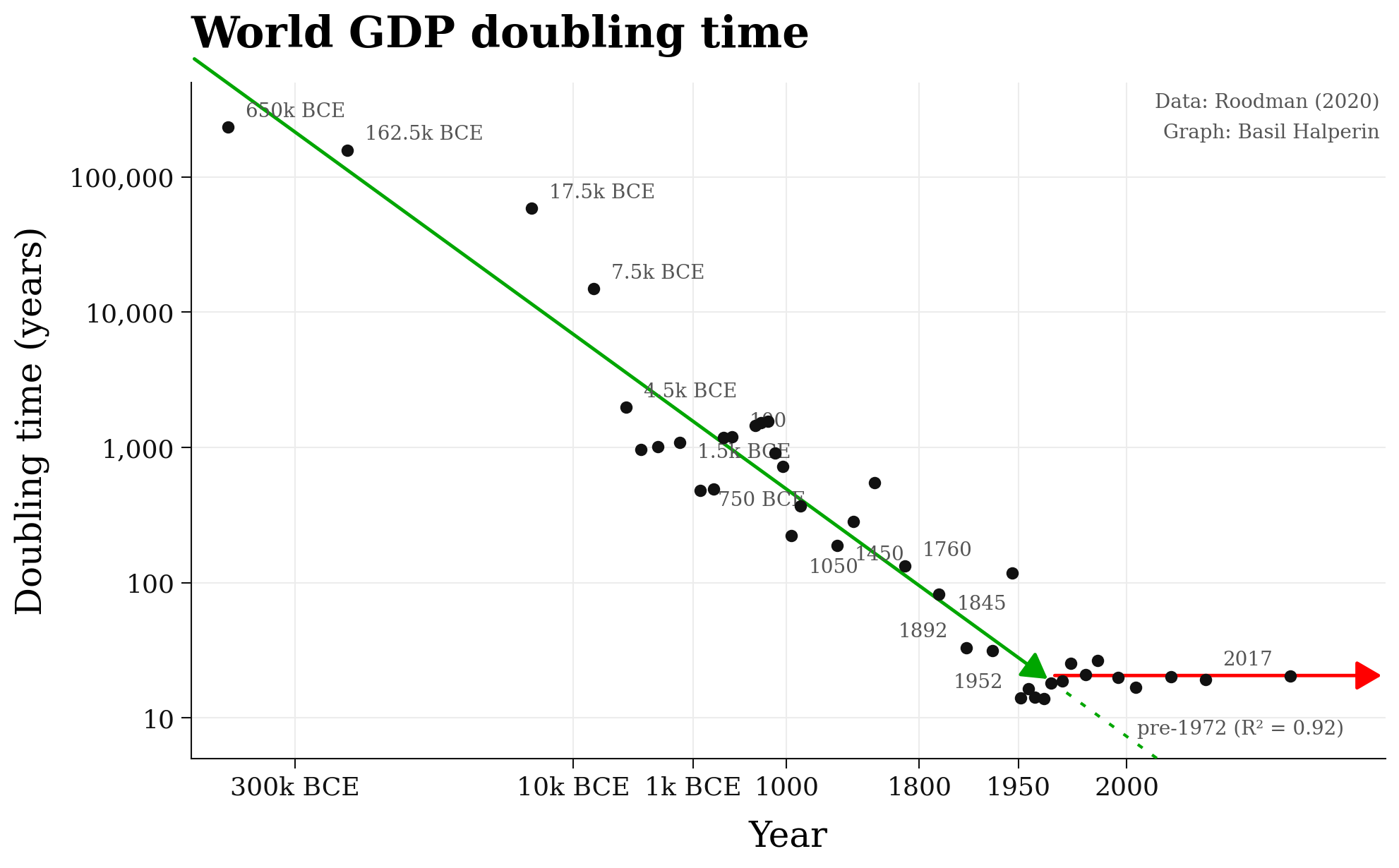
And that the rate of growth is increasing. I see so much anti-AI sentiment here and it's very appalling because atleast technologically competent people should realize how big of a deal engineering is. STEM is accelerating yet again, and I hope the results are felt soon across the world. I hope to see a decrease in absolute poverty all around the world. Actually a lot of these guys are selfish tbh - caring about their first world cushy programming jobs and thus defending the current status quo. No different from billionaires tbh. If anything guys like Amodei or Huang are the ones leading the progress here.
"But what about my job!" has been the refrain of the selfish and unimaginative preventing progress that benefits billions throughout history. It's the most parochial thinking possible. Thank god we never listen to those people or we'd still be out here smashing rocks together.
Look forward to explaining to my children that can't afford housing, can't find a job and are living through a worsening climate crisis that it's OK because we've made "progress".
> I hope the results are felt soon across the world.
Yes, oligarchs will feel their pockets overflowing. > Actually a lot of these guys are selfish tbh - caring about their first world cushy programming jobs and thus defending the current status quo. No different from billionaires tbh. If anything guys like Amodei or Huang are the ones leading the progress here. Progress towards what? The Industrial Revolution raised the living standards of the working masses because there was room to extract more resources from the environment. There was a hiccup in employment, but lost jobs were eventually replaced by new ones that allowed for even greater resource extraction. A crucial role was also played by socialist/communist movements, which forced capitalists to become more competitive in terms of wages. Neither of these conditions holds today. We are already overextracting, so any projected productivity gains will come at the expense of further deterioration of the planet we are still bound to. And there is also no real social movement that would force capitalists to transfer part of the productivity gains to working people. That last part is already a dire reality. See [1] (also posted recently on HN) citing: "We've already seen a substantial reduction in the share of national income going to workers." I.e. the GDP per capita which is the focus of TFA is just an average, and its increase does not translate to an equitable increase of the income of workers. So, anyone drawing parallels between the Industrial Revolution and a potential upcoming AI Revolution, is up to for a rude awakening. The "cushy programming jobs" are just the canaries in the coal mine in this case. If the workers who enabled the AI revolution are excluded from its fruits, it begs the question of how the rest of the workforce will benefit. [1] https://paulkrugman.substack.com/p/pop-goes-the-bubble
I don't think the Industrial Revolution primarily raised living standards by increasing extraction. The main thing it did was to increase productivity.
There's a difference between those two things. Extraction is just getting more stuff because you increase inputs. Productivity is getting more stuff just because.
> I hope to see a decrease in absolute poverty all around the world. > Actually a lot of these guys are selfish tbh - caring about their first world cushy programming jobs and thus defending the current status quo. No different from billionaires tbh. If anything guys like Amodei or Huang are the ones leading the progress here. Do you honestly think that with our current trajectory we are on course for decreasing absolute poverty around the world? and that "Amodei or Huang are the ones leading the progress here"? Can you join the dots for me here, I'm struggling to understand your line of reasoning. How does the increase of AI lead to decreased poverty around the world?
The increasing availability of cheap middling(even, in the worst case) intelligence will decrease by orders of magnitude the cost of the immaterial services and goods provided.
On the topic of material goods, it's already making headway into CAD and PCB/IC design again increasing productivity by 2-3x. And that's not including the compounding gains automating the software already did. Add to that pile the new STEM stuff made accessible by AI and we could indeed see material goods getting cheaper by an order of magnitude. This is huge. Like one area I'm especially interested in is pharmaceuticals and the pathology industries. So yea, life is good. PS - Don't bring up stuff like the "cost of living" and stuff. I'm more concerned about the rest of the world excluding NA/EU. Y'all already live rich enough lives. PPS - If you want a concrete example - if the adoption of LLMs makes a chemical plant 2x efficient due to future cheap robots driven by VLAs that amortize over say a decade in say India. Then the entire world benefits, including the poorest regions of the world. Like I said, not everybody is fortunate enough to care about cars or houses in some first world country. This is what I consider more important as an engineer.
Where's the burden of proof on that question? Historically absolute poverty all the world over has been decreasing. It can be hard to see because year to year it seems nothing changes but imagine you have a choice between living in the poorest country in the world today vs. 500 years ago? Or 100 years ago? Or 50?
At some point (1 year ago? 10 years ago?) you'd rightly say it's a wash or even that you'd be better off in the past but it's going to be a small window. On a larger time scale everyone would say the present. Does AI contribute to that or take away from it? I tend to think it enables that growth but honestly, ask me in 10 years? Or 20 years. If it doesn't though most people aren't even going to remember what an AI is.
Comments (84) 19 threads
Earlier commentsA similar correlation graph would be “chances of being murdered” or “chances of starving to death”.
It's been going up pretty well almost everywhere.
(Doesn't mean there aren't pockets of things going bad, of course.)
After World War II, factory workers with a high school education could raise a family on one income, buy a house and car and send kids off to college.
Nowadays young couples can not afford to buy a house. Even FAANG workers have endured layoffs and slack hiring.
Macrohistory:
Anthropologists found migratory hunter-gatherers often work only 35 or 30 hours a week. They often have to work less than we do. That is human history before the rise of slave empires several thousand years ago.
With European and US leaders cheering as Israel announced it was blocking food to Gaza, often increasing aid at that point, and other horrors, I don't see things in Panglossian terms. Nor do laid of FAANG workers, or workers the world over. It is why places like New York are getting socialist mayors.
1. That number is kinda debated because it only counts the time away from camp, but I'll give it to you.
2. This does not address the difference in quality of life or life expectancy.
3. Multiple civilizations gave up hunting and moved to agriculture independently, thousands of years ago, because it made more sense, and not because of "slave empires".
(Or if the barbarians won, they might become the new military elite.)
I thought this was a pretty good introduction:
Pre-Industrial Societies: Anatomy of the Pre-Modern World by Patricia Crone
https://www.amazon.com/dp/1780747411
Look at the rest of the people in the world. Global poverty was higher, much higher.
And uh not to mention even in the US life was really only good for cis white men, but that's a topic for another day.
Like I think socialist policies can work, but this line of reasoning is so obnoxious it completely turns me off.
Also you're welcome to join the uncontacted tribes in Amazon if you believe they live a better life than ours. Like I'm not even debating your point of them only work 30-35 hrs which might or might not be correct.
But to keep a modern society functional people do have to sacrifice and work hard, so hard that you can't think of anything except work.
This sort of lazy thinking is the reason western countries overproduce RNs, PAs and other healthcare workers, but never doctors & surgeons. It takes a lifetime commitment which apparently isn't something y'all are capable of.
And that the rate of growth is increasing. I see so much anti-AI sentiment here and it's very appalling because atleast technologically competent people should realize how big of a deal engineering is.
STEM is accelerating yet again, and I hope the results are felt soon across the world. I hope to see a decrease in absolute poverty all around the world.
Actually a lot of these guys are selfish tbh - caring about their first world cushy programming jobs and thus defending the current status quo. No different from billionaires tbh. If anything guys like Amodei or Huang are the ones leading the progress here.
Continue this thread — 1 reply
Yes, oligarchs will feel their pockets overflowing.
> Actually a lot of these guys are selfish tbh - caring about their first world cushy programming jobs and thus defending the current status quo. No different from billionaires tbh. If anything guys like Amodei or Huang are the ones leading the progress here.
Progress towards what? The Industrial Revolution raised the living standards of the working masses because there was room to extract more resources from the environment. There was a hiccup in employment, but lost jobs were eventually replaced by new ones that allowed for even greater resource extraction. A crucial role was also played by socialist/communist movements, which forced capitalists to become more competitive in terms of wages.
Neither of these conditions holds today. We are already overextracting, so any projected productivity gains will come at the expense of further deterioration of the planet we are still bound to. And there is also no real social movement that would force capitalists to transfer part of the productivity gains to working people.
That last part is already a dire reality. See [1] (also posted recently on HN) citing: "We've already seen a substantial reduction in the share of national income going to workers." I.e. the GDP per capita which is the focus of TFA is just an average, and its increase does not translate to an equitable increase of the income of workers.
So, anyone drawing parallels between the Industrial Revolution and a potential upcoming AI Revolution, is up to for a rude awakening. The "cushy programming jobs" are just the canaries in the coal mine in this case. If the workers who enabled the AI revolution are excluded from its fruits, it begs the question of how the rest of the workforce will benefit.
[1] https://paulkrugman.substack.com/p/pop-goes-the-bubble
There's a difference between those two things. Extraction is just getting more stuff because you increase inputs. Productivity is getting more stuff just because.
> I hope to see a decrease in absolute poverty all around the world.
> Actually a lot of these guys are selfish tbh - caring about their first world cushy programming jobs and thus defending the current status quo. No different from billionaires tbh. If anything guys like Amodei or Huang are the ones leading the progress here.
Do you honestly think that with our current trajectory we are on course for decreasing absolute poverty around the world? and that "Amodei or Huang are the ones leading the progress here"?
Can you join the dots for me here, I'm struggling to understand your line of reasoning. How does the increase of AI lead to decreased poverty around the world?
On the topic of material goods, it's already making headway into CAD and PCB/IC design again increasing productivity by 2-3x. And that's not including the compounding gains automating the software already did.
Add to that pile the new STEM stuff made accessible by AI and we could indeed see material goods getting cheaper by an order of magnitude.
This is huge. Like one area I'm especially interested in is pharmaceuticals and the pathology industries. So yea, life is good.
PS - Don't bring up stuff like the "cost of living" and stuff. I'm more concerned about the rest of the world excluding NA/EU. Y'all already live rich enough lives.
PPS - If you want a concrete example - if the adoption of LLMs makes a chemical plant 2x efficient due to future cheap robots driven by VLAs that amortize over say a decade in say India. Then the entire world benefits, including the poorest regions of the world.
Like I said, not everybody is fortunate enough to care about cars or houses in some first world country. This is what I consider more important as an engineer.
At some point (1 year ago? 10 years ago?) you'd rightly say it's a wash or even that you'd be better off in the past but it's going to be a small window. On a larger time scale everyone would say the present.
Does AI contribute to that or take away from it? I tend to think it enables that growth but honestly, ask me in 10 years? Or 20 years. If it doesn't though most people aren't even going to remember what an AI is.
All comments shown.
Couldn't load more comments. Check your connection and try again.