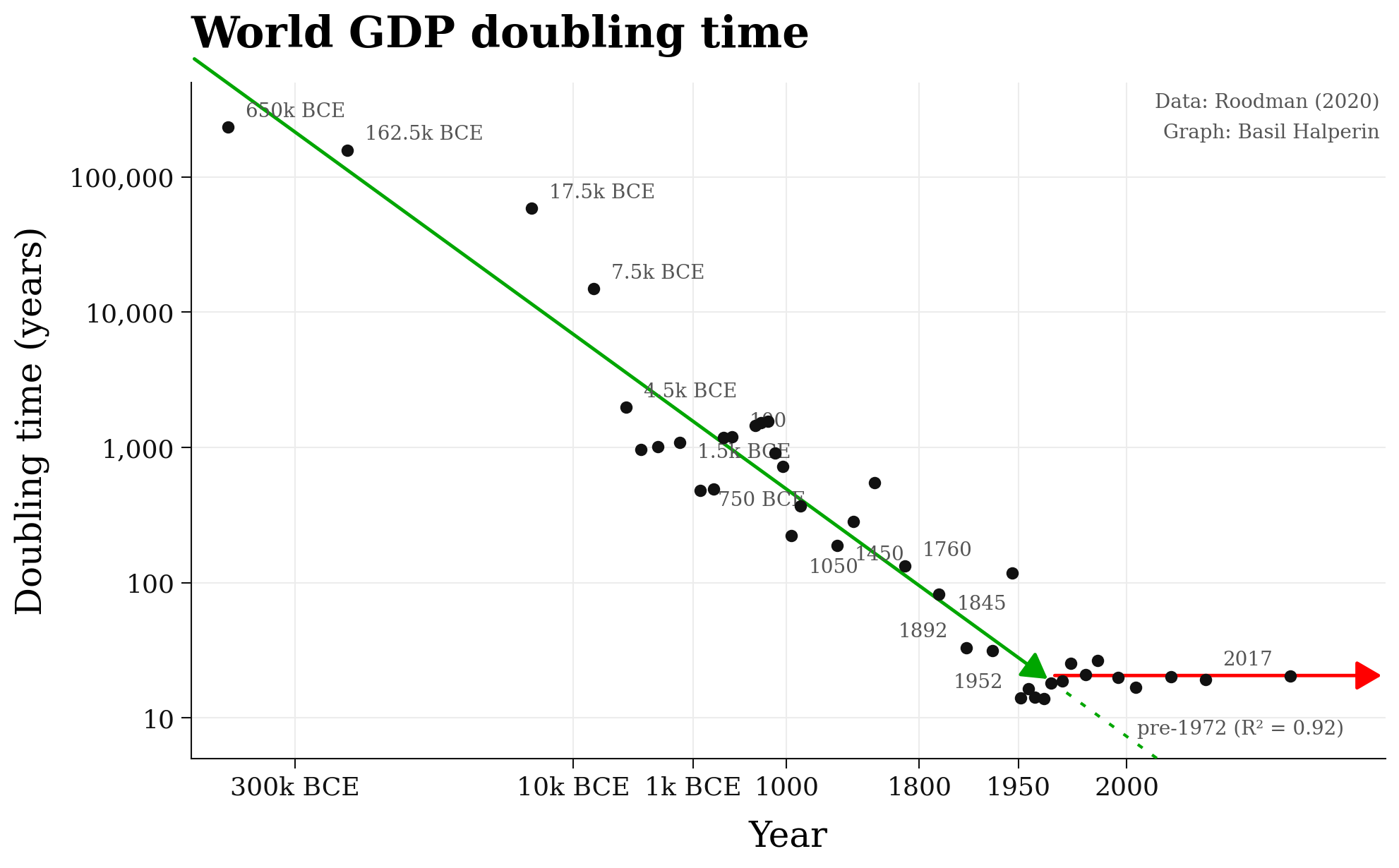
I would really like to repeat for the ones in the back - we used to be really poor before the industrial revolution.
And that the rate of growth is increasing. I see so much anti-AI sentiment here and it's very appalling because atleast technologically competent people should realize how big of a deal engineering is. STEM is accelerating yet again, and I hope the results are felt soon across the world. I hope to see a decrease in absolute poverty all around the world. Actually a lot of these guys are selfish tbh - caring about their first world cushy programming jobs and thus defending the current status quo. No different from billionaires tbh. If anything guys like Amodei or Huang are the ones leading the progress here.
"But what about my job!" has been the refrain of the selfish and unimaginative preventing progress that benefits billions throughout history. It's the most parochial thinking possible. Thank god we never listen to those people or we'd still be out here smashing rocks together.
Look forward to explaining to my children that can't afford housing, can't find a job and are living through a worsening climate crisis that it's OK because we've made "progress".
> I hope the results are felt soon across the world.
Yes, oligarchs will feel their pockets overflowing. > Actually a lot of these guys are selfish tbh - caring about their first world cushy programming jobs and thus defending the current status quo. No different from billionaires tbh. If anything guys like Amodei or Huang are the ones leading the progress here. Progress towards what? The Industrial Revolution raised the living standards of the working masses because there was room to extract more resources from the environment. There was a hiccup in employment, but lost jobs were eventually replaced by new ones that allowed for even greater resource extraction. A crucial role was also played by socialist/communist movements, which forced capitalists to become more competitive in terms of wages. Neither of these conditions holds today. We are already overextracting, so any projected productivity gains will come at the expense of further deterioration of the planet we are still bound to. And there is also no real social movement that would force capitalists to transfer part of the productivity gains to working people. That last part is already a dire reality. See [1] (also posted recently on HN) citing: "We've already seen a substantial reduction in the share of national income going to workers." I.e. the GDP per capita which is the focus of TFA is just an average, and its increase does not translate to an equitable increase of the income of workers. So, anyone drawing parallels between the Industrial Revolution and a potential upcoming AI Revolution, is up to for a rude awakening. The "cushy programming jobs" are just the canaries in the coal mine in this case. If the workers who enabled the AI revolution are excluded from its fruits, it begs the question of how the rest of the workforce will benefit. [1] https://paulkrugman.substack.com/p/pop-goes-the-bubble
I don't think the Industrial Revolution primarily raised living standards by increasing extraction. The main thing it did was to increase productivity.
There's a difference between those two things. Extraction is just getting more stuff because you increase inputs. Productivity is getting more stuff just because.
Increased productivity directly led to increased extraction because more work could be done across the entire workforce and there were new industries and technologies that would consume the added extracted goods, it snowballed.
The increase of living standards being driven by more extraction makes sense to me. Can you explain why you don't agree? It seems logical - if you just increase productivity without upping the scale, you put a lot of people out of their jobs because you don't need them all to do the same amount of work you were doing. Which is what happened in the Industrial Revolution, and only after many years, after the rate of extraction and byproducts of industrialization caught up and demanded more work, did the positive trend really start growing.
> I hope to see a decrease in absolute poverty all around the world. > Actually a lot of these guys are selfish tbh - caring about their first world cushy programming jobs and thus defending the current status quo. No different from billionaires tbh. If anything guys like Amodei or Huang are the ones leading the progress here. Do you honestly think that with our current trajectory we are on course for decreasing absolute poverty around the world? and that "Amodei or Huang are the ones leading the progress here"? Can you join the dots for me here, I'm struggling to understand your line of reasoning. How does the increase of AI lead to decreased poverty around the world?
The increasing availability of cheap middling(even, in the worst case) intelligence will decrease by orders of magnitude the cost of the immaterial services and goods provided.
On the topic of material goods, it's already making headway into CAD and PCB/IC design again increasing productivity by 2-3x. And that's not including the compounding gains automating the software already did. Add to that pile the new STEM stuff made accessible by AI and we could indeed see material goods getting cheaper by an order of magnitude. This is huge. Like one area I'm especially interested in is pharmaceuticals and the pathology industries. So yea, life is good. PS - Don't bring up stuff like the "cost of living" and stuff. I'm more concerned about the rest of the world excluding NA/EU. Y'all already live rich enough lives. PPS - If you want a concrete example - if the adoption of LLMs makes a chemical plant 2x efficient due to future cheap robots driven by VLAs that amortize over say a decade in say India. Then the entire world benefits, including the poorest regions of the world. Like I said, not everybody is fortunate enough to care about cars or houses in some first world country. This is what I consider more important as an engineer.
> Add to that pile the new STEM stuff made accessible by AI and we could indeed see material goods getting cheaper by an order of magnitude.
> Like one area I'm especially interested in is pharmaceuticals and the pathology industries. What keeps prices high in these industries is patents and possibly monopolies, not the lack of AI or technologies. AI won't help.
Where's the burden of proof on that question? Historically absolute poverty all the world over has been decreasing. It can be hard to see because year to year it seems nothing changes but imagine you have a choice between living in the poorest country in the world today vs. 500 years ago? Or 100 years ago? Or 50?
At some point (1 year ago? 10 years ago?) you'd rightly say it's a wash or even that you'd be better off in the past but it's going to be a small window. On a larger time scale everyone would say the present. Does AI contribute to that or take away from it? I tend to think it enables that growth but honestly, ask me in 10 years? Or 20 years. If it doesn't though most people aren't even going to remember what an AI is.
Comments (99) 20 threads
Show all comments
Showing thread 16 of 20
And that the rate of growth is increasing. I see so much anti-AI sentiment here and it's very appalling because atleast technologically competent people should realize how big of a deal engineering is.
STEM is accelerating yet again, and I hope the results are felt soon across the world. I hope to see a decrease in absolute poverty all around the world.
Actually a lot of these guys are selfish tbh - caring about their first world cushy programming jobs and thus defending the current status quo. No different from billionaires tbh. If anything guys like Amodei or Huang are the ones leading the progress here.
Continue this thread — 1 reply
Yes, oligarchs will feel their pockets overflowing.
> Actually a lot of these guys are selfish tbh - caring about their first world cushy programming jobs and thus defending the current status quo. No different from billionaires tbh. If anything guys like Amodei or Huang are the ones leading the progress here.
Progress towards what? The Industrial Revolution raised the living standards of the working masses because there was room to extract more resources from the environment. There was a hiccup in employment, but lost jobs were eventually replaced by new ones that allowed for even greater resource extraction. A crucial role was also played by socialist/communist movements, which forced capitalists to become more competitive in terms of wages.
Neither of these conditions holds today. We are already overextracting, so any projected productivity gains will come at the expense of further deterioration of the planet we are still bound to. And there is also no real social movement that would force capitalists to transfer part of the productivity gains to working people.
That last part is already a dire reality. See [1] (also posted recently on HN) citing: "We've already seen a substantial reduction in the share of national income going to workers." I.e. the GDP per capita which is the focus of TFA is just an average, and its increase does not translate to an equitable increase of the income of workers.
So, anyone drawing parallels between the Industrial Revolution and a potential upcoming AI Revolution, is up to for a rude awakening. The "cushy programming jobs" are just the canaries in the coal mine in this case. If the workers who enabled the AI revolution are excluded from its fruits, it begs the question of how the rest of the workforce will benefit.
[1] https://paulkrugman.substack.com/p/pop-goes-the-bubble
There's a difference between those two things. Extraction is just getting more stuff because you increase inputs. Productivity is getting more stuff just because.
The increase of living standards being driven by more extraction makes sense to me. Can you explain why you don't agree? It seems logical - if you just increase productivity without upping the scale, you put a lot of people out of their jobs because you don't need them all to do the same amount of work you were doing. Which is what happened in the Industrial Revolution, and only after many years, after the rate of extraction and byproducts of industrialization caught up and demanded more work, did the positive trend really start growing.
> I hope to see a decrease in absolute poverty all around the world.
> Actually a lot of these guys are selfish tbh - caring about their first world cushy programming jobs and thus defending the current status quo. No different from billionaires tbh. If anything guys like Amodei or Huang are the ones leading the progress here.
Do you honestly think that with our current trajectory we are on course for decreasing absolute poverty around the world? and that "Amodei or Huang are the ones leading the progress here"?
Can you join the dots for me here, I'm struggling to understand your line of reasoning. How does the increase of AI lead to decreased poverty around the world?
On the topic of material goods, it's already making headway into CAD and PCB/IC design again increasing productivity by 2-3x. And that's not including the compounding gains automating the software already did.
Add to that pile the new STEM stuff made accessible by AI and we could indeed see material goods getting cheaper by an order of magnitude.
This is huge. Like one area I'm especially interested in is pharmaceuticals and the pathology industries. So yea, life is good.
PS - Don't bring up stuff like the "cost of living" and stuff. I'm more concerned about the rest of the world excluding NA/EU. Y'all already live rich enough lives.
PPS - If you want a concrete example - if the adoption of LLMs makes a chemical plant 2x efficient due to future cheap robots driven by VLAs that amortize over say a decade in say India. Then the entire world benefits, including the poorest regions of the world.
Like I said, not everybody is fortunate enough to care about cars or houses in some first world country. This is what I consider more important as an engineer.
> Like one area I'm especially interested in is pharmaceuticals and the pathology industries.
What keeps prices high in these industries is patents and possibly monopolies, not the lack of AI or technologies. AI won't help.
At some point (1 year ago? 10 years ago?) you'd rightly say it's a wash or even that you'd be better off in the past but it's going to be a small window. On a larger time scale everyone would say the present.
Does AI contribute to that or take away from it? I tend to think it enables that growth but honestly, ask me in 10 years? Or 20 years. If it doesn't though most people aren't even going to remember what an AI is.