Before my father qualified for Medicare he figured out this hack.
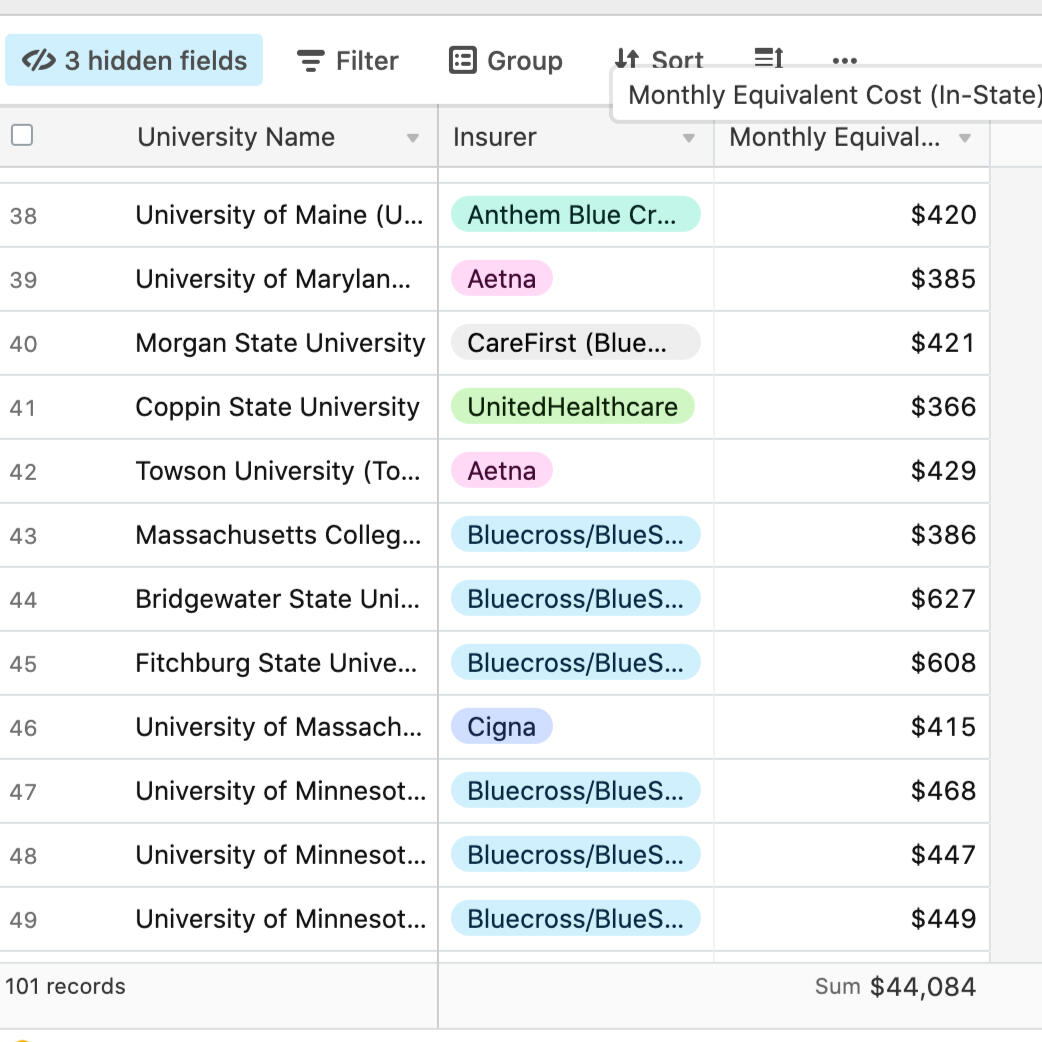
He has a severe chronic condition. Health insurance for him as a self employed person at the time was $4k/month Tuition at the local public college at the time came with a senior discount for folks in his age group and insurance for $10k/year. He loved the classes and saved a bundle on health insurance. He needed a life flight and weeks of hospitalization related to his chronic illness. The insurance had him covered. I think it was a non-trivial payout for the insurance company. The following year the insurance company changed the terms with the university to charge more if you didn’t live on campus. My father went to a different school with a different insurer after that. He’s finally on Medicare. We shouldn’t tie healthcare coverage to employment in our country. It’s stupidly expensive.
Tying health insurance to your employer is incredibly dumb. It means insurarers compete for your employers business, not yours, which influences their incentives. It means if you don't like your insurance company, your only option is to change jobs. It disincitives people from being self employed, because then health insurance is prohibitively expensive.
Let's say HR really does care about employees interests. It could be that they chose an insurance program that is best for 90% of employees, but is a terrible choice for you. HR is unlikely to change anything because of a few outliers.
Think about the state of the software rolled out for HR. i.e. speed, UX, cross platform support.
I think from that alone you can safely conclude that HR departments don’t or can’t deliver things that employees need. Employees are not the customers of HR departments and they won’t or can’t fix your health insurance.
No, it works exactly as it was designed. Health insurance keep s costing more, cover less and not care about helping people in the time of need. That is not an accident. It is a result of concentrated effort of lawyers, lobbyists, salesmen, etc... - a whole system that maximizes profits and market share at all costs, and not the quality, breadth and affordability of healthcare. It is like that by design. So the results are logical - we pay more and get less. And will continue paying more and getting even less. There will be a point in future when this approach will "meet its maker", the hope is that will happen sooner rather than later.
It's an efficient market. It's efficient at collecting money from customers who little or no choice, and at not providing those customers with a service - because providing a service costs money, which takes a cut out of profits.
This is what markets do. They amplify political and financial inequality. Anyone who thinks that competition will somehow magically fix this isn't paying attention to how markets actually work.
> Anyone who thinks that competition will somehow magically fix this isn't paying attention to how markets actually work.
If you allowed foreign doctors to come and practice in USA the problem would get fixed extremely quickly. Competition is the solution. The problem isn't the free market here, but that the incumbents gets to control legalization and hence stifle competition. I'm not sure why private money has so much more influence in USA than other western countries, but it is the main source of this problem.
we can both complain about the final outcome and disagree on how we got here. I think it's a stretch to call healthcare an efficient market. There are huge upfront and switching costs for almost every component making it rife with opportunities (intentional) and mistakes (mistakes) that erode efficiency. I also feel you conflate what markets can do with what their intent is. You seem to imply that markets have no role in a huge swath of our economy and lives, yet I look at my medical experiences in Canada (almost 100% public) and wonder if many people actually know how it works and what the outcomes look like. In a nutshell it's both harder to die and harder to get better under our system, and I think markets could help with the later without hurting the former.
You are conflating markets with meta-markets. The market for healthcare has been corrupted by activities outside of the market.
The market has been intentionally manipulated to set up little choice for individuals and even worse, little transparency on cost and benefits. Markets DO work, but you have to set them up to succeed. Customers need to be able to choose between providers, customers need to know what the full cost of healthcare is prior to committing, and customers need to be able to walk away or find an alternative if a price is unattractive.
As is not allowing interstate competition, and not requiring pricing to be published, and not paying rebates for seeking out less expensive treatments.
I'm my own employer, and the exchange choices are shitty beyond belief. I pay $15K/yr for a family of 3 (that's excluding the considerable deductibles), and I'm not even sure to what extent I will be covered if I e.g. break a leg. The premiums go up every year like clockwork, and will likely go _way_ up this year, due to C19. I'm thinking of just finding a clinic somewhere abroad if shit really hits the fan, and going without insurance in the US at all, covering my yearly physical out of pocket. It boggles the mind that politicians are proposing to sink trillions more into the bottomless money pit that is the US "healthcare" system.
I was paying about $1.5k / mo for a terrible plan for just a family of two in NC under ACA. The public risk pool is completely terrible and large corporate employers’ risk pools are separated from the general public and self employed.
More and more employers are now self insured. Making your employer your negotiate with healthcare providers directly for care. They might also us a TPA (third party administrator).
Thing is, your boss may know way more about your health than you’d expect. The entire system is broken.
In my experience, when I was unemployed, an ACA plan doesn't cost $4K or even $800. I'm not sure even COBRA was that expensive.
Perhaps your anecdote is from before the ACA, but is it really productive to still be complaining about the way things were? Maybe spend more time making sure we vote for people who will keep it going.
I have had an ACA plan during two separate periods of time over the last decade and it was on the order of $400/month, with no consideration of pre-existing conditions. I've also had the opportunity for COBRA, which was too expensive, but still under $800.
Depends on the state and plan. For me COBRA was $2000/mo. When employed I paid like $20/mo and my employer paid $1980/mo. When I left I paid the entire amount.
The plan you had was $2,000 (wow, that's really a lot though) and your employer was willing to pay $1,980 (again, that's a lot compared to employers I worked for) in addition to your salary.
Has the ACA caused prices to go down? I'm getting mixed messages about who has actually benefited, with "only insurers and people who were covered by the Medicare expansion actually benefited" being the impression that I get.
Whether prices have gone down may be of importance to society, but on a personal level, being able to pay is more germane. Before the ACA, when I was unemployed and not in school, I just wasn't insured. At this point though, that's kind of a long time ago.
Also, I think you may be confusing Medicare and Medicaid. I've never been covered under either.
Comments (283) 29 threads
Show all comments
Showing thread 1 of 29
He has a severe chronic condition.
Health insurance for him as a self employed person at the time was $4k/month
Tuition at the local public college at the time came with a senior discount for folks in his age group and insurance for $10k/year.
He loved the classes and saved a bundle on health insurance.
He needed a life flight and weeks of hospitalization related to his chronic illness. The insurance had him covered. I think it was a non-trivial payout for the insurance company.
The following year the insurance company changed the terms with the university to charge more if you didn’t live on campus.
My father went to a different school with a different insurer after that.
He’s finally on Medicare.
We shouldn’t tie healthcare coverage to employment in our country.
It’s stupidly expensive.
Continue this thread — 1 reply
Continue this thread — 9 replies
It's a huge chilling effect on employee turnover. Until ACA pre-existing conditions was a huge aspect of that. Even now IIRC when I changed jobs once I recall any existing conditions would not be covered for 1 month.
And it's the biggest cost increase over the past 2 decades and has soaked up almost all the profits that could have gone to employee salaries.
https://www.pewresearch.org/fact-tank/2018/08/07/for-most-us...
https://www.healthsystemtracker.org/chart-collection/u-s-spe...
Continue this thread — 1 reply
Well, a bit less effective, but sometimes works, you can also complain to HR about the insurance.
I think from that alone you can safely conclude that HR departments don’t or can’t deliver things that employees need.
Employees are not the customers of HR departments and they won’t or can’t fix your health insurance.
This is what markets do. They amplify political and financial inequality.
Anyone who thinks that competition will somehow magically fix this isn't paying attention to how markets actually work.
If you allowed foreign doctors to come and practice in USA the problem would get fixed extremely quickly. Competition is the solution. The problem isn't the free market here, but that the incumbents gets to control legalization and hence stifle competition. I'm not sure why private money has so much more influence in USA than other western countries, but it is the main source of this problem.
Continue this thread — 4 replies
The market has been intentionally manipulated to set up little choice for individuals and even worse, little transparency on cost and benefits.
Markets DO work, but you have to set them up to succeed. Customers need to be able to choose between providers, customers need to know what the full cost of healthcare is prior to committing, and customers need to be able to walk away or find an alternative if a price is unattractive.
Continue this thread — 2 replies
Continue this thread — 6 replies
I'm my own employer, and the exchange choices are shitty beyond belief. I pay $15K/yr for a family of 3 (that's excluding the considerable deductibles), and I'm not even sure to what extent I will be covered if I e.g. break a leg. The premiums go up every year like clockwork, and will likely go _way_ up this year, due to C19.
I'm thinking of just finding a clinic somewhere abroad if shit really hits the fan, and going without insurance in the US at all, covering my yearly physical out of pocket. It boggles the mind that politicians are proposing to sink trillions more into the bottomless money pit that is the US "healthcare" system.
Thing is, your boss may know way more about your health than you’d expect.
The entire system is broken.
Perhaps your anecdote is from before the ACA, but is it really productive to still be complaining about the way things were? Maybe spend more time making sure we vote for people who will keep it going.
COBRA is just regular health insurance.
Where do you get your "information"?
Continue this thread — 3 replies
https://www.hhs.gov/healthcare/about-the-aca/pre-existing-co...
The plan you had was $2,000 (wow, that's really a lot though) and your employer was willing to pay $1,980 (again, that's a lot compared to employers I worked for) in addition to your salary.
Also, I think you may be confusing Medicare and Medicaid. I've never been covered under either.
Continue this thread — 1 reply
Continue this thread — 2 more replies
Continue this thread — 2 more replies