This comes to my attention at a really convenient time. As a teenager, I initially got interested in Computer Science due to cryptography. Over a decade later, I've gotten into the subject for the first time since then.
For the last few days, I've been writing my own encryption for fun even though it's 100% not secure enough or powerful. My belief is that even though it's not super useful, the experience of attempting to write one is teaching me a lot more than I would have by simply studying it.
Rather than write crypto, what I'd actually recommend is to break it. Schneier put together a block cipher cryptanalysis course a long time ago and while I don't usually recommend his crypto books these days, the course is good: https://www.schneier.com/academic/archives/2000/01/self-stud... (in this case, his crypto book might actually be useful, because it documents some of these out of date ciphers. There's (was?) a mistake in the DES code though iirc).
It is essentially a tour of all the early cryptanalysis literature, complete with suggestions of ciphers to target (e.g. FEAL). This will give you a sense of how the attacks work. Many of the ciphers are old, but I wouldn't let that put you off. The study technique for this would be a) implement each cipher with toggles to control rounds and any other features, then implement attacks. Most of the papers should be open access by now since the 'course' was written in the year 2000. You could also 'catch up' on the constructions and attacks that have come out since. I would caveat this with: what I am advising is purely for potential interest. Bear in mind there is little need to implement new block ciphers these days (what I'm saying is: this is a very specialized skill and most people won't find jobs in it).
How long before we see this website as the source for some "hacker sequence" in a movie where a person wearing a black hoodie states they are "... working on cracking their SHA-256 encryption, should only take a sec."
Syntax-highlighted ALGOL-y code blocks seem to be back in style if they're not going with the constant "toss that screen up to a hologram" bit.
Sometime there will be a nice interview of such on the design that goes into that, not necessarily for "hacker sequences" but general imaginary computer interfaces like https://www.hudsandguis.com/home/2021/theexpanse .
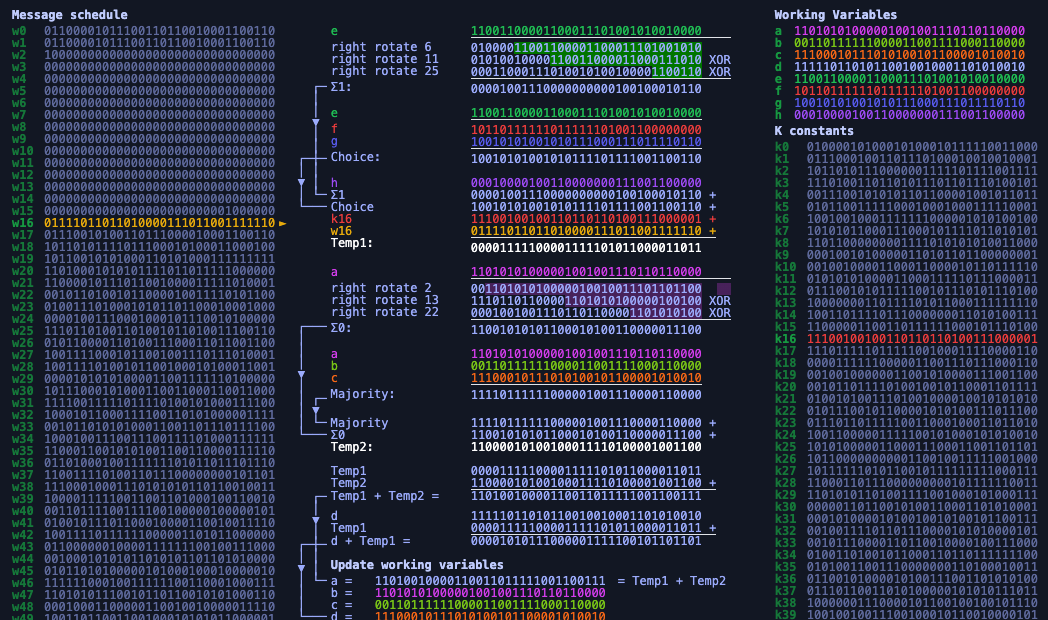
This is fantastic. I once implemented SHA-256 in Google Sheets to visualize it, but it had horrible performance compared to this. This is the best visualization I've seen yet.
Comments (137) 40 threads
Earlier commentsFor the last few days, I've been writing my own encryption for fun even though it's 100% not secure enough or powerful. My belief is that even though it's not super useful, the experience of attempting to write one is teaching me a lot more than I would have by simply studying it.
It is essentially a tour of all the early cryptanalysis literature, complete with suggestions of ciphers to target (e.g. FEAL). This will give you a sense of how the attacks work. Many of the ciphers are old, but I wouldn't let that put you off.
The study technique for this would be a) implement each cipher with toggles to control rounds and any other features, then implement attacks. Most of the papers should be open access by now since the 'course' was written in the year 2000. You could also 'catch up' on the constructions and attacks that have come out since.
I would caveat this with: what I am advising is purely for potential interest. Bear in mind there is little need to implement new block ciphers these days (what I'm saying is: this is a very specialized skill and most people won't find jobs in it).
"Just a second, I need to backdoor the SHA256 rootkit to penetrate the directory. Shit, they have an X62 firewall. Luckily I brought my pentester."
Sometime there will be a nice interview of such on the design that goes into that, not necessarily for "hacker sequences" but general imaginary computer interfaces like https://www.hudsandguis.com/home/2021/theexpanse .
All comments shown.
Couldn't load more comments. Check your connection and try again.