It's already dead. Google mined all the links that were curated by the initial internet communities for all it was worth and turned them into profits for Google's earliest employees and shareholders. Now that no one is curating useful links anymore their search quality, unsurprisingly, is deteriorating. Without human curation there is no signal for Google to use anymore and whatever signal is there is just SEO spam that is optimized for serving ads. It's like an ouroboros eating its own tail.
Wonder how we could set up an alt-web without the incentives that cause this problem. Delist any for-profit site? How would the sites keep the lights on without ads?
There’s no better solution - you either have ads or a paywall, which will result in few users.
If there were a better solution we’d all already be using it. Certainly you can rely on savvy people to produce free stuff, but the total amount of content will be drastically lower and therefore fewer consumers. The best thing is to just use bookmarks and your favorite sites’ own search. There’s just too much trash on the net
People could certainly run hand-curated indexes and search engines seeded by such. I think marginalia.nu search behaves somewhat like that.
I'm really interested in the idea of decentralized search where everyone has the power to choose for themselves who to trust. > How would the sites keep the lights on without ads? Making them turn off the lights is the goal. Good riddance I say, once we get there.
> Making them turn off the lights is the goal. Good riddance I say, once we get there.
I wish there was some middle ground. Think of all the useful Youtube videos showing how to play an instrument, do woodworking projects, fix cars... there is a vast amount of knowledge there. Maybe YT should be nationalized :-)
Federation is the only reasonable solution at this time but the technical overhead of federated search is high enough that most people won't use it so it won't benefit from network effects like Google did in the beginning. There might be a combination of blockchain juju that could make federation viable but all the thought leaders in that ecosystem are too high on their own supply to realize they could use blockchains for anything other than gambling.
To me it's more a sociological problem than technological. Also networks have changed.. somehow the decentralization idea is spreading fast. For ideological, technical, cost .. or other reasons. Some people start neighborhood wireless networks etc.
It also seems to me that internet has somehow became a middle man and is not providing human deep enough interactions, especially outside chat-like website (basically any exchange, business).. I could envision a whatsapp like system with quality control for producers and transparent transaction/tracking/accounting management offered by the network so people spend less time on side-loads and just focus into helping each others and doing what they need to.
It's a new internet protocol (NOT www) designed to be minimalist and interesting to hobbyists. > How would the sites keep the lights on without ads? The same way they did in the web 1.0 days - somebody would maintain the server themselves, or pay to have it maintained. Discussion: https://news.ycombinator.com/item?id=30072085
I honestly don't think this is the problem, like at all. There are human websites made by humans, still. There's more crap, sure, but the good stuff is largely still out there.
The problem begins and ends with the conflict of interest that Google both sells ads and selects search results. If they didn't have a vested interest in people visiting sites with their ads on them, they could decimate the number of spam results.
Which websites are shown in the search results is not influenced by whether Google has ads on them.
The only thing that influences Google search results is Google's desire to keep as many people using Search as often as possible, since nearly all of Google's money comes from showing those text ads at the top of the Search results. This is all public information, you can read it in the 10K etc. So if Search sucks, it's not because Google has the wrong incentives but because they can't solve the problems Search faces.
Hard to proof this but anecdotally lots of energy that used to go into people's hobby or passion websites now is going into digital platforms like reddit, pinterest or Twitter, or if lucky substack or Medium. Some of those are walled gardens and Reddit as discussed here is where people now search. Much less out on the actual net
Well, since I actually run a search engine looking for this sort of stuff, I think I'm able to demonstrate that a lot of what was out on the net is still there, just exceptionally hard to find on Google.
This sounds almost like Goodhart's Law: "When a measure becomes a target, it ceases to be a good measure."
Google made links on the web the measure of how good a page was. That became the target of everyone trying to do SEO. As a result, it stopped being a good measure of how good a page was. But in the long run, nothing will work in that environment, because every measure will be gamed as soon as people figure out that Google is using it. Google's only choice is to try to stay ahead of the SEO crowd, and I'm not sure they can do that (well) for too much longer. In fact, if the article is to be believed, they're already starting to fail.
Yes, it's very similar with the added caveat that Google has an interest in serving results that have ads from their own network. This is why Google's metrics can be hacked. Anything that is barely above being classified as spam but serves ads from Google's ad network will be prioritized over other results simply because they have to hit their quarterly revenue targets. SEO hacking is not possible if a search engine is just a search engine but Google is also an ad network so they will always be susceptible to being gamed.
This is also the case for social media platforms. They're incentivized to surface content that generates engagement and ad revenue. Basically ads are at the root of all problems when it comes to the internet and the content on it.
> SEO hacking is not possible if a search engine is just a search engine
Uh, yes it is. If the owner of the site being searched is generating profit from that site being searched then they will game the search engine's algorithm to get them the most clicks.
Here and further down this thread you repeatedly allege Google upranks pages if they participate in their ads program. Google explicitly says they do not do this [1]. Do you have evidence to contradict this?
It’s not just the links. After the links, google mined facts, like “how much does a german shepherd weigh,” so no on gets those clicks, and the incentive is gone there too. They’re even mining the snippets of the content, lowering the incentives for creating that too.
It's essentially a machine for printing money and people don't really understand what they're giving up in exchange for "free" search results. Google is beholden to market forces, it's no longer in the business of indexing useful information because the market doesn't value useful information, it values ad revenue.
This is a structural problem and anything that gets large enough will succumb to the same forces. If the incentives are for optimizing ad revenue then that's what all corporate machines will do at scale, regardless of their initial motives and incentive structure. It doesn't help that Google is also an ad network, hence the ouroboros aspect.
You say it's a machine for printing money in a topic about people complaining that it doesn't work any more. It may have been but it won't be forever if things keep going the way they're going. Quality content is already being locked away.
We're in agreement. I don't think quarterly earnings are the right way to design and build products. Maximizing profits is not correlated with value and is often inversely proportional to it. Google was so successful that they changed the incentive structure of all content on the web. Now they're like the yeast drowning in the byproducts of their own metabolic processes. They exploited whatever nutrients were available (hand curated links) to make them initially successful and now there is no more worthwhile content being generated that is not designed to rank highly on Google (which is not the same thing as quality content and is instead content optimized for generating ad revenue from the Google ad network).
It's the same with social networks, upvotes and likes skew the the type of content that is generated to be liked by the people liking and upvoting instead of being insightful. Popularity is not the same thing as insight so the social web is full of mostly useless but popular content.
Well, if it makes you lads feel any better, we're not the only ones who feel this way
Paul Graham has been pushing for someone to disrupt web search on and off for at least the last 10 years: http://paulgraham.com/ambitious.html (he tweeted about it more recently, but I couldn't dig it up since I'm not much of a tweet man)
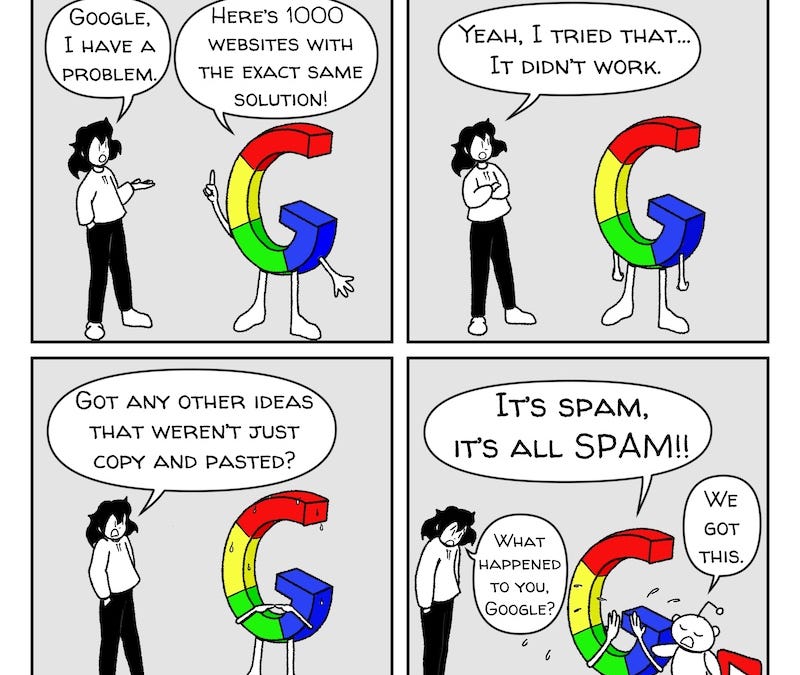
Comments (1,561) 373 threads
Show all comments
Showing thread 7 of 373
If there were a better solution we’d all already be using it. Certainly you can rely on savvy people to produce free stuff, but the total amount of content will be drastically lower and therefore fewer consumers.
The best thing is to just use bookmarks and your favorite sites’ own search.
There’s just too much trash on the net
I'm really interested in the idea of decentralized search where everyone has the power to choose for themselves who to trust.
> How would the sites keep the lights on without ads?
Making them turn off the lights is the goal. Good riddance I say, once we get there.
I wish there was some middle ground. Think of all the useful Youtube videos showing how to play an instrument, do woodworking projects, fix cars... there is a vast amount of knowledge there. Maybe YT should be nationalized :-)
Continue this thread — 1 reply
Do you think there's a lot of good content out there left to index?
Continue this thread — 3 replies
It also seems to me that internet has somehow became a middle man and is not providing human deep enough interactions, especially outside chat-like website (basically any exchange, business)..
I could envision a whatsapp like system with quality control for producers and transparent transaction/tracking/accounting management offered by the network so people spend less time on side-loads and just focus into helping each others and doing what they need to.
It's a new internet protocol (NOT www) designed to be minimalist and interesting to hobbyists.
> How would the sites keep the lights on without ads?
The same way they did in the web 1.0 days - somebody would maintain the server themselves, or pay to have it maintained.
Discussion: https://news.ycombinator.com/item?id=30072085
The problem begins and ends with the conflict of interest that Google both sells ads and selects search results. If they didn't have a vested interest in people visiting sites with their ads on them, they could decimate the number of spam results.
https://simplifier.neocities.org/
https://cheapskatesguide.org/
https://indieseek.xyz/
https://www.gameboomers.com/
https://sadgrl.online/
Continue this thread — 10 replies
The only thing that influences Google search results is Google's desire to keep as many people using Search as often as possible, since nearly all of Google's money comes from showing those text ads at the top of the Search results. This is all public information, you can read it in the 10K etc.
So if Search sucks, it's not because Google has the wrong incentives but because they can't solve the problems Search faces.
Admittedly more in some areas than others.
Continue this thread — 2 replies
Google made links on the web the measure of how good a page was. That became the target of everyone trying to do SEO. As a result, it stopped being a good measure of how good a page was.
But in the long run, nothing will work in that environment, because every measure will be gamed as soon as people figure out that Google is using it. Google's only choice is to try to stay ahead of the SEO crowd, and I'm not sure they can do that (well) for too much longer. In fact, if the article is to be believed, they're already starting to fail.
This is also the case for social media platforms. They're incentivized to surface content that generates engagement and ad revenue. Basically ads are at the root of all problems when it comes to the internet and the content on it.
Uh, yes it is. If the owner of the site being searched is generating profit from that site being searched then they will game the search engine's algorithm to get them the most clicks.
Continue this thread — 6 replies
[1] - https://support.google.com/adsense/answer/9717?hl=en
Continue this thread — 3 replies
This is a structural problem and anything that gets large enough will succumb to the same forces. If the incentives are for optimizing ad revenue then that's what all corporate machines will do at scale, regardless of their initial motives and incentive structure. It doesn't help that Google is also an ad network, hence the ouroboros aspect.
It's the same with social networks, upvotes and likes skew the the type of content that is generated to be liked by the people liking and upvoting instead of being insightful. Popularity is not the same thing as insight so the social web is full of mostly useless but popular content.
Paul Graham has been pushing for someone to disrupt web search on and off for at least the last 10 years: http://paulgraham.com/ambitious.html
(he tweeted about it more recently, but I couldn't dig it up since I'm not much of a tweet man)