Show HN: I built an app for when I talk too much in online meetings (opens in a new tab)unblah.me
451 pointsAlexis here, I’m a product manager and software developer in Berlin by way of New York.
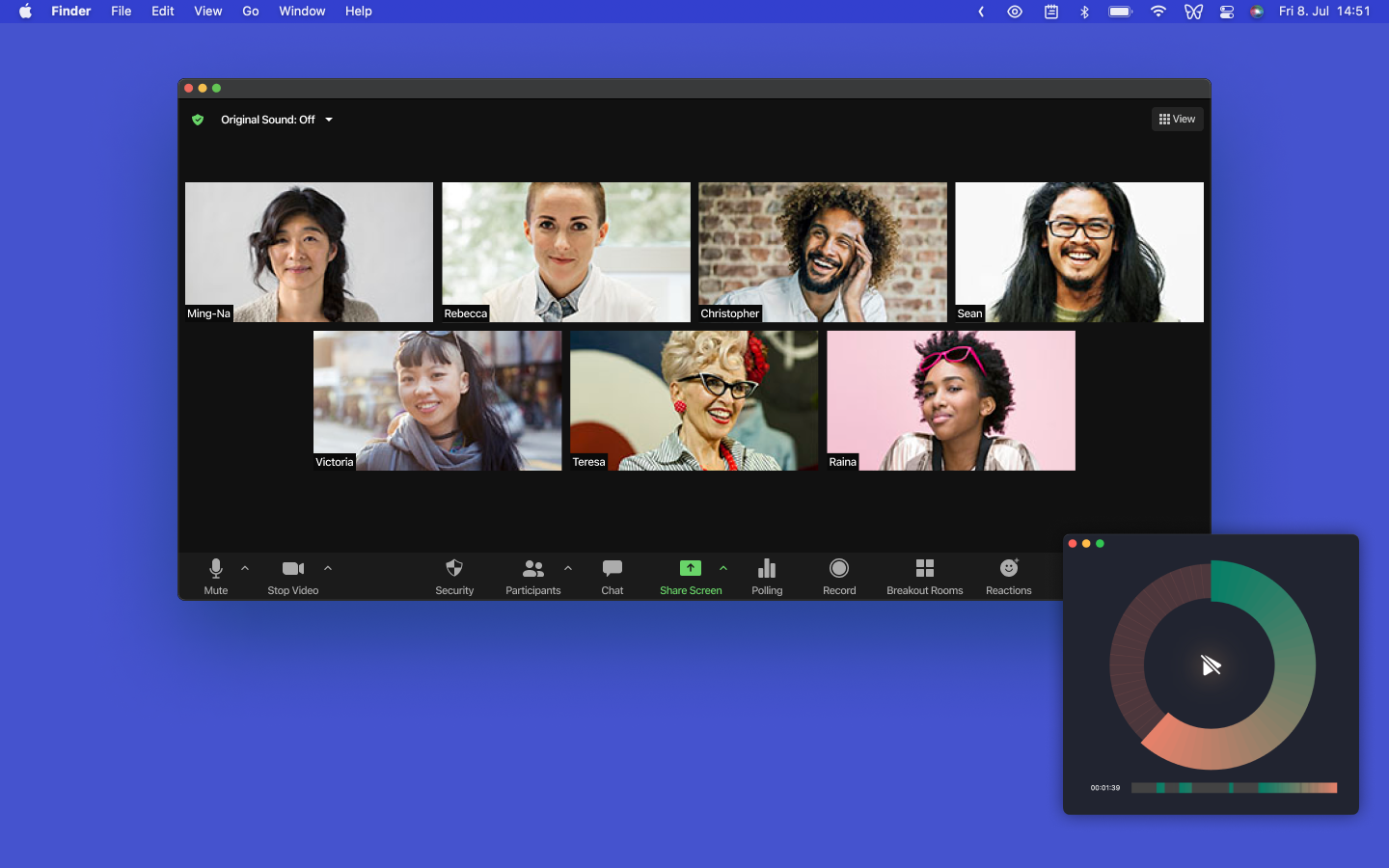
I want to show you this app I made – It’s like a "buddy" for those, like myself, who inadvertedly talk too much in meetings.
The app gives me feedback and a little more in control of what I have influence over by:
* Keeping track of how long I’ve been speaking
* Catching myself before I talk too much
* Developing a better sense of timing
I truly love having conversations with people in real-life.
But online meetings, especially group calls, tend to make me nervous. I can't read body language. The tone of voice, micro-experessions and social cues get lost.
If you, too, accidentally talk too much too often, check it out "Unblah". Watch the quick 2-minute demo and download the macOS app over at https://unblah.me/.
Cheers!
Alexis
PS: There’s a whole FAQ section for common questions you may have – Including if this is yet another "native" Electron app ;)
edit: bullet-list formatting
Comments (189) 56 threads
Show all comments
Showing thread 5 of 56
For everyone here who's asking how to get their coworkers using something like this, there's a similar feature in Sesh (web app https://sesh.com/ and zoom app https://marketplace.zoom.us/apps/lmZj36WWSJut8-hAaUJrhQ ) that gives everyone equal opportunities to speak (and plays you off oscars-style when you go too long), and another feature called "talk time" that shows how long each person spent talking at the end of each meeting.
At it's core, it's a really useful meeting agenda app, so sharing it is less "hey you talk too much" and more "let's make our meetings better and more equitable".
I work there & am happy to demo or answer any questions about it :)
Again, really love that you made a version of this that individuals can spin up for their own accountability without the need for whole-team buy in. The design is great too!
https://www.indy100.com/news/victorias-secret-model-lyndsey-...
https://www.fastcompany.com/40456604/these-women-entrepreneu...
https://hbr.org/1995/09/the-power-of-talk-who-gets-heard-and...
https://janicetomich.com/women-speaking-while-female/
https://time.com/3666135/sheryl-sandberg-talking-while-femal...
Hopefully it will raise awareness and those men who support equality in the workplace and more importantly, see the value of women’s ideas - ideas that they perhaps do not hear because they are not giving time for them to speak them- will benefit.
To be more specific, I am also afraid of over-indexing on inclusion. Do I call on female coworkers more often to speak up in areas where I know they are experts because I know they may not do so themselves? Is that fair to them? Does it make them feel inadequate or is it appreciated or does it not even register? If I ask Susan to elaborate on a sprint update but don't ask Frank does that signal that I don't trust Susan? What if I am really just interested in her task?
I know the cliches about confident white men in tech. Talking over people, the white savior, etc. But, as a confident white man in tech I need input from everyone to be better. So, thanks for sharing.
Continue this thread — 2 replies
It was hilarious when he was told by the moderator that no, Jo had used the least time. She’d make a good point, then stop talking. No bloviating like the men.
As a long timer man in tech, being a shy and private person and being uncomfortable speaking in public, I've experienced the same exact things listed in those articles for as long as I can remember, except having to fake a business partner cause I've never participated in a round of funding, but I'd probably hire one if I needed to. Because it would work better than sending myself.
I've learned that those aren't my strongest skills and that's OK, I've become a very good writer instead, because it's something I like and I feel comfortable doing. to the point that people now ask me to help them or plainly ask me if they can pay me to write for them (notice that if you think my writing is mediocre it's because it's true: English is not my native language and foreign languages are another of those "not my strongest skills", I'm much better with programming languages)
Sometimes things are as they are because we are as we are.
I also think there's a cultural aspect to the phenomenon, in some countries, especially in USA, people are pressured to talk in public and express "dominance" or "confidence" by taking the stand.
Fake until you make it they usually say.
In my case it only made me feel more of an impostor, who was faking skills he did not have.
But.
Quiet men in tech who are tempted to this line of thinking - that they too have problems with being talked over, that they too don't get noticed for promotions because they aren't the voice people remember hearing...
Please consider that the avenues that are open to you as a man in this industry to overcome those difficulties might not be as available to a woman in the same position. Women are more likely to find themselves in that position, because they have been in situations in the past where speaking up has led to negative reactions, where being opinionated has been dismissed as being bossy, etc. - those constraints are not the same ones you have faced. Your solutions may not work.
You owe it to your female colleagues, when they say 'we find we tend to face these particular problems in ways that we see men tend not to', not to dismiss that as 'well, I'm pretty sure some men have the same issue'. Their experience is relevant. You will learn by listening to what they have to say.
As you rightly recognize, we all have or lack different privileges. As a non-native English speaker doubtless you have encountered challenges I haven't, and indeed that native English speaking women don't face.
But this dismissal of a raft of worthwhile sources for a well documented problem that many women actually experience as 'of dubious general value' is disingenuous.
Non a reaction, just an informed opinion from a man who's been working in tech for the past 27 years and is old enough to understand that the more you age the more you learn how to react to things that you're sensitive to.
> But this dismissal of a raft of worthwhile sources for a well documented problemFor example being interrupted, some people, like me, do not mind at all.
I used to, now I don't care, I know people younger than me (men and women) feel the urge to make themselves noticed in the workplace, but I'm there as a well paid senior consultant, if they do not want to listen or want to engage in endless discussions over minutia or just to show off what they know, it's their problem. I let them do it also because it's a way to teach them that the more we go off rails or talk over each other, the more the meeting is gonna last. And they will have less time to do the actual job they are paid to do.
Don't like long meetings? (who does?) Don't interrupt and don't go overboard. It's gonna be over much sooner.
And anyway: speak up, if you don't want to participate or think that you have better things to do or don't particularly like that person's temper, say it, using a bit of diplomacy.
If the people paid to solve these problems won't listen, you know you're in the wrong place.
> - that they too have problems with being talked
That's my point.
People talking over other people are not doing it because they are men, there's no such DNA trait in men, their brain is no different in any way for being men.
What is lacking, in my opinion, in those articles is data.
We don't know who these people are, we don't know if it's higher ranking talking over subordinate, the opposite, or it's random, we don't know if it's always the same people doing it or it's only men when there are women present, otherwise the meeting goes butter smooth.
We simply don't know anything more than a spurious correlation: they are men, it must be a men's thing.
As a man I can testimony that no, not every man talks over other men, in fact it is quite the opposite, some of them do, most of them don't.
It's also kinda obvious that in a male dominated work sector you'll encounter more men interrupting than women, if we go in a female sector (like education), I guess the results would be different.
It could simply be that they are American, for what we know.
I too had issues communicating and working with USA people in startup environments, man or woman it did not make any difference.
> Please consider that the avenues that are open to you as a man in this industry to overcome those difficulties might not be as available to a woman in the same position.
Sorry, but that's a non sequitur.
You can't possibly know what I've been through, nobody really knows what others have been through, it doesn't follow that we shouldn't use common sense because somebody had a bad experience in the past. We all had them (mostly) but in the workplace one has to assume to be surrounded by functioning adults that can handle themselves.
> those constraints are not the same ones you have faced. Your solutions may not work.
Exactly, how do you know that?
Because in my past speaking up has led to negative reactions and still of today for some people my being opinionated is dismissed as being bossy
It isn't traumatizing if you believe in what you say, just frustrating at times.
But there are other ways to prove yourself other than having a fight in a meeting.
Not taking it personally helped me a lot to deal with these situations, it's one person talking only to (of) the worker me that is not the whole me and not even the most important part of me.
Even the Bible says something like (not exact words)
I'm not dismissing the work this person has done, I'm saying it's of no great general value, because the sources are lacking the necessary data to draw a conclusion.
As someone who'd rather not speak I dislike this. Now I can't just sit back, relax, and let the talkative people run out the clock. There's now a metric to punish my quietness. :P