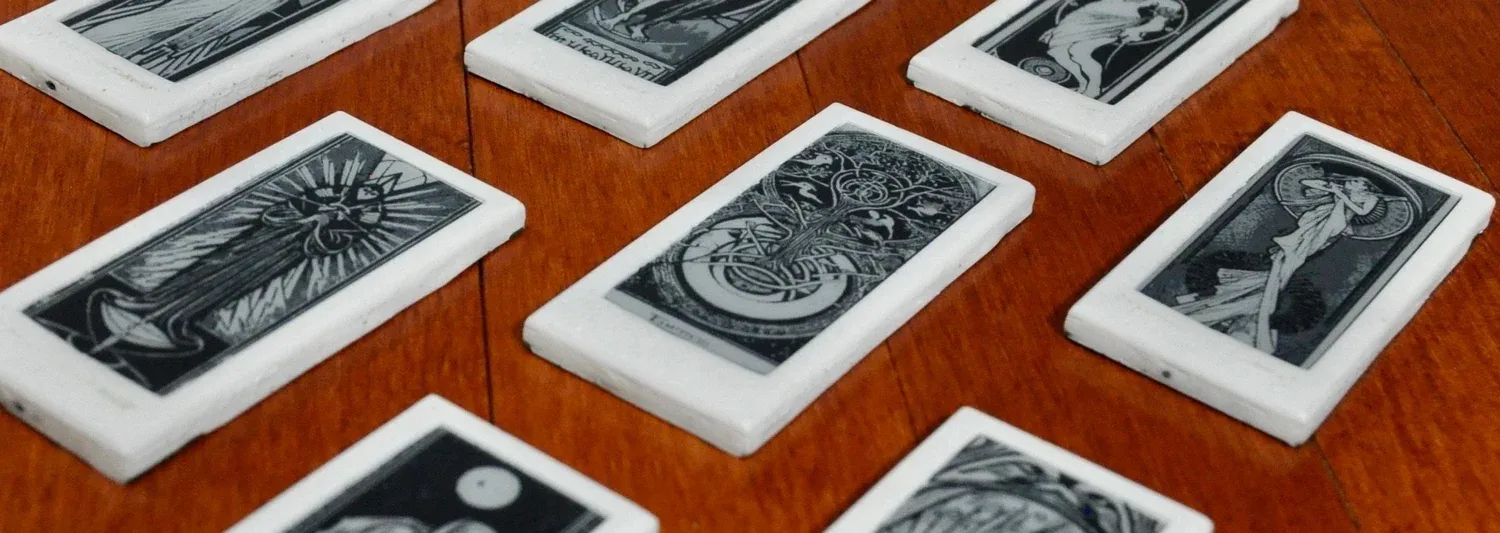
Show HN: Trading cards made with e-ink displays (opens in a new tab)wyldcard.io
1149 pointsI made a thing!
In 2014, I was holding a stack of iPhones and thought to myself:
"Hey, if I had each phone display a playing card, I could click a button and they'd shuffle themselves"
Right now, each card costs me about $20 each, but with only a bit more scale, I think I can get that down to $10.
In doing this project, I learned how to design electronics and circuit boards. I learned Rust and wrote my first driver, I upped my CAD skills, 3D printed, and did my first resin casting. I generated the images on the cards using stable-diffusion.
HN always seems to appreciate new uses for e-ink. Thought I'd share :)
Comments (291) 95 threads
Earlier commentsIn terms of making a game with them, I think a design where the pins are on the face of the card may be useful. I want to be able to 'draw' a card without knowing what is on it.
Certainly can be useful with pins on the back (and I totally get how this orientation is probably more size-efficient), but I think front pins would be more 'playable'. Maybe a design could be achieved with holes that pass through all the way so it can be written with either orientation?
Being able to 'power up' an existing card in the upwards orientation could be really cool for situations where you kind of want 'counters' applied to a portable card. Could have a base-station that allows you to 'add' the qualities of one card to another target card, or 'evolve' a pokemon, etc.
Maybe I should raise the priority on that.
Definitely I'm into the idea of evolving, or breeding cards like pokemon. Powerup or 'combine' would be cool too.
That would work. But you can also make that work with current hardware (I think): you just need a delay between pressing the button and the screen changing? So that the player can press the button, pick up the card, and five seconds later, it's revealed.
So in a way, you could "leave" traps or powerups on spots on the base, and your character activates them when it lands there.
(obligatory: 'you've activated my trap card')
This isn't an actual game, but I'm thinking it would be great to pick a card face up that's "red" and be able to make a decision to turn it into "cyan". Others could pick "green" and "blue" face up, but can click a button to turn it to something else, and then the game resolves itself when everyone reveals it. Like if everyone can discuss and if everyone reveals the primary colors everyone wins.
I'm sure there's interesting game mechanics you can come up with when you give a decision to the player.
Additionally, I think this could make an interesting programmable suite of games. You don't have to sell just one game.
Ah, the cards have buttons next to them on the base. I figured they could display icons on the card next to each button (each spot on the base has 3 right now). I call it the 'ATM' style UX.
[0] https://en.wikipedia.org/wiki/Soft_key
For example, perhaps a game that has a general flow of: players have their cards, there’s a central base station, but most play is not digital. Maybe they somehow battle their cards, they can go around and battle people as much as they want, but their “moves” are tied to the switches and when they use a move, they flick the switch off (wonder if it could be made to actually get stuck in position, to provide physical feedback indicating that the moves are “used up.”)
Then, when they want, they go back to the Pokécenter — I mean, oops, base station. It recharges their abilities (unflips the switches), maybe runs some “level up” logic, etc etc.
I mean, this quickly started to stretch credibility as far as the mechanism goes, but the idea of giving the players/game designers a couple bits of state that they can toggle away from the base station might allow more asynchronous type games.
Continue this thread — 1 reply
It seems the big assumption everyone's making in the comments is that the displays will just stay there on the electronics box. The reality is that you can refresh the display and then take it back into your hand. You could even trade it with other players while disconnected.
Furthermore, these displays can be refreshed hundreds of thousands of times (some can do millions) and therefore can last a lot longer than regular cards. They're also stupidly cheap in bulk! Example of a cheap NFC-powered one: https://www.aliexpress.us/item/3256803070283516.html (not the best example since it's kinda thick but you can get much thinner ones around the same price).
You just need to come up with some example games that take advantage of the trading dynamic. Also, if you're up to the engineering it would be neat if you could use one epaper "card" to modify another one. Much like how in many card games you can add an "enchantment" or "modifier" style card on top of another to give it additional capabilities.
I also recommend adding a cover or shutter to the cards so that they can be refreshed without the other players seeing what it is. Once the card is back in your hand you can move the cover out of the way and see what you got. Alternatively, you could make it so that the cards refresh their displays upside down. That way you can refresh it without anyone seeing what's there.
A few comments have mentioned being able to refresh the cards while upside down, or covered by another. Maybe my next prototype can put the contacts on the edges and have them wrap around or pass through, so they work on both sides.
That will be a bit more complexity for fabrication, but sounds like a fun project.
For anyone curious, the symbol made by the contacts is the Tree of Life from the kabbalah
Magic the Gathering has a monopoly on fantasy, and the cyberpunk genre is played out. Plus I want the inner-workings to be somewhat mysterious.
I had a lot of fun thematically laying out the contacts. For example: Keter is VCC and Malchut is GND
Beautiful
All comments shown.
Couldn't load more comments. Check your connection and try again.