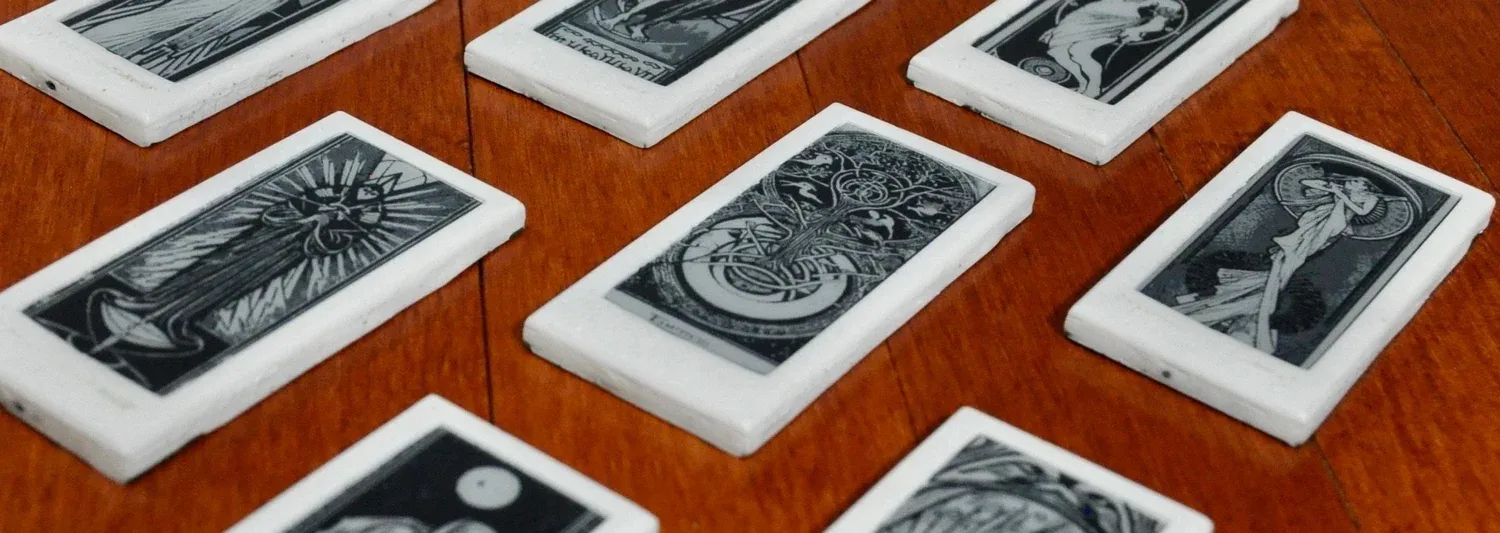
Show HN: Trading cards made with e-ink displays (opens in a new tab)wyldcard.io
1149 pointsI made a thing!
In 2014, I was holding a stack of iPhones and thought to myself:
"Hey, if I had each phone display a playing card, I could click a button and they'd shuffle themselves"
Right now, each card costs me about $20 each, but with only a bit more scale, I think I can get that down to $10.
In doing this project, I learned how to design electronics and circuit boards. I learned Rust and wrote my first driver, I upped my CAD skills, 3D printed, and did my first resin casting. I generated the images on the cards using stable-diffusion.
HN always seems to appreciate new uses for e-ink. Thought I'd share :)
Comments (291) 95 threads
Show all comments
Showing thread 13 of 95
In terms of making a game with them, I think a design where the pins are on the face of the card may be useful. I want to be able to 'draw' a card without knowing what is on it.
Certainly can be useful with pins on the back (and I totally get how this orientation is probably more size-efficient), but I think front pins would be more 'playable'. Maybe a design could be achieved with holes that pass through all the way so it can be written with either orientation?
Being able to 'power up' an existing card in the upwards orientation could be really cool for situations where you kind of want 'counters' applied to a portable card. Could have a base-station that allows you to 'add' the qualities of one card to another target card, or 'evolve' a pokemon, etc.
Maybe I should raise the priority on that.
Definitely I'm into the idea of evolving, or breeding cards like pokemon. Powerup or 'combine' would be cool too.
That would work. But you can also make that work with current hardware (I think): you just need a delay between pressing the button and the screen changing? So that the player can press the button, pick up the card, and five seconds later, it's revealed.
So in a way, you could "leave" traps or powerups on spots on the base, and your character activates them when it lands there.
(obligatory: 'you've activated my trap card')