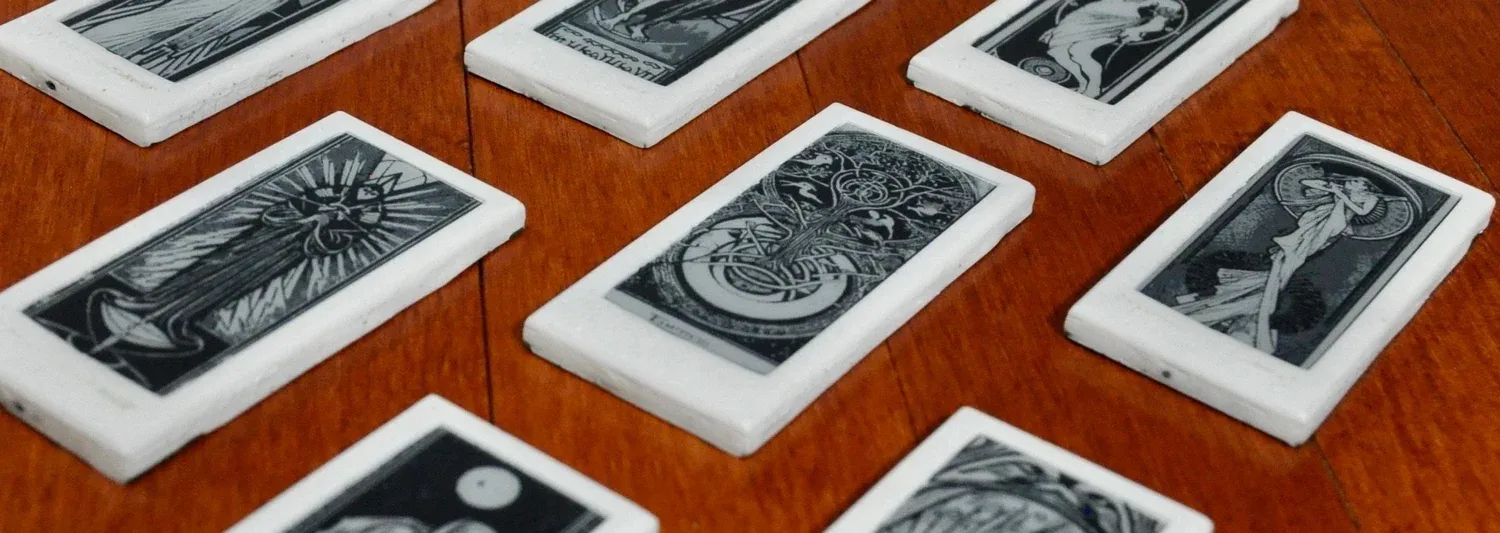
Show HN: Trading cards made with e-ink displays (opens in a new tab)wyldcard.io
1149 pointsI made a thing!
In 2014, I was holding a stack of iPhones and thought to myself:
"Hey, if I had each phone display a playing card, I could click a button and they'd shuffle themselves"
Right now, each card costs me about $20 each, but with only a bit more scale, I think I can get that down to $10.
In doing this project, I learned how to design electronics and circuit boards. I learned Rust and wrote my first driver, I upped my CAD skills, 3D printed, and did my first resin casting. I generated the images on the cards using stable-diffusion.
HN always seems to appreciate new uses for e-ink. Thought I'd share :)
Comments (291) 95 threads
Show all comments
Showing thread 15 of 95
It seems the big assumption everyone's making in the comments is that the displays will just stay there on the electronics box. The reality is that you can refresh the display and then take it back into your hand. You could even trade it with other players while disconnected.
Furthermore, these displays can be refreshed hundreds of thousands of times (some can do millions) and therefore can last a lot longer than regular cards. They're also stupidly cheap in bulk! Example of a cheap NFC-powered one: https://www.aliexpress.us/item/3256803070283516.html (not the best example since it's kinda thick but you can get much thinner ones around the same price).
You just need to come up with some example games that take advantage of the trading dynamic. Also, if you're up to the engineering it would be neat if you could use one epaper "card" to modify another one. Much like how in many card games you can add an "enchantment" or "modifier" style card on top of another to give it additional capabilities.
I also recommend adding a cover or shutter to the cards so that they can be refreshed without the other players seeing what it is. Once the card is back in your hand you can move the cover out of the way and see what you got. Alternatively, you could make it so that the cards refresh their displays upside down. That way you can refresh it without anyone seeing what's there.
A few comments have mentioned being able to refresh the cards while upside down, or covered by another. Maybe my next prototype can put the contacts on the edges and have them wrap around or pass through, so they work on both sides.
That will be a bit more complexity for fabrication, but sounds like a fun project.