Show HN: I spent 2 years building a personal finance simulator (opens in a new tab)projectionlab.com
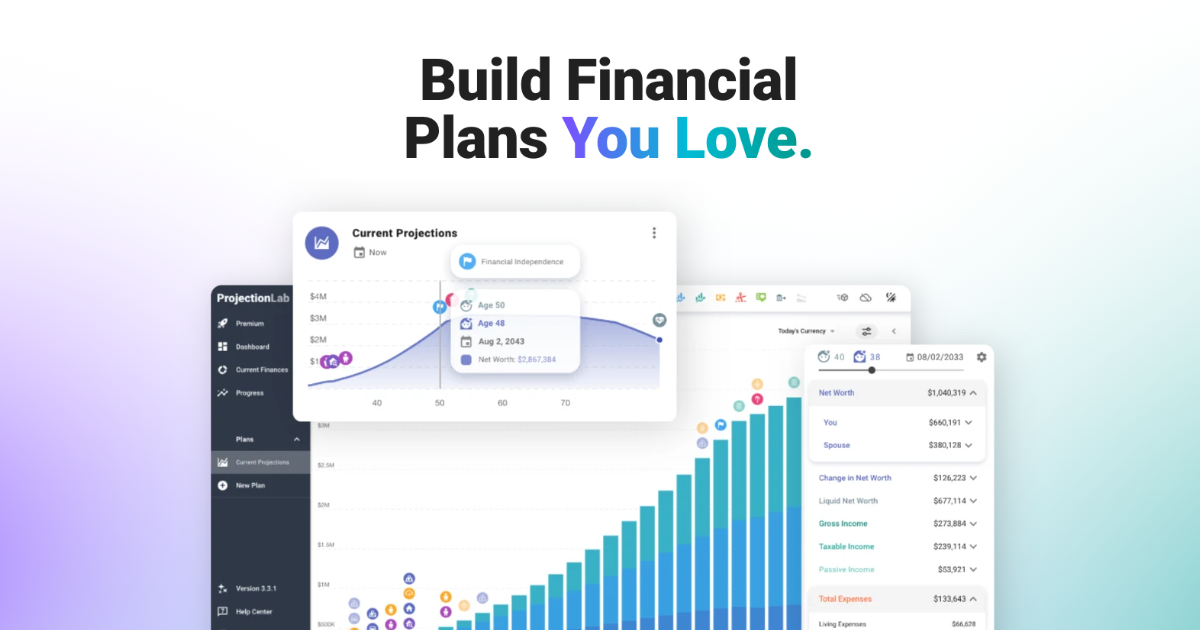
766 pointsTL;DR - ProjectionLab (https://projectionlab.com) is a privacy-friendly personal finance planning tool where you can create financial plans that go beyond the standard online retirement calculators. And by popular request, it now supports self-hosting for Lifetime users!
Something I'm grateful for is that our community here on HN is the difference between PL existing and not. There was actually a time early on when I was one day away from halting work on it. I posted here on a whim, and was shocked to receive some really constructive and energizing feedback that went on to power my indie dev journey over the past two and a half years.
As a quick recap, the story started when I dove head-first down the financial independence rabbit hole. I wanted a hands-on and visual way to explore the trade-offs between different life paths. One thing led to another, and I decided to build ProjectionLab.
After last year's Show HN, I really put my nose to the grindstone, and here are some of the big developments:
- Self-hosting for Lifetime users (spin up your own private deployment, based on Docker Compose, includes support for auth/encryption)
- Cash-flow visualization for each simulated year (sankey charts)
- Tax analytics (detailed breakdowns for projected income, taxes, marginal rates, effective brackets, etc)
- Major redesign of entire app, with landing page and resources now split into separate project
- Filing separately option to improve support for international locations that don't have joint filing
- Roth Conversions and 72t (SEPP) distribution modeling
- Improvements to US tax estimation (Secure 2.0 updates, rental property tax deductions, Medicare + IRMAA, NIIT, principal residence exclusion, etc)
- Better support for planning as a couple
- More modeling options for cash-flow priorities to support different budgeting philosophies and goals
- Extra liquidity + withdrawal options, ability to fund expenses with specific accounts or route income to specific accounts
- Customization options for Monte Carlo simulations (characterization of success rates and outcome types, option to set random seed, etc)
- And a whole bunch more! (https://projectionlab.com/changelog)
The HN community has had a huge role in shaping my overall direction with PL, and I can't wait to hear what you all think of the updates and where you would like to see things go from here.
As always, PL is free to try, with no need to create an account. It does not ask to link your financial accounts, and it has a sandbox mode if you just want to hop in and see how it works.
--Kyle
Comments (288) 77 threads
Show all comments
Showing thread 4 of 77
I went down this road in 2016. Spent about a year on an incredibly sophisticated retirement planner, with customizable scenarios. It was personally very useful so I started down the commercialization path.
I found that a bunch of people had tried this with a direct-to-consumer model and it ended up being small potatoes every time. All of the companies who had achieved any scale at all were doing so through partnerships with banks or financial planners.
In the end, I decided it wasn't something I wanted to spend years of my life with. I found OnTrajectory, which was a "good enough" solution at the time (and still is).
In a way, my hope was that "small potatoes" for a large company might still translate into "sustainable lifestyle business" for an indie/solo dev.
Rarely as an individual are you running into such complex financial modeling where the selling point "This has great UI/UX and allows me to accomplish task XYZ 20% faster" actually matters. It's actually kind of the opposite, where the slicker and more "magical" the tool is, the more I'm suspicious that I'm missing something and would prefer to just do it myself.
When I was initially casting about for alternate tools that might be a step up from that spreadsheet, I found myself frustrated when I ran into anything opaque or where methodology / assumptions weren't clear. With PL, I've made an effort to expose as many of those as I can directly to the user (while packaged into a UI that tries not to overwhelm), but I'm sure at the end of the day it's always going to be a reflection of the parameters and decision space I had in mind when designing it.
If you ever check it out and run into areas where you feel the model needs more clarity, definitely let me know.