Show HN: Heynote – A dedicated scratchpad for developers (opens in a new tab)heynote.com
1063 pointsHey!
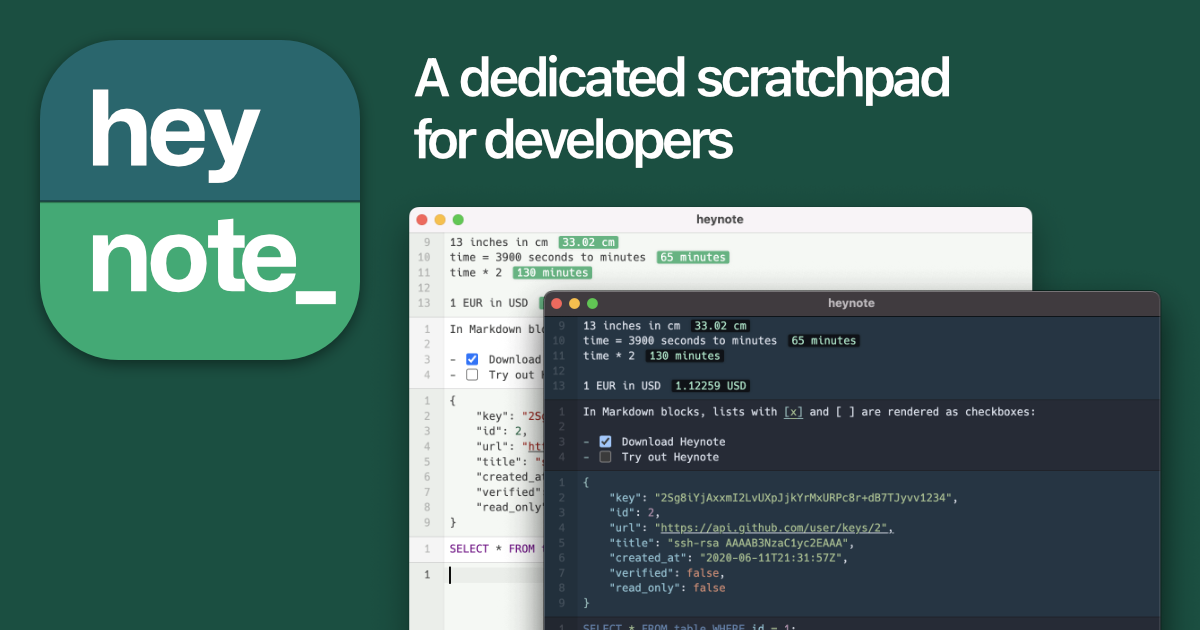
I made Heynote entirely for my own use case. For many years, I always had an Emacs instance running with the scratch buffer open, even long after I had abandoned Emacs as my programming editor in favor of more recent IDE:s.
The simplicity of having just one big scratch buffer appeals to me, but I still want to separate the different things I jot down somehow (without using tabs or similar). Previously, my solution was to insert a bunch of blank lines between the notes, but hitting C-A would still select the entire buffer. That's why I came up with the concept of "blocks", which turned out really well for my use cases.
I decided to release Heynote, thinking it might be useful to others.
Comments (303) 149 threads
Show all comments
Showing thread 4 of 149
I've started using Obsidian with a new note for each day and separating "blocks" with a Markdown horizontal rule (`---`) to achieve something similar, but this is much cleaner.
The strength of such an approach is making capture extremely easy -- new block, start writing, no thinking about where this goes and how to fit it into pre-existing structure. I find that if I'm trying to do that, then by the time I find where my idea goes, I've lost the idea.
The downside, of course, is finding things again. The ability to tag or title a block and search by tag or title would be great. More ambitiously, it would be cool to experiment with incorporating LLMs and embeddings to automatically tag, summarize, categorize, cluster etc. your blocks.
There's a lot of different directions one could take this, but I'll echo the sentiment of others to refrain from adding too many features and losing the original appeal of simplicity. :)
Also: How do you handle performance when the buffer gets very large?
open source doesn't mean source code is there. open source has a specific definition. There is a list of acceptable open source licenses, as defined by OSI. similarly there is a list of acceptable free software licenses, as defined by FSF. Broadly, the two lists are the same. Commons Clause is definitely not open source.
Continue this thread — 2 replies