Lurker News
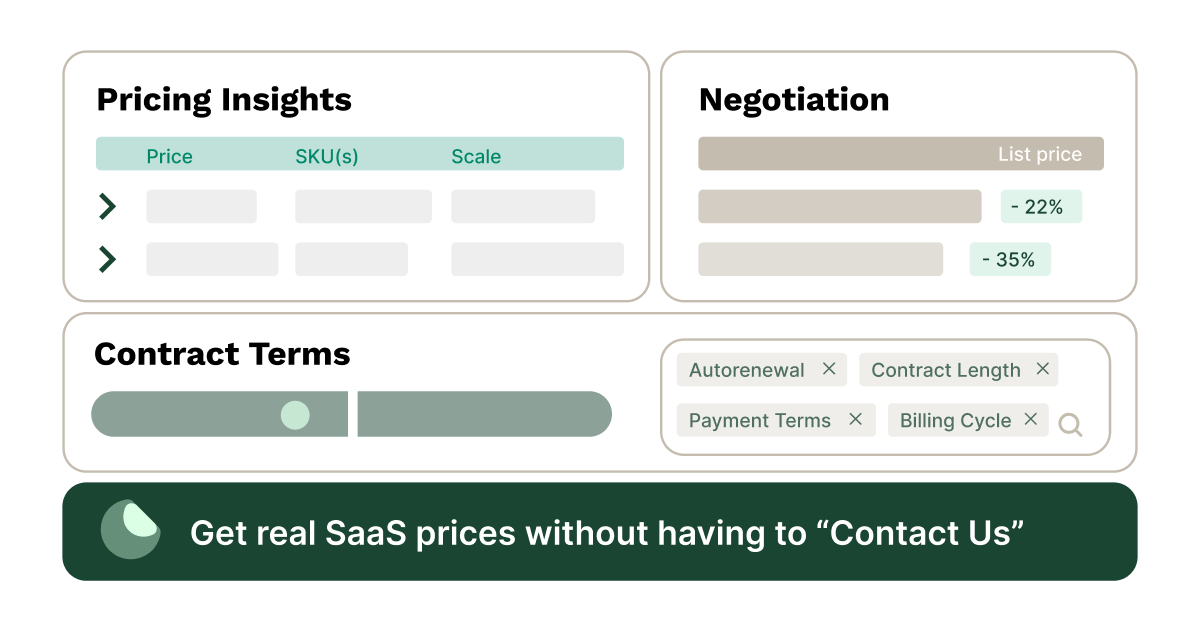
Hey HN! Christine and Steven here. As a PM and engineer, we’ve both evaluated and purchased a lot of software. One of the biggest frustrations was figuring out how much it would cost us without having to go through the sales process. When we did have a quote, we had no idea if we were getting a good deal or ripped off.

We built a site where you can see what other companies are actually paying for SaaS and enterprise software. Buyers contribute prices via quotes, pricing proposals, and other documentation to ensure quality.
We unlocked Talkdesk for Show HN users so that you can use the product without needing to sign in or upgrade. Check it out at https://www.pricelevel.com/showhn. Would love to hear any feedback, thank you!
Comments (176) 52 threads

Show all comments

Showing thread 1 of 52

passwordoops12 replies#
Love this! As a consumer, there's nothing like open pricing.

However, as a provider I can totally see a situation where I (proverbially, I'm not in this business) sue you for disclosing what amounts to a trade secret (depending on what's in the fine print) and compel you to give up all documents so I can go after my loose-lipped client too.
I hope you've got your legal bases covered

uoaei3 replies#
Is there precedent that points in either direction that pricing details are considered a trade secret (or whatever the legally enforceable version of that is)?
passwordoops#
I've signed and written quotes that have those provisions. What the legal standing is, I can't comment on because it never came to that.

This is with the obvious caveat that public tenders are the exception, but only after it's awarded

staticautomatic#
Sure. Broadly, a trade secret under state and federal law is "information that derives independent economic value from not being generally known to the public or people who can obtain economic value from it and is the subject of efforts to maintain its secrecy that are reasonable under the circumstances." Price lists could clearly fall under this definition, and they do! Here's an 8th circuit case where the plaintiff "adequately allege[d] that the information that was purportedly misappropriated— ... pricing information ... qualifies as trade secret[]." Ahern Rentals, 59 F.4th 948 (2023).
tyingq#
There's precedent that points in both directions. There was a fair amount of research when there was a push for transparency in hospital pricing for services in the US. One piece of research: https://portal.ct.gov/-/media/OHS/Healthcare-Cabinet/2021-Me...

You'll see there's some cited court cases that supported pricing as a trade secret, and some that held it was not.
It seems to be still pretty muddy legally.

mickael-kerjean#
Loving this as well from the point of view of a small saas provider who has no idea what typical enterprise contract runs for.
RowanH#
I can totally see some uninformed staff member contributing what they're paying for things, and landing their employer in deep, deep, trouble with their suppliers.

I've found in competitive price analysis there's some companies that do very, very, well at hiding their pricing. If they've worked that hard, that long, to protect/hide pricing they're not going to take it lying down.

unstatusthequo2 replies#
Pricing isn’t a trade secret.
nosefurhairdo2 replies#
I'm not a lawyer, but it seems possible that an enterprise software licensing agreement could contain a non-disclosure agreement or confidentiality clause.

Not making a value judgement and happy to be corrected if this is not a thing.

willcipriano3 replies#
Sounds like something the FTC should investigate.

Continue this thread — 3 replies

airstrike#
but then that's a breach of an NDA which is not the same as sharing a quote-unquote "trade secret"
OccamsMirror#
Pricing strategy isn't the same thing as a price you gave a client.
spxneo2 replies#
prices aren't a trade secret and difficult to enforce even if its covered under an NDA
passwordoops2 replies#
"prices aren't a trade secret"

Is there a basis for this in recent case law? And how difficult would it be to enforce against a 3rd party actively publishing pricing, and therefore competitive, strategy?
Nope I'm not staying they should shut down or they will get sued, but they should do the sensible thing and talk to a good lawyer

spxneo5 replies#
there hasn't been any caselaw from my knowledge where they went after a customer for revealing the price of a software license

prices wouldn't be enforceable because knowing how much you charge isn't revealing anything proprietary (because you have to tell your customers in order to get them to make a decision).
Also not exactly possible to expect confidentiality around prices because your banks and their staff will see it..

Continue this thread — 5 replies

makeitdouble#
Not a lawyer either, but I think there is a more obvious angle to this: publicly traded companies can be audited, publish costs to investors, list their creditors and amount when going bankrupt, ask for tax rebates by declaring their expenses etc. In many circumstances their money flow needs to be transparent.

Not being allowed to expose the buying price of a service would go against many of these procedures/obligations.
We could look at it the same way disclosing one's salary can't be illegal: how do you then apply for a loan for instance ?

staticautomatic1 reply#
They totally can be. There's plenty of case law on it.

Source: I'm a 3L about to graduate with an IP specialization and got an award for being the best student in my trade secret law class.

spxneo8 replies#
can you share some?

Continue this thread — 8 replies

mox13 replies#
Just to let you know this kind of pricing information is available and given out during F500 SaaS deals.

Our microsoft reseller was using pricing and contract info on a deal he closed last week to assure us he would and could get us a similar deal.
Gartner will literally cutthtoat re-negotiate any large contract you have, using pricing data they have gathered from their members.
Call them up tomorrow, tell them your current cost for Splunk, they will tell you exactly how much you can save.
So this type of thing is not illegal and not even frowned upon for the big players.

jpgvm1 reply#
Once you are big enough to have a procurement department this isn't just not frowned upon it's expected and very much "part of the game".

I personally hate it but it's just how the game is played and it's why all enterprise software has stupidly high advertised prices so they can give "90% discounts" and let people think that is a good deal when it is ultimately just the real price that all the big players are getting anyway.

pcl1 reply#
When I worked at BEA (which I think published its prices), the steep discounts on a crazy high price actually had a clever reason — evidently the sales team could discount the list price pretty freely, but they were forbidden to discount the yearly support and maintenance fees. Sorta subscription pricing before it was cool.

Continue this thread — 1 reply

vasco#
My practical experience with vendor negotiations is you ask for a discount and talk to them honestly and make the sales person have a good time with you and you don't need to play hardball, say you have some secret information or other crap. I have seen many contracts negotiated by a regular engineering manager and by "proper" procurement people, and the outcome is clear that hardball negotiations end up in worse outcomes than just being a nice person and speaking plainly.
matt-p#
There's a difference between 'a company negotiates on behalf of a number of clients and individuals happen to get a feeling for ballpark figures' verses publishing the exact figures of every deal on the internet.
blackeyeblitzar#
I’m not sure you can sue to block price signals and that seems blatantly anti competitive. Also other services provide this type of intelligence already, like Vendr, Sastrify, Torii, etc.

Continue this thread — 5 more replies