Lurker News
Thank you for your comments, just some context:

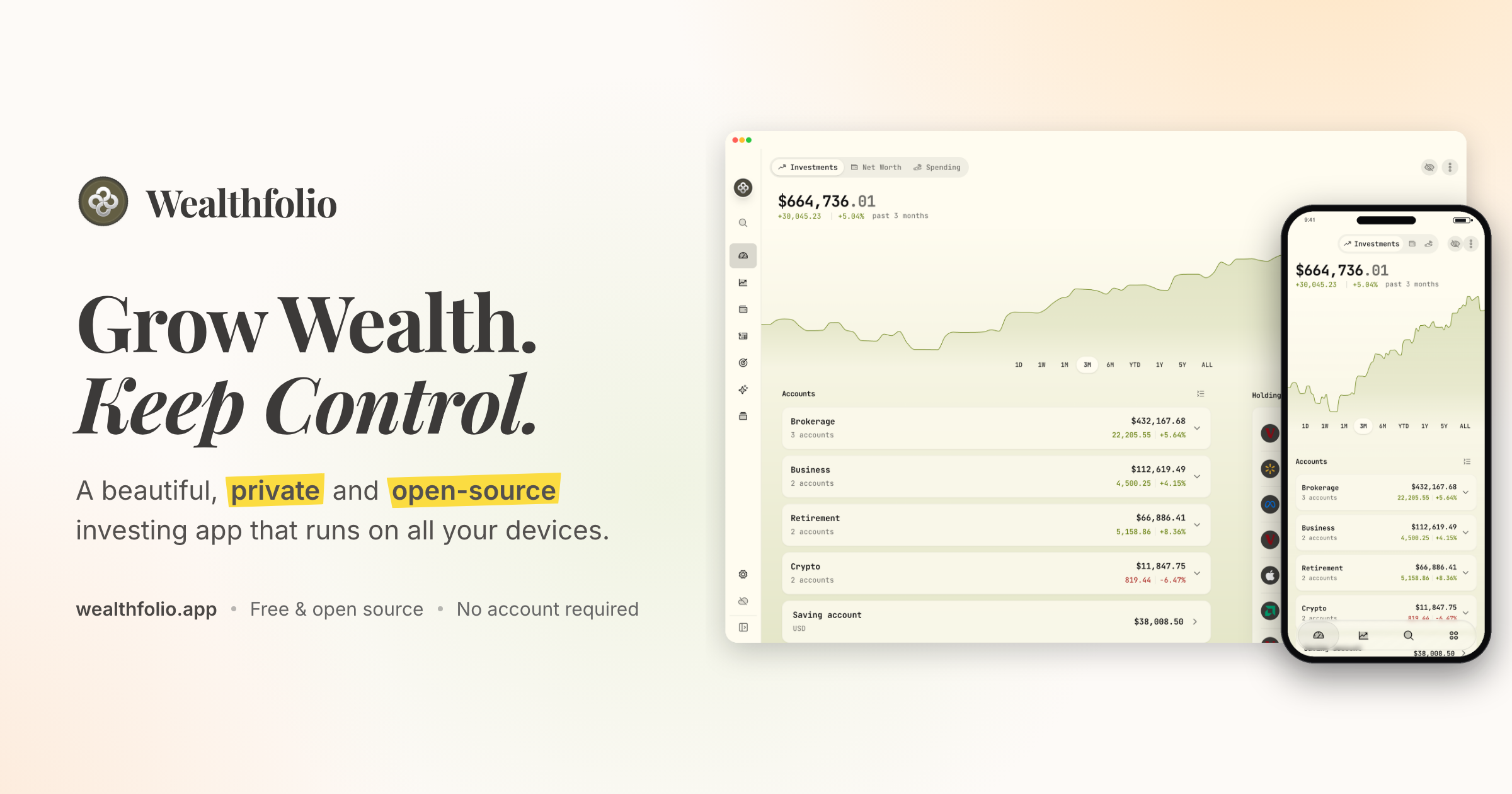
- The app is a simple desktop application that works on macOS, Windows, and Ubuntu.
- I developed this app for my own needs. Getting tired of SaaS app subscriptions and privacy concerns.
- For now, the activities are logged manually or imported from a CSV file. No integration with Plaid or other platforms.
- No monetization is planned for now (only a "buy me a coffee" if you use and appreciate the app).
Comments (263) 80 threads

Show all comments

Showing thread 1 of 80

diggan12 replies#
First question from reading through the landing page is about this part:

> Import your statements from your broker or bank.
Exactly what brokers/banks that are supported should be listed somewhere and linked here, as that's a "make or break" feature for a lot of people I bet. Not much point in replacing my homegrown "Banks CSV export -> Data processing > Import into spreadsheet" workflow unless I just replace that last step but the previous ones remain the same.

progforlyfe3 replies#
That's what I was wondering. It's a ton of work, but would love the auto importing / screen scraping features that Mint.com had. For a local desktop tool it even has the potential to support every possible service because they can't do IP blocking on end-users (versus the server-to-server model that Mint.com had, caused many services to IP block Mint's servers).

Unfortunately, depending on an open-source tool to do this is a double edged sword if it had these features, because we would be opening the risk of supply-chain attacks -- malicious actors getting commits into the repository code which cause the program to send your data elsewhere -- or worse, deplete accounts' funds.

diggan2 replies#
> but would love the auto importing / screen scraping features that Mint.com had

I never used it, but didn't that ask you for the username/password in order to do its job? If so, I wouldn't touch it with a ten-foot pole.
> cause the program to send your data elsewhere -- or worse, deplete accounts' funds.
Again, seemingly because their shitty architecture would that even be possible.
There are modern (possibly only European?) standards nowadays that forces the banks to expose proper APIs for doing things like that. Would require a business entity to deploy to production (I think that's one of the requirements?) but otherwise wouldn't be a huge task compared to manually scraping stuff.

nightski1 reply#
Some banks allow you to create separate limited read only credentials at least that can be revoked at any time. But not all of them allow this.

Continue this thread — 1 reply

j-a-a-p#
I suppose you mean PSD2. That is mandatory for EU banks that do payments. I don't think your stock and crypto trading services need to comply.
jfdjkfdhjds#
only if there were regulations for consumer banking having the bare minimum for application security as is for everything else banks themselves depend on.
mulmen#
> Unfortunately, depending on an open-source tool to do this is a double edged sword if it had these features, because we would be opening the risk of supply-chain attacks -- malicious actors getting commits into the repository code which cause the program to send your data elsewhere -- or worse, deplete accounts' funds.

This is FUD. You’re describing open-commit, which I don’t think anyone does. Open source is not more susceptible to supply chain attacks than closed source software.

neilv1 reply#
I don't know about Wealthfolio, but the import QFX/OFX/CSV/etc. into GnuCash has ways to reconcile that with transactions you've manually recorded/edited, which can be much richer than the bank or CC knows. (GnuCash also has a way to import via network access, but I haven't tried it.)

(Example of richness: splitting am Amazon CC charge into the multiple expense accounts for the items that went into the order, and also accounting for the CC rewards and the Gift Card balance that contributed.)
I tried taking a break from GnuCash for maybe year, and going to a spreadsheet, and found: (1) it was still substantial work to maintain an accurate view of balances, and (2) I was missing a lot of information I found I needed in practice.

jsdwarf2 replies#
That's exactly my problem. Assigning the purchase of a new computer mouse to the "Expenses:ITEquipment" account? Easy if you purchased the mouse at your local computer store and used your debit card. Just define a text pattern to make any purchase from that store go to the ITEquipment account and run it against the csv from your checkings account.

Same purchase from amazon? Difficult, because you have two layers of indirection: checking account > credit card > amazon > it equipment.
Currently testing a new spreadsheet approach to deal with such scenarios, but not easy.

ska#
Isnt' why splits exist though? I've never found that to be onerous, and I did run a small business on it for a while.

Then again I'd never trust rules to do everything right anyway, so I'm reviewing at least once to reconcile.

dmohs#
You just need one more account. The card payment is just a transfer to an "Amazon Balance" account or something. Then the individual items are entries against that account.
klinquist3 replies#
I just assumed it uses Plaid.
diggan#
I assume it uses no external services at all as it's supposed to be local first and "No Cloud" is basically the first thing you see when opening up the landing page.

Not to mention the second paragraph is "no more worries about SaaS services playing around with your data"

aketchum2 replies#
unlikely, who would pay the plaid bill here? they dont really have ala cart pricing - you have to create an account with them etc
arez#
yep, it would be way too expensive
stavros1 reply#
I can provide an API key, you can use their staging API that allows a few banks for free. That's what I do with a local script I wrote, I get my banks' balances once a week.
danielvanacker1 reply#
They deprecated their staging API. The equivalent now is “limited production access”.
stavros#
Ah really? That's too bad, I guess I haven't used mine in a while, but I was just about to again.
jchook#
Imagine if Plaid was open source...
brutal_boi1 reply#
For that very reason I tried selfhosting Actual Finance[1] but it is more of a budgeting app than a networth tracking app.

I ended up coding a small exporter[2] since I already had some stack in place that queries SimpleFI[3], which essentially allows querying balance and transaction information for most US-based banks (read only); most similar to plaid but a lot more developer-friendly afaik.
[1] https://actualbudget.com/
[2] https://github.com/eduser25/simplefin-bridge-exporter
[3] https://beta-bridge.simplefin.org/

johntash1 reply#
Do you have any experience with plaid to compare it to simplefin by any chance? I started a similar project with plaid before, but haven't really gone back to it since dev accounts became a lot more limited.
brutal_boi1 reply#
I could not find a way to make or enroll as a dev in plaid; that was a while ago tho.

SimpleFIN on the other hand seems to be pretty good for dev work; plus very responsive in terms of questions and requests. Can only speak good of them.

Continue this thread — 1 reply

figmert1 reply#
I really feel like there should be a tool that wraps Woob[0] finance and provides something similar to Plaid, but self-hosted. There are some great finance apps that could then potentially integrate it to improve automation.

Woob does a great job of providing a good API for automating the web, and sure, not everything works, but it's a good start. Unfortunately, it seems it's not very well known still.
[0] https://woob.tech/

aketchum#
this sounds incredibly hard to do - plaid's moat is that it is a bunch of work to keep up to date with all these different bank UI's, plus many banks have moved to OAuth which they only provide to trusted partners - like plaid. You cant get an oauth token to your BofA account just because you have an account there
a-fadil1 reply#
For now only a standard csv file is supported with these columns: Date, Symbol, Quantity, Activity Type, Unit Price, Currency, and Fee. Supported activity types: BUY SELL DIVIDEND INTEREST DEPOSIT WITHDRAWAL TRANSFER_IN TRANSFER_OUT CONVERSION_IN CONVERSION_OUT FEE TAX Example CSV format: date,symbol,quantity,activityType,unitPrice,currency,fee 2024-01-01T15:02:36.329Z,MSFT,1,DIVIDEND,57.5,USD,0 2023-12-15T15:02:36.329Z,MSFT,30,BUY,368.6046511627907,USD,0 2023-08-11T14:55:30.863Z,$CASH-USD,600.03,DEPOSIT,1,USD,0
cvoss1 reply#
Seems like this arrangement of columns can't properly support dividends, as 1) there is no change to the held quantity when a dividend is issued, 2) the unit price of the symbol is irrelevant, and 3) there is no column to record the actual amount received. My bank records a quantity of 0 and a dummy unit price of $1. It would be incorrect for the bank to record a non-zero quantity.
anamexis#
Why would that preclude supporting dividends? As you mentioned, unit price and quantity can simply be ignored for those rows.

Continue this thread — 6 more replies