Lurker News
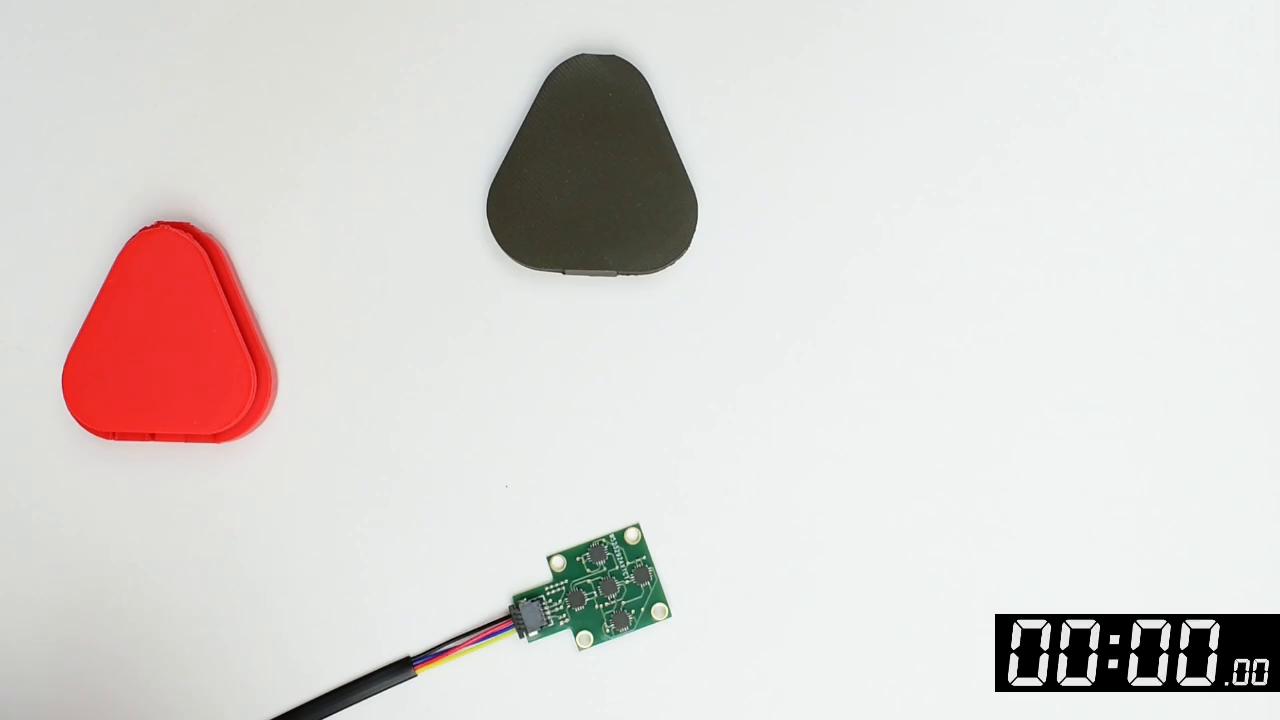
We just released a very excited touch sensor that finally simplifies touch sensing for robotics.

Our most exciting result: Learned visuotactile policies for precise tasks like inserting USBs and credit card swiping, that work out-of-the-box when you replace skins! To the best of our knowledge, this has never been shown before with any existing tactile sensor.
Why is this important? For the first time, you could now collect data and train models on one sensor and expect them to generalize to new copies of the sensor -- opening the door to the kind of large foundation models that have revolutionized vision and language reasoning.
Would love to hear the community's questions, thoughts and comments!
Comments (66) 27 threads

Earlier comments
aabajian#
I get the application being a touch sensor, but the real breakthrough is the embedding of magnetic particles with parallel orientations in a flexible medium. A few immediate questions:

-The company that makes Magnequench presumably knows their particles can be embedded in other materials. What's the most common use case for these types of particles? Are they typically embedded in fixed (non-flexible) solid medium or liquids?
-Is it necessary to use Dragon Skin? The idea of mixing magnetic particles in a semi-solid medium is intriguing to me. Like putting particles into Jello or Silly Putty. Could I then apply an external magnetic field and have the particles deform/shape the medium they are in?

fragmede1 reply#
> Learned visuotactile policies for precise tasks like inserting USBs and credit card swiping...

> opening the door to the kind of large foundation...
Sounds like this enables robots to literally open a door, using a door handle or door knob. Exciting!

raunaqmb#
Yes, and importantly we find that visuotactile policies work even when replacing skins. This hasn't been shown before, to the best of our knowledge, and opens the door to a number of exciting large-scale applications of this sensor.
Animats1 reply#
Nice packaging.

Sensors like that have been around for decades, but this is a nice way to package them. The replaceable cover is a big win. "Skin" type sensors have been built many times, but the part that wears out contained the sensors, so they were not suitable for production use.[1]
You have to have a Google account to order one. Even though this was funded by Meta.
[1] https://www.youtube.com/watch?v=HLdVkaF9ZR4

raunaqmb#
We are just collecting emails on the Google form as contact information to get more details when shipping samples. I am sorry that the form is asking for a google account - we will fix that as soon as possible.
rapjr91 reply#
I'm imagining a small, flat robot with a skinny gripper using this sensor that can roam a floor, going under furniture, and grab anything it can find and bring it to a collection point. So it would have to deal with picking up coins laying flat, empty soda cans, full soda cans, toys, dead bugs, dust balls, pens, a very wide variety of objects. Different objects may have different force feedback requirements, picking up an empty aluminum can would be different than picking up a full can. Picking up a coin might require good sensing at the very edge of the sensor.

It might be useful to create a map of the sensors response across its entire surface. Is the edge response weaker? That might suggest some improvements like working on creating less dead space around the edges of the sensor.

raunaqmb1 reply#
The fun thing about using microparticles is that there's no dead zone! In fact, the edge response is even stronger (as you can see on the video on our website) because despite the distance from the chips, the skin is much more deformable at the edges.
rapjr9#
I did watch the video but that's not the same as a precise repeatable experiment. As you say the edge response does seem stronger which means the sensor response is not linear across its surface. I guess I'm thinking of precision manipulations of objects in predictable ways, which is probably not your original intent, but it seems likely you could improve the sensing at the edge. An experimental measurement of the response might show some nonlinearities across the surface which you might consider correcting by using a microparticle cap that varies in thickness or correcting it in software, to produce a more accurate sensor surface. While it seems quite useful as it is, adding precision may expand the possible uses, such as finer manipulation of more fragile objects. It would also be interesting to see how the response varies for different kinds of contacts with objects, such as gripping a cube by the corners and by the sides, by the sides of a sphere, soft objects in various orientations, maybe others. Another possibility is being able to infer the mass of an object when the sensors are used to lift an object. The deformation at that time may directly correspond to weight. Together it may be possible to do some rough object identication, such as "pointy contact surfaces with mass of 20g". Combined with steroscopic cameras to ID the object, this could give a machine learning algorithm more to work with when figuring out how to manipulate objects. You might be able to use the ability to measure slip and the known distance between the grippers to tell how soft an object is, and together with camera input, decide how fragile an object is and whether the gripper is crushing it. The force changes during a crushing motion might indicate if the object is just soft or if it is semirigid and might break. Besides gripping, you could explore pushing and rubbing objects as well. Rubbing could tell you something about surface texture, which is also related to what the object is made of. Maybe there are uses in rolling objects between the grippers also? To reorient the objects along an axis of rotation while simultaneously characterizing the nature of the object?

Load more comments