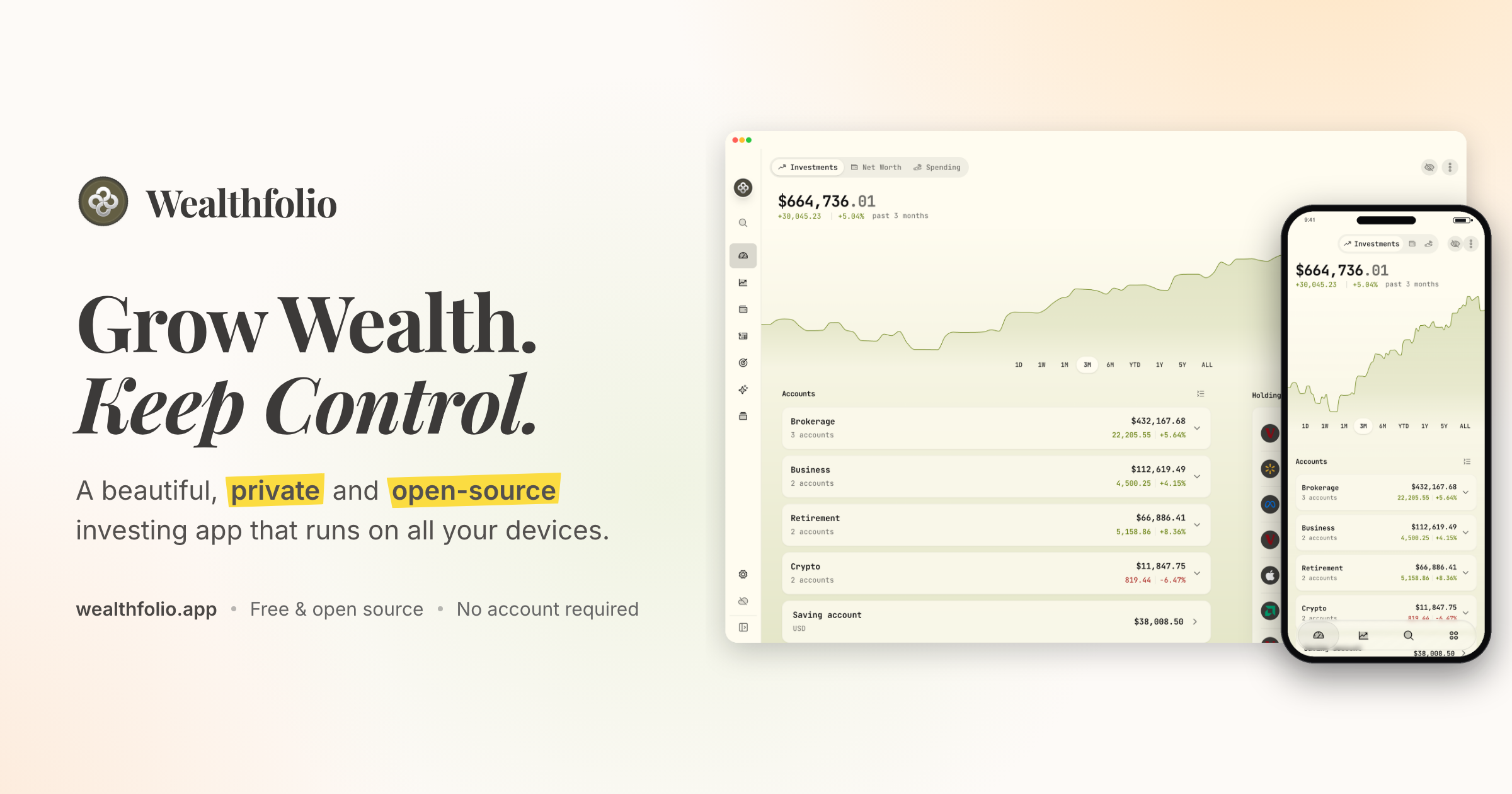
Show HN: Wealthfolio 2.0- Open source investment tracker. Now Mobile and Docker (opens in a new tab)wealthfolio.app
676 pointsHi HN, creator of Wealthfolio here.
A year ago, I posted the first version. Since then, the app has matured significantly with two major updates:
1. Multi-platform Support:
Now available on Mobile (iOS), Desktop (macOS, Windows, Linux), and as a Self-hosted Docker image.
(Android coming soon).
2. Addons System:
We added explicit support for extensions so you can hack around, vibe code your own integrations, and customize the app to fit your needs.
The core philosophy remains the same: Always private, transparent, and open source.
Comments (215) 59 threads
Show all comments
Showing thread 9 of 59
This is unfortunately going to be the deal breaker for wide adoption. Self hosting is great, but manually importing data from dozens of accounts every day and entering every single transaction as you make it is simply too much of a burden.
I'm also experimenting with local llm models to parse files and statement and call the app tools to feed data.
https://www.google.com/search?q=site%3Awealthfolio.app+map+p...
Would be happy to contribute profiles.
In a year when I consolidated a bunch of accounts, I’ve found essentially no program regardless of off or online that’s able to build a global view.
It’s a pretty classic data problem—-heterogeneous data sources, entity resolution, etc. Should be amenable to a ml solution.
Used to be, you'd use what Quicken calls "direct connect" where the client software itself connects to your bank's servers and pulls down your transactions and balances. They also had this "quicken connect" where the client software connects to Quicken servers, who, in turn, contact your bank--making Intuit an unwanted middleman. Slowly, but consistently, Quicken has been dropping "direct connect" support and coercing their users to go the middleman route.
I, too, have been looking for an alternative to Quicken, but: 1. I don't want to have to go to each bank's crappy web site and download a crappy CSV to import, and 2. I also don't want the software developer inserting itself into what should be a data transfer between me and my bank.
The Holy Grail personal finance software would 1. be free and open source, 2. download data directly from financial institutions without CSVs or a middleman and 3. store the data in an open format like sqlite that I can query and manipulate outside of the application.
I end up saving CSV's locally and importing the transactions from there (no hand entry, but I still need the intermediate download step.) I don't find it that too burdensome since I don't have a zillion different accounts.
[This](https://reds-rants.netlify.app/personal-finance/the-five-min...) project (I am not affiliated in any way) claims to automate ledger update even further.
Continue this thread — 1 reply
So the holy grail is really "Banks must be required to provide all customer info in a machine-readable format, via a programmable API, directly to their customers." :-)
1. https://finance-quote.sourceforge.net/
I haven't researched much on Robinhood or Coinbase but I suspect they have much better APIs. That's an idea where a plugin system would be awesome, something like Plaid but for brokerages and Crypto exchanges only.