Show HN: If you lose your memory, how to regain access to your computer? (opens in a new tab)eljojo.github.io
402 pointsDue to bike-induced concussions, I've been worried for a while about losing my memory and not being able to log back in.
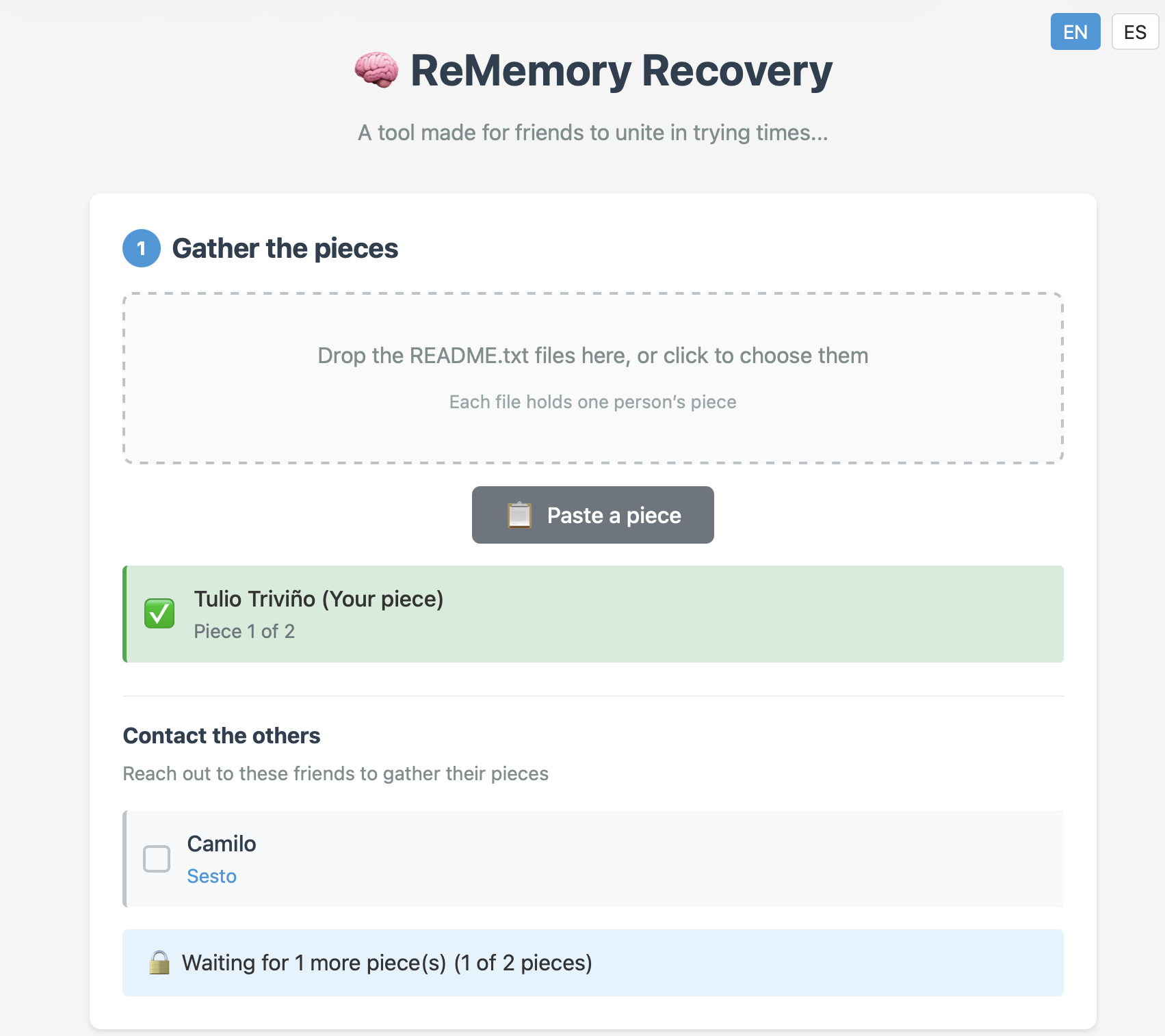
I combined shamir secret sharing (hashicorp vault's implementation) with age-encryption, and packaged it using WASM for a neat in-browser offline UX.
The idea is that if something happens to me, my friends and family would help me get back access to the data that matters most to me. 5 out of 7 friends need to agree for the vault to unlock.
Try out the demo in the website, it runs entirely in your browser!
Comments (233) 69 threads
Earlier comments* you forget that you have a clever password scheme
* you forget that you have data to decrypt
* your mental capacities are deteriorated enough that someone else takes over decisions making for you. This person may not know you or your data protection scheme.
* you are physically injured where biometrics are non functional. Or a biometric system with a limit on tries may have been tripped by those trying to help you.
* you were in an incident that your friends/family were also affected by
In my opinion, the best way to protect against these is simply write stuff down in plaintext somewhere that relies on physical security, like with documents in your home. Also notate what they are and why someone would need to access them and how.
(If you have a trusted third party, you can also enforce a cooling off period: e.g. that any attempt to access results in a notification to the account holder that if not denied within some time period, access is granted)
This is obviously more cumbersome, and probably costly, if you intend on changing your password. I guess you could change the part of it you don’t store with them.
[1]: https://github.com/cyphar/paperback
Since you wrote it in Rust, I'd suggest compiling it to wasm and releasing a browser-based version
Continue this thread — 3 replies
However, there is still the issue of the service provider going offline or out of business which we don't have a solution for yet.
We have started with a good password manager and will be adding digital inheritance/social recovery soon! [0]
Take a look, thoughts and feedback welcome.
[0]: https://saveoursecrets.com
for the time lock mechanism, how do you go about it? I'm interested in exploring using drand time lock, but that also relies on the service continuing to run (which is admittedly very likely) https://github.com/drand/tlock
If you want to share your password with M family members such that you only need N to agree to recover the original:
Split your password into ordered chunks.
Make a polynomial p, of power N where the p(1) = chunk1, p(2) = chunk2, ...
Evaluate the polynomial at M other points: p(N+1),p(N+2)...
Gives those M new points to your family along with their index (+1,+2,...).
If less than N family members get together, they will not be able to figure out the password much better than guessing. If N get together, they can interpolate their points to form the unique polynomial which will match p. Then evaluate p at p(1),p(2),... to get your original password.
If you put the whole password into 1 chunk, and pad the polynomial with random extra coefficients or points to make the polynomial of sufficient degree, then they get literally no information on the password without having at least N cooperate. If you make multiple chunks then they can do a little correlation between the chunks without knowing the whole thing.
This is sufficiently simple you can even work this out by hand without a computer, though it would be somewhat tedious.
"Do not roll your own crypto" though.
Shamir's secret sharing scheme does not allow anyone to bruteforce it, no matter if they have 99 out of the 100 required pieces that unlock a 10-character password. If you want to do this sort of thing, I would recommend using a secret sharing scheme instead
Shameless plug: I wrote a project a few years ago to create PDF-based backups with sharded keys which would do exactly what I suspect you want[2], unfortunately I got stuck at the "make a nice UI for it" stage (everything works but it's just a CLI tool at the moment). I guess I should take a look at using an LLM for that these days... (I used this to store my password manager root password and necessary keys to pull and decrypt the encrypted backups of my server.)
[1]: https://en.wikipedia.org/wiki/Shamir%27s_secret_sharing [2]: https://github.com/cyphar/paperback/
I would be in an impaired state, and cannot function in way that would be conducive to either work or pleasure in terms of computer use.
That is to say, the entire reason why I have password security at all is to keep out people who do not know the password. If someone does not know the password, they should not be able to access the system. That obviously and clearly applies to myself as much as any other person. "If you do not know it, then you do not need it."
The important thing is to ensuring your computer is not a single point of failure. Instead of losing a password, you could have theft, flood, fire, etc. Or for online accounts, you are one vendor move away from losing things. None of these should be precious and impossible to replace. I've been on the other side of this, and I think the better flow is to terminate or transfer accounts, and wipe and recycle personal devices.
A better use of your time is to set up a disaster-recovery plan you can write down and share with people you trust. Distribute copies of important data to make a resilient archive. This could include confidential records, but shouldn't really need to include authentication "secrets".
Don't expect others to "impersonate" you. Delegate them proper access via technical and/or legal methods, as appropriate. Get some basic legal advice and put your affairs in order. Write down instructions for your wishes and the "treasure map" to help your survivors or caregivers figure out how to use the properly delegated authority.
All comments shown.
Couldn't load more comments. Check your connection and try again.