Show HN: Micasa – track your house from the terminal (opens in a new tab)micasa.dev
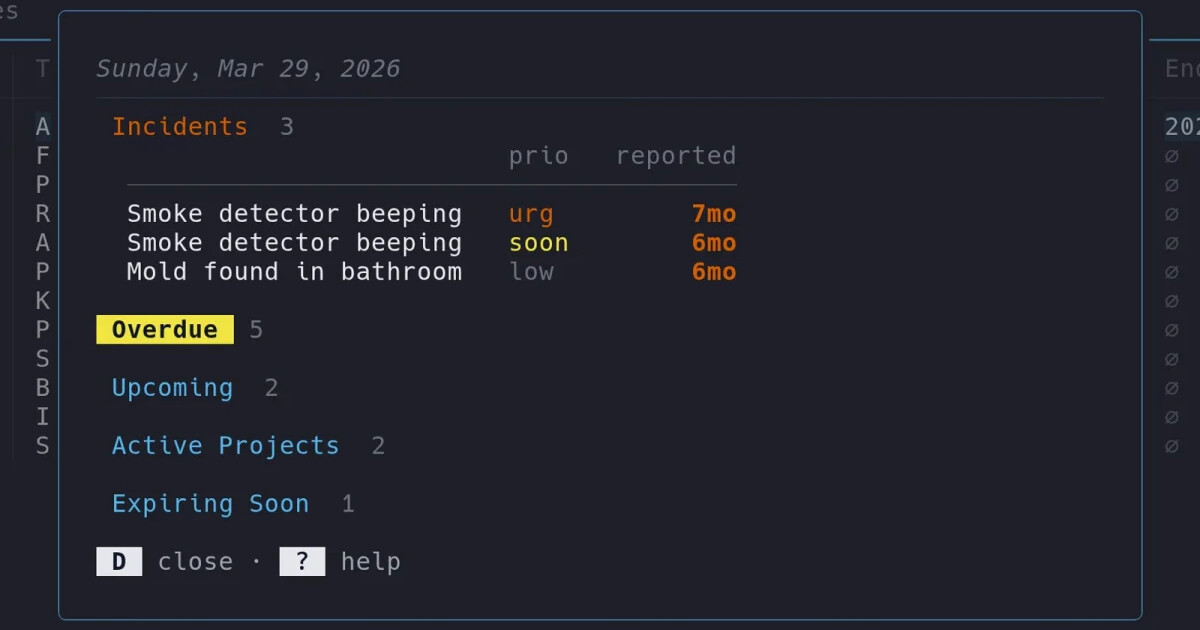
657 pointsI built it because I was tired of losing track of everything in notes apps, and "I'll remember
that"s. When do I need to clean the dishwasher filter? What's the best quote for a complete
overhaul of the backyard. Oops, found some mold behind the trim, need to address that ASAP. That
sort of stuff.
Another reason I made micasa was to build a (hopefully useful) low-stakes personal project where
the code was written entirely by AI. I still review the code and click the merge button, but 99%
of the programming was done with an agent.
Here are some things I think make it worth checking out:
- Vim-style modal UI. Nav mode to browse, edit mode to change. Multicolumn sort, fuzzy-jump to
columns, pin-and-filter rows, hide columns you don't need, drill into related records (like
quotes for a project). Much of the spirit of the design and some of the actual design choices
is and are inspired by VisiData. You should check that out too.
- Local LLM chat. Definitely a gimmick, but I am trying preempt "Yeah, but does it AI?"-style
conversations. This is an optional feature and you can simply pretend it doesn't exist. All
features work without it.
- Single-file SQLite-based architecture. Document attachments (manuals, receipts, photos) are
stored as BLOBs in the same SQLite database. One file is the whole app state. If you think
this won't scale, you're right. It's pretty damn easy to work with though.
- Pure Go, zero CGO. Built on Charmbracelet for the TUI and GORM + go-sqlite for the database.
Charm makes pretty nice TUIs, and this was my first time using it.
Try it with sample data:
go install github.com/cpcloud/micasa/cmd/micasa@latest && micasa --demo
If you're insane you can also run micasa --demo --years 1000 to generate 1000 years worth of
demo data. Not sure what house would last that long, but hey, you do you.
Comments (218) 83 threads
Show all comments
Showing thread 3 of 83
On a cost basis, it no longer makes sense--practically--not to use visual/text/audio intelligence to manage such a large asset. We just don't have the user-friendly mass-market interfaces for it just yet.
It's possible to scan every manual, every insurance policy, ingest every local bylaw. It's possible to take a video of your home and transform it into a semantically segmented Gsplat of [nearly] everything you own. It's possible to do sensor fusion of all the outward facing cameras from your home. And obviously agents like OpenClaw can decide what to do with all of this (inventory, security, optimization, etc).
Is that legal though? I'm guessing it the US it might be, given the amount of cameras of public places you can see in various communities, but wonder how common that is. Where I live (Spain) it's not legal to just stick a camera on your house and record public places, you need to put the camera in a way so you're only filming your private property or similar.
Not a legal expert just what I’ve heard.
That's legal.
If someone gets recorded that's because they left the public land and entered mine.
That makes sense, you're not actually recording public spaces, that'd be legal here too. "all the outward facing cameras from your home" makes it sound like that's including public spaces though, but maybe I'm just reading it too strictly.
Continue this thread — 1 reply
Bricks are there (Home assistant, Frigate, Pihole,...)
There's also the inherit struggle of being everything for everyone with an app like this, and focusing on features 80% of your users want and leaving the other 20% niche features on the backlog upsets people, mostly the power users.
Anyways we document our reasoning here: https://homechart.app/docs/explanations/architecture/#separa...
Continue this thread — 5 replies
On top of it all, the most important thing to consider is intent -> An emergency plumbing visit is often very different than a proactive upgrade.
edit: spelling
- building outputs for price fairness (based on publicly available labor data)
- scope match (is vendor over/under scoping user's intent)
- risk (vendor risk, timeline, price variability, etc.)
- value (some combination of price, service, longevity, etc.)
I don't get much hallucinations in my testing, but overall it's pretty complex pipeline since it is broken down into so many steps.
Continue this thread — 1 reply
I had a really complex negotiation for car repairs (goodwill warranty, balancing a long list of repairs/recalls etc) which was pretty time sensitive. If I had already had my service record in a structured format along with the manufacturer's policies I feel like I could have responded with better preparation. Same for any other big maintenance items on the house, mortgage, insurance, etc.
And then there's the flip side--what do my policies and healthcare/loyalty plans cover that I'm not taking advantage of? What can be combined towards my goals etc.
I do have the concept of an "asset" which could be a car, house, etc. and with enough basic info it's pretty easy for the LLM to cross reference common problems, or at least suggest questions that you should follow up on.
I'm leaving intent pretty free-form for now, the most friction I'm willing to add is 2 things:
- Basic enum preferences around budget and flexibility to help with prompting
- A claude code style "a few questions" follow up
Any additional form friction I think gets too complex.
It's funny, a lot of my research has been from subreddits for auto, homeownership, questions for people who work in trades, etc. Every time someone asks "is this quote fair", the response from the experts is almost always "But what do you want"
So in a time-sensitive repairs scenario, intent could "What get's my car safe to drive again for daily commute.... or for a long roadtrip". The output analysis could recommend which fixes are highest priority, where work could be split up, delayed etc.
It’s my sole area of focus, with more document retrieval and analysis (and UI polish) on the way.
So many landing pages just explain things with text then jump straight to a signup or pricing page, but what I want to know at a glance is what does your app do. Again, might be a personal preference and I don't know how well this fits with the "call to action" rules people normally have for landing pages, but I typically ignore any site that can't show me what it does before it asks me to give information.