Show HN: I built a sub-500ms latency voice agent from scratch (opens in a new tab)ntik.me
570 pointsI built a voice agent from scratch that averages ~400ms end-to-end latency (phone stop → first syllable). That’s with full STT → LLM → TTS in the loop, clean barge-ins, and no precomputed responses.
What moved the needle:
Voice is a turn-taking problem, not a transcription problem. VAD alone fails; you need semantic end-of-turn detection.
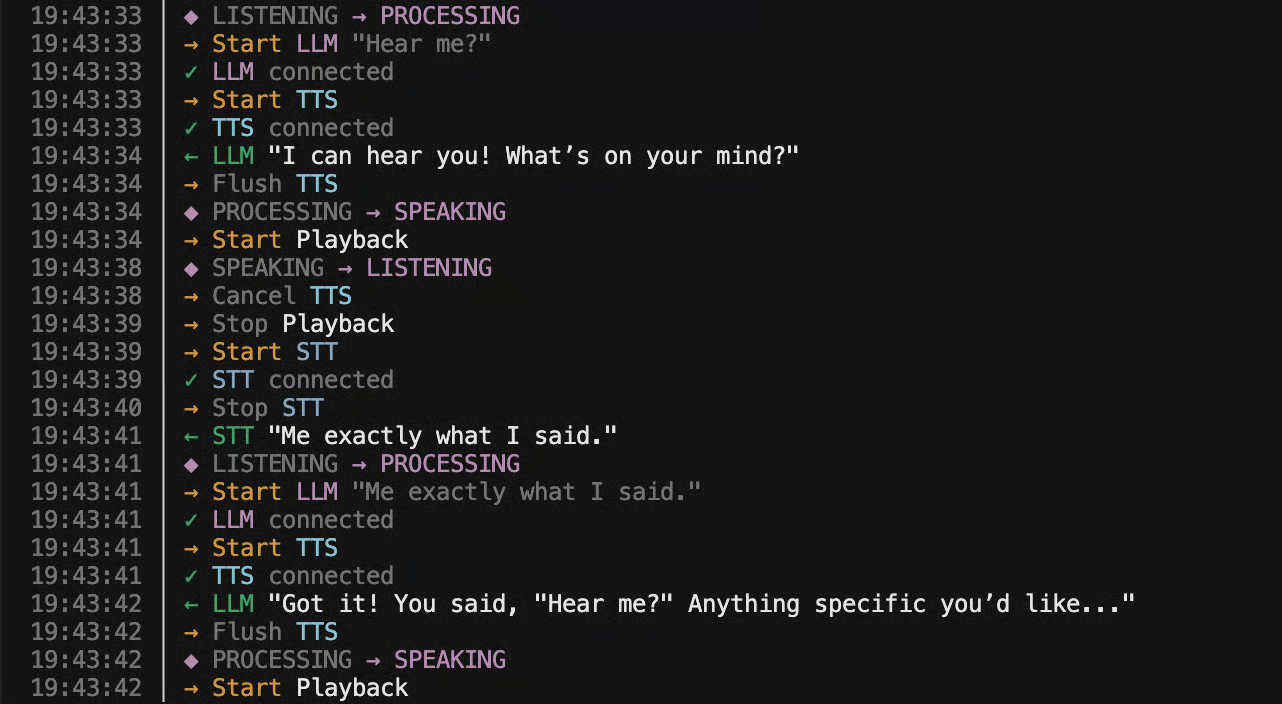
The system reduces to one loop: speaking vs listening. The two transitions - cancel instantly on barge-in, respond instantly on end-of-turn - define the experience.
STT → LLM → TTS must stream. Sequential pipelines are dead on arrival for natural conversation.
TTFT dominates everything. In voice, the first token is the critical path. Groq’s ~80ms TTFT was the single biggest win.
Geography matters more than prompts. Colocate everything or you lose before you start.
GitHub Repo:
https://github.com/NickTikhonov/shuo
Follow whatever I next tinker with: https://x.com/nick_tikhonov
Comments (153) 62 threads
Show all comments
Showing thread 5 of 62
https://research.nvidia.com/labs/adlr/personaplex/
Is it super sexy? No. But each individual type of model is developing at a different rate (TTS moves really fast, low latency STT/ASR moved slower, LLMs move at a pretty good pace).
Just use the same tricks humans are using for that.
The cascading model (STT -> LLM -> TTS), is unlikely to go away anytime soon for a whole lot of reasons. A big one is observability. The people paying for voice agents are enterprises. Enterprises care about reliability and liability. The cascading model approach is much more amenable to specialization (rather than raw flexibility / generality) and auditability.
Organizations in regulated industries (e.g. healthcare, finance, education) need to be able to see what a voice agent "heard" before it tries to "act" on transcribed text, and same goes for seeing what LLM output text is going to be "said" before it's actually synthesized and played back.
Speech-to-Speech (end-to-end) models definitely have a place for more "narrative" use cases (think interviewing, conducting surveys / polls, etc.).
But from my experience from working with clients, they are clamoring for systems and orchestration that actually use some good ol' fashioned engineering and that don't solely rely on the latest-and-greatest SoTA ML models.