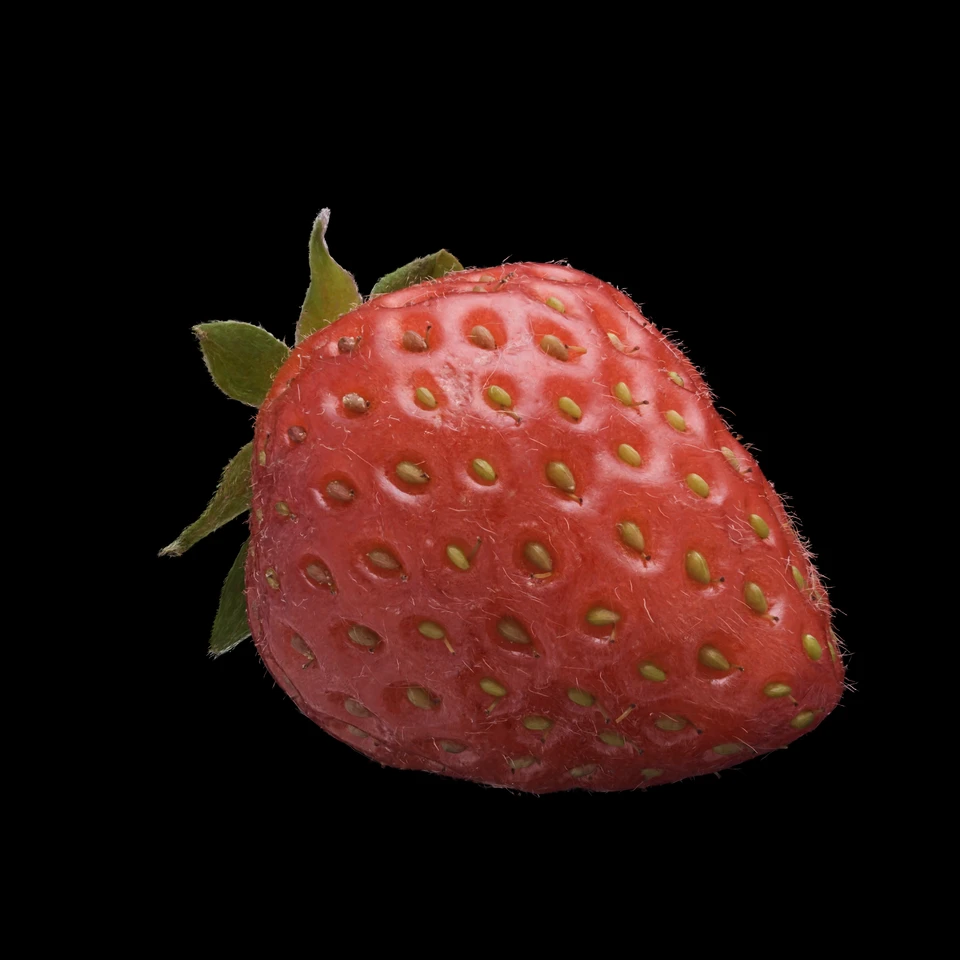
This is like a beautiful little miniature. It's cool to see gaussian splatting applied to a detailed small thing versus a big scene.
I have a question about perhaps the most boring aspect of this strawberry: the license. you write, "You can download it under CC BY license, but attribution is appreciated rather than required." IANAL, but I'm pretty sure you can't license your work CC-BY and then waive the BY requirement in the description. Rather, you'd have to license it with something more permissive like CC0 and request attribution if you want attribution to be optional. Is that right?
It's their content. They can do anything they like.
Sort of. There are countries like France where attribution rights are fundamentally inalienable, and the author can always demand attribution, even after forever waiving the right to attribution. But in the US, the party who benefits from a contractual provision can generally choose to ignore or forfeit that provision. Whether it's still called the "CC BY" after that is debatable, since the whole point is attribution, but licensing by the CC BY and immediately waiving that requirement seems legitimate to me.
The filesize of a 3d animated splat is seemingly very small, and the method enables ~arbitrary FPS. But it seems the setup required to record it is still huge and expensive, which limits its usefulness. Even with that there are some interesting use cases, eg. I'd love to be able to watch concerts this way, and freely move around the stage and crowd from any angle.
There is a faint sensation of translucency, I wonder if that's an artefact of the process, or if it's the actual optics of the surface layer if the strawberry...
Well, at certain angles you actually get very noticeable gaps in the strawberry that are visible when rotating it, but almost invisible when static. I think it's mostly due to that.
It's an artefact unfortunately. Gaussian splats have no concept of refraction and have a hard time dealing with reflection. Highlights, usually so so. Something I always wrangle.
I wonder if that is somehow related to how you seem to have very strong studio light for the subjects? Somehow the bright light penetrating deeper into the material or something like that
The light doesn't need to be completely flat like what you'd do when scanning it more traditionally, for meshing. The problem is when the highlight is sharp and reflects it's surrounding. You could remove it, with cross polarization.. But then it wouldn't look realistic anymore.
Comments (200) 61 threads
Earlier commentsI have a question about perhaps the most boring aspect of this strawberry: the license. you write, "You can download it under CC BY license, but attribution is appreciated rather than required." IANAL, but I'm pretty sure you can't license your work CC-BY and then waive the BY requirement in the description. Rather, you'd have to license it with something more permissive like CC0 and request attribution if you want attribution to be optional. Is that right?
Sort of. There are countries like France where attribution rights are fundamentally inalienable, and the author can always demand attribution, even after forever waiving the right to attribution. But in the US, the party who benefits from a contractual provision can generally choose to ignore or forfeit that provision. Whether it's still called the "CC BY" after that is debatable, since the whole point is attribution, but licensing by the CC BY and immediately waiving that requirement seems legitimate to me.
The filesize of a 3d animated splat is seemingly very small, and the method enables ~arbitrary FPS. But it seems the setup required to record it is still huge and expensive, which limits its usefulness.
Even with that there are some interesting use cases, eg. I'd love to be able to watch concerts this way, and freely move around the stage and crowd from any angle.
All comments shown.
Couldn't load more comments. Check your connection and try again.