Show HN: I trained a 125M model to autocomplete piano on-device (opens in a new tab)simedw.com
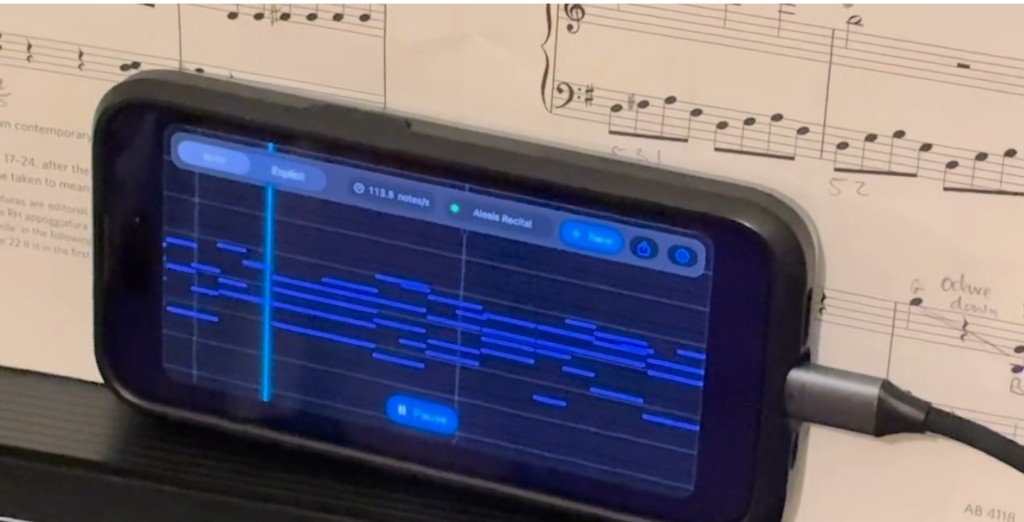
598 pointsI trained a 125M-parameter transformer to autocomplete piano performances in real time (~108 notes/sec on an iPhone 15).
The idea is basically GitHub Copilot or Tabnine, except instead of prompting it with code, you prompt it by playing a few notes on a MIDI piano. The model then continues what you played, entirely on-device.
The app is free if anyone wants to try it. Happy to answer questions about the model, training, Core ML, or the many things that didn't work.
Comments (117) 65 threads
Earlier commentsThe closest we've had to realtime orchestration around a melody in the "real world" is probably arranger keyboards though your left hand is still responsible for the chord progression itself.
[1] - https://en.wikipedia.org/wiki/Microsoft_Research_Songsmith
Some details: https://shop.chessbase.com/en/products/ludwig_3_engl
You can still download it for free: https://www.heise.de/download/product/ludwig-58854 (Heise is a renowned German publisher, nothing shady)
I am still waiting for something like this based on generaitive AI.
Some protocols (like I2C or MIDI) are gonna be with humanity forever, probably.
Does anybody know of a project that has produced more convincing results?
While LLMs (and ANNs in general) are definitely great for musical analysis (though still limited), I think they're likely overkill for the generation part, plus they tend to suffer from "creative collapse" as they prefer averages rather than exploration (which can be good or bad depending on what you want).
You started by playing a simple I - vii - I as the first sub-phrase. Then the AI started its response with a dominant 7th-chord. In the vast majority of cases I can think of from the Classical era, the AI's sub-phrase would end with a half-cadence. So, including what you played, the first two sub-phrases would look like this:
I - vii - I
V(7) - I - V
But instead, the AI took the unusual step of having a full cadence for that 2nd sub-phrase. This in music is what someone might call a "double beat" in screenwriting.
Moreover, there are no half cadences in the phrase after that. It's all full cadences in the tonic key, plus two plagal cadences over a tonic pedal there in the 2nd phrase. Each sub-phrase just extends the tonic. There are idiomatic ways to just stay in the tonic for awhile, like "Horn fifths." But this excerpt isn't idiomatic and sounds like the composer accidentally forgot to develop the harmony.
I'm going to claim that this excerpt would sound like the musical equivalent of a run-on sentence to any composer who lived from the time of J.S. Bach to Robert Schumann. And from Mahler on they'd assume you're thumbing your nose at convention.
Put another way: the kind of student who'd use this to finish a harmony exercise would end up getting the same grade they would have gotten doing it on their own.
Edit: clarifications
All comments shown.
Couldn't load more comments. Check your connection and try again.