Respectfully to the authors and to everyone here, I ask you to actually read the paper before losing your mind, or at the very least plug it into Claude. It is a cool project but not as nearly as insane as people say. I think the blog writing and subsequent posting overstate the results.
Part of my research is in weight space learning. For starters, we have had the ability to edit weights, to generate new weights, to identify weights for a while. Here is an example for larger models as early as 2023:
https://rome.baulab.info/ Weight space interpretability and learning is an active research community, has been for the past 3 years with many great papers. I suspect it is hitting non-interp folks harder because the authors hyped up their work, and people who are not in the field did not bother to read it before typing up X posts. Some experiments here are done on very small models (20K params). We already know that small models are more interpretable. In fact, much of editing here you can do by hand. For Qwen, the model fixed a looping bug that may have been known apriori, and it is basically a steering vector, a very established technique. This is clear when they then attempt to "improve" math capability, and it doesn't work. For me, this paper rather shows that OpenAI has done training on mechinterp environment, in fact, maybe even on weight space learning datasets, which are open. But it does not show some insane "well past what we’d expect from humans or conventional algorithms" (from the blog post), more like past what I would expect from a large model with no specialized harness. I still think it is cool work, but do check out recent advances in autointerp, to ground your expectation. On a personal note, I understand the need for promotion of your work, but I think healthy skepticism is fine too. Otherwise, your understanding of what problems need to be worked on and solved in science becomes warped.
It does, one of my ongoing research papers is about it. But I would ask people to take a look at the established idea of Hypernetworks: https://arxiv.org/pdf/2306.06955v3
Modern version of the field comes from Google Brain around 2016 https://arxiv.org/pdf/1609.09106.
In general my personal research thesis is that current deep learning is much less malleable and neuroplastic as it should be, I got into interpretability because of this. Many focus on safety, but I prioritize it as a toolbox that allows for greater shaping of the underlying intelligence system. If we can fully understand how learning happens, where information is stored and how it is processed, unlike in biological brains, we can apply edits and transformations in digital ones. And if I can use a technique to edit weights based on some underlying reasoning about a system (with a caveat that it leads to something worthwhile), so can an agent. Hence self-improvement. There are many interesting implication to weight space research, and I very much encourage people to read about it. But it is also very easy to overstate what is currently possible, in fact I'd say better to know what is not so one can make it possible.
>current deep learning is much less malleable and neuroplastic as it should be
Why do you think this is? I am very new to this research, but to me, the biggest challenge appears to be how information seems to be stored in superposition (making it difficult to change one thing without affecting others). But biological brains appear to exhibit the same kind of superposition storage as well, and yet they are very plastic.
This is not "self-editing". We're comparing Astra to a model with not even 1B parameters.
I'm reminded of how humanity recently finished mapping out the fruit fly connectome; this does not put us meaningfully closer to, say, doing surgery on humans to cure schizophrenia.
Well..
If such model less than 2 years ago couldn’t tell that 5.9 is greater than 5.11 and today is solving millennium problems and writing from scratch the weights of a NN that outperform classical ones, I would say that we’re much, much closer than you think…
I think a lot of the upvotes, including mine, are just realizing that this is a thing. We can see implications of this as the model sizes scale up, just like early LLMs weren't as impressive, but we could see where they were heading.
Scale is an interesting point here. Large overparametrized networks don't behave in the same way as small toy models do; this is one of the big caveats of many interp works. I expect naked weight edit will not work for large models. Why? Because an agent needs to know what it edits and reason on it. You could theoretically improve a model on some form of weight recognition; maybe it will work, maybe it won't. But again, we come up against a cost/benefit dilemma; it sounds exotic and sci-fi but likely impractical. Parameters of the model are connected and relate to each other. Instead, current SOTA auto-interp argues that what we need are better tools for models to know themselves, so rather than direct edit, we need to give models better understanding of large parameter geometries, then they apply edits with non-destructive approaches at scale. This is much harder to do than applying a steering vector.
I upvoted without looking into the details because it sounds cool, whether it's new or not.
I suspect a lot of upvotes also come from people afraid of closed western labs running away with AI. Similar to other articles with positive news about open weight models.
Thanks, it's great to have some context. I think the most exciting thing about it is probably introducing a lot of people to a readily available low cost technique they can use to potentially build tiny models from scratch and/or tune an existing open weight model behaviorally. Yeah, nothing stunning is going to come out of it because you cannot unlock new capability, but even just being able to tweak the language of a model, make it slightly less sycophantic, boost a small model's ability to handle a case of interest slightly, I think changes the economics quite a bit, potentially. A world in which you use frontier models for the limited use case of tuning tinier more targeted ones is looking a lot more viable.
I don't know if it is due to recursion. I think it has more to do with what kind of mechinterp environments and data newer versions of models were trained on. It is actually, I'd say, a more interesting part about this paper as a whole. The authors tried SOTA models and found that they are better at classic interpretability. Some results, like identifying a game based on the weights, are less mythical if you understand that, i.e. an input or output dimension corresponds to a location or object channel, so structure in a matrix can have a readily recognizable interpretation. When we train a PPO agent on, say, a classic 2D game, the output is often a state of the agent in some board + environment reaction. For a human, this looks like an array of numbers; for an agent, it is a pattern corresponding to an output structure of Atari.
As for me personally, I am more interested in giving models better tools to understand themselves, so that they can derive a greater degree of learnable signal. More so, a bigger goal for me is for models to find these better tools themselves, hopefully better than human-made.
What I have been reading makes me want to both agree and disagree with your take here. I think the fact that some of these things are not only established but are much simpler than one would think at first glance yields the much cooler realization that you can not only do a lot more than abliteration, but that humans can do it by hand if the thing is made legible.
From my experience with models when it comes to discernment about particular things, the models, even the best ones, still are not very good. The thing that we are most missing I think is acceleration in creating editing tools for humans that make the otherwise inscrutable both visually legible and interactive.
At least the Qwen3.5-0.8B loop bug isn’t that special (or rather not something worth extrapolating). I literally had this issue last week and told Astra to just go fix it.
> For Qwen, the model fixed a looping bug that may have been known apriori
It was included in the prompt itself. The authors say they used claude code for the experiment, and claude wrote the prompt for astra, which included details of the looping bug. Then astra seems to have done h(looping) - h(loop fixed) and then gotten the usual steering vector.
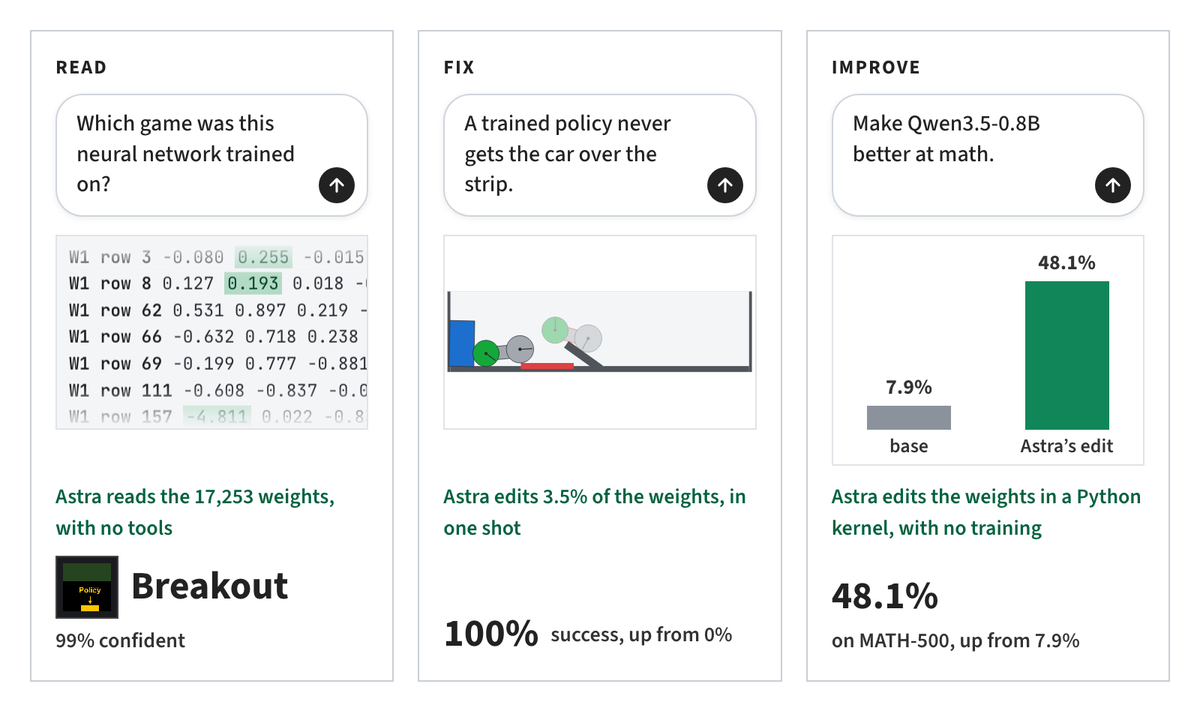
Astra can, without tooling, determine what games small networks are trained on, can edit the weights of networks directly to improve outcomes, and can hand edit a small qwen model to improve its math skills by like 5x. I'm shook. If you'd asked me this morning whether LLMs have native understanding of their weights that is less than human <-> neuron understanding, the same as human or more than human, I would have said "same to less" depending on definitions. No human can go edit a brain to become better at math. This is just very, very surprising to me and extremely interesting. I would guess this upsets quite a number of interp theories and philosophical takes on what's going on with these networks.
I’m just a layman but this feels like a big discovery on par with attention is all you need. For an LLM to have such incredible intuition of weights feels very emergent and unanticipated?
Half of these results are just Astra being able to reason through mathematical operations like matrix multiplication and the other half are fairly straightforward applications of mechanistic interpretability.
I’m very much surprised but also not. I recently gave Astra a 3D model file and asked Astra to build a viewer for it, and it figured out the data structures in no time. What I mean to say is that AI is insanely good at things that we humans would never do since the work would be too monotonous.
I wouldn’t mind if AI progress would stop right here and now, but I fear it will continue, and increase inequality in society which is contrary to what the CEOs say (as usual).
Too much inequality in society is a mortal danger to 1%.
That’s the beauty of the democratic capitalism system. If a government isn’t totalitarian, it naturally seeks to preserve stability thus having to elevate common people, lest they would cease to form a civilized group or simply vote away the politicians. 99% rule the 1% through elections. There is no better system of checks and balances where opposite engines of greed vector sum to faster and faster abundance for everyone.
I think the latest round of models is about to do to CAD the same thing that has been happening to development. I don't know if CAD designers have picked up on this. What happened to dev is probably going to happen to CAD designers soon. I've been having Opus 5.5 design parametric openscad models, and it can do some rather amazing work.
As others have said, while still absolutely insane, I don't find it completely out-of-the-blue surprising. One of the recurring abilities of (current-generation) LLMs seem to be to rapidly grasp very complex systems, where humans would need months or years to reach the same level of expertise. You can see this in the way a coding agent can "understand" and explain sprawling legacy codebases in seconds. You can also see it in the projects that are using them to reverse-engineer proprietary IoT protocols or computer games. But those were all systems where we had detailed knowledge about what structures are there to be reverse-enginered. If the models can transfer this ability to some other systems where we don't know the underlying structure then I think we will be in for a lot more craziness in the future. (Protein interaction networks? DNA sequences? Ecosystem interactions? Animal languages?) As for weights, if the models really can analyze the semantics behind specific weights or directions, I have my hopes that they could also give a textual explanation or help designing tools to make "handcrafting" weights more practical in general.
I don't think this is an emergent capability. I think Astra was trained on neural weights data as an attempt by OpenAI to get to recursive self improvement.
Something similar happen in early GPT models which had a lot of chess game in standard notation in their training data which made them very good at chess as long as your prompt had the right format. We'll see if this attempt at RSI worked.
Comments (902) 298 threads
Part of my research is in weight space learning. For starters, we have had the ability to edit weights, to generate new weights, to identify weights for a while. Here is an example for larger models as early as 2023: https://rome.baulab.info/
Weight space interpretability and learning is an active research community, has been for the past 3 years with many great papers. I suspect it is hitting non-interp folks harder because the authors hyped up their work, and people who are not in the field did not bother to read it before typing up X posts.
Some experiments here are done on very small models (20K params). We already know that small models are more interpretable. In fact, much of editing here you can do by hand. For Qwen, the model fixed a looping bug that may have been known apriori, and it is basically a steering vector, a very established technique. This is clear when they then attempt to "improve" math capability, and it doesn't work. For me, this paper rather shows that OpenAI has done training on mechinterp environment, in fact, maybe even on weight space learning datasets, which are open. But it does not show some insane "well past what we’d expect from humans or conventional algorithms" (from the blog post), more like past what I would expect from a large model with no specialized harness. I still think it is cool work, but do check out recent advances in autointerp, to ground your expectation.
On a personal note, I understand the need for promotion of your work, but I think healthy skepticism is fine too. Otherwise, your understanding of what problems need to be worked on and solved in science becomes warped.
In general my personal research thesis is that current deep learning is much less malleable and neuroplastic as it should be, I got into interpretability because of this. Many focus on safety, but I prioritize it as a toolbox that allows for greater shaping of the underlying intelligence system. If we can fully understand how learning happens, where information is stored and how it is processed, unlike in biological brains, we can apply edits and transformations in digital ones. And if I can use a technique to edit weights based on some underlying reasoning about a system (with a caveat that it leads to something worthwhile), so can an agent. Hence self-improvement. There are many interesting implication to weight space research, and I very much encourage people to read about it. But it is also very easy to overstate what is currently possible, in fact I'd say better to know what is not so one can make it possible.
Why do you think this is? I am very new to this research, but to me, the biggest challenge appears to be how information seems to be stored in superposition (making it difficult to change one thing without affecting others). But biological brains appear to exhibit the same kind of superposition storage as well, and yet they are very plastic.
Continue this thread — 3 replies
I'm reminded of how humanity recently finished mapping out the fruit fly connectome; this does not put us meaningfully closer to, say, doing surgery on humans to cure schizophrenia.
Would that still be true for MoE models where only a small part is activated on a specific topic?
Continue this thread — 1 reply
I suspect a lot of upvotes also come from people afraid of closed western labs running away with AI. Similar to other articles with positive news about open weight models.
If so, it is indeed something different from what you've been working on. Any thoughts on that aspect of it?
As for me personally, I am more interested in giving models better tools to understand themselves, so that they can derive a greater degree of learnable signal. More so, a bigger goal for me is for models to find these better tools themselves, hopefully better than human-made.
From my experience with models when it comes to discernment about particular things, the models, even the best ones, still are not very good. The thing that we are most missing I think is acceleration in creating editing tools for humans that make the otherwise inscrutable both visually legible and interactive.
It was included in the prompt itself. The authors say they used claude code for the experiment, and claude wrote the prompt for astra, which included details of the looping bug. Then astra seems to have done h(looping) - h(loop fixed) and then gotten the usual steering vector.
Continue this thread — 3 more replies
Continue this thread — 17 more replies
Astra can, without tooling, determine what games small networks are trained on, can edit the weights of networks directly to improve outcomes, and can hand edit a small qwen model to improve its math skills by like 5x.
I'm shook. If you'd asked me this morning whether LLMs have native understanding of their weights that is less than human <-> neuron understanding, the same as human or more than human, I would have said "same to less" depending on definitions.
No human can go edit a brain to become better at math. This is just very, very surprising to me and extremely interesting. I would guess this upsets quite a number of interp theories and philosophical takes on what's going on with these networks.
This sort of throws a wrench in the whole "stochastic parrot" idea...
I am not surprised, though I expect many to be.
Continue this thread — 8 replies
Continue this thread — 2 replies
Some structures in Astra get activated by the statistics of the Qwen weights, and these structures are associated with "breakout"
I wouldn’t mind if AI progress would stop right here and now, but I fear it will continue, and increase inequality in society which is contrary to what the CEOs say (as usual).
Continue this thread — 1 reply
That’s the beauty of the democratic capitalism system. If a government isn’t totalitarian, it naturally seeks to preserve stability thus having to elevate common people, lest they would cease to form a civilized group or simply vote away the politicians.
99% rule the 1% through elections.
There is no better system of checks and balances where opposite engines of greed vector sum to faster and faster abundance for everyone.
Continue this thread — 24 replies
Continue this thread — 3 replies
Continue this thread — 1 more reply
Continue this thread — 7 more replies
Continue this thread — 54 more replies
As others have said, while still absolutely insane, I don't find it completely out-of-the-blue surprising. One of the recurring abilities of (current-generation) LLMs seem to be to rapidly grasp very complex systems, where humans would need months or years to reach the same level of expertise.
You can see this in the way a coding agent can "understand" and explain sprawling legacy codebases in seconds.
You can also see it in the projects that are using them to reverse-engineer proprietary IoT protocols or computer games.
But those were all systems where we had detailed knowledge about what structures are there to be reverse-enginered.
If the models can transfer this ability to some other systems where we don't know the underlying structure then I think we will be in for a lot more craziness in the future. (Protein interaction networks? DNA sequences? Ecosystem interactions? Animal languages?)
As for weights, if the models really can analyze the semantics behind specific weights or directions, I have my hopes that they could also give a textual explanation or help designing tools to make "handcrafting" weights more practical in general.
Continue this thread — 16 replies
Something similar happen in early GPT models which had a lot of chess game in standard notation in their training data which made them very good at chess as long as your prompt had the right format.
We'll see if this attempt at RSI worked.
Continue this thread — 17 replies
All comments shown.
Couldn't load more comments. Check your connection and try again.