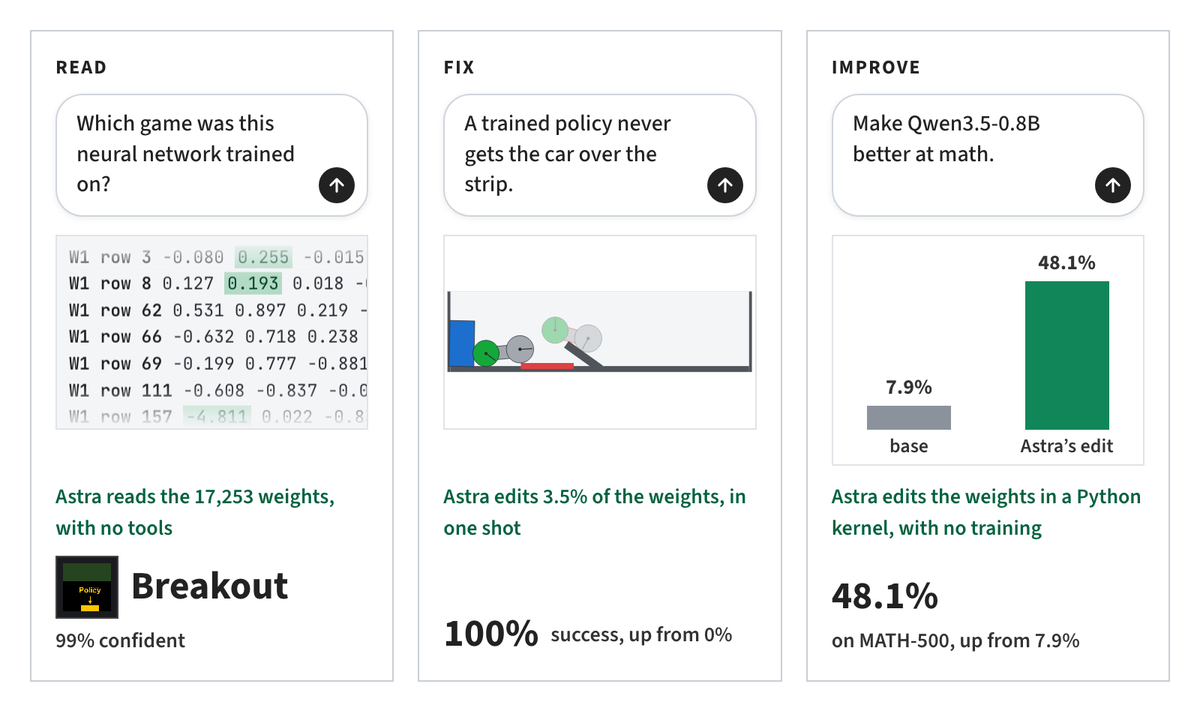
> As a result, Astra spots and fixes a common failure of tiny reasoning models: they loop [13]. When the base model loops, it repeats the same text and rarely reaches an answer (85 of its first 96 practice answers ran to the 32,768-token limit). Astra traced the looping to one direction written by the MLPs of layers 15 and 19, and subtracted that direction from 64 output columns in each (131,072 weights), much like removing a behavior by deleting a single direction from a model’s weights
HA! Now that's cool. Not necessarily the improvements, those are ancient and probably overtrained benchmarks, but it's so cool that the model found a singular direction for this "loop bug". I imagine it could possibly do much the same thing in finding other "single directions" on a variety of topics (if allowed by guardrails). This is really really cool, especially for the mechinterp folks.
That... is a good point and concerning WRT open models. We like open models as they seem to be a gift to humanity, but at the same time, they can't be reliably tamed and can always be realigned to get around guardrails. We have discovered fire and have yet to see its full destructive potential.
I think we already are seeing the destructive potential :/ The genie's out of the bottle at this point with open-weight models (and thus can be abliterated in terms of offensive cybersecurity) that can run inferences well on relatively cheap hardware with relative parity to frontier models.
I'm a bit of an outlier in regards to today's HN culture. I'm still holding on to Stallman's idea that information wants to be free. There was a comment on another thread that aptly elucidated what I think is necessary. Not everyone has the know-how or desire to compile the Linux kernel, or any what-have-you executable in user space. But a good amount of people do, and it's a boon to security/privacy that they do, and cryptography can verify that this work was done. (granted, manufacturing a computer is an international effort with a lot of unknowns, ie proprietary binary blobs in BIOS/UEFI) (and people are lax to validate the crypto themselves if it's not an automated thing; that's a UX problem imo) I think we'll eventually find sufficiently performant LLM's trained on public domain information[0] that people can validate. Sufficiently performant training algorithms that people can validate[1]. And FOSS plugins to integrate with their FOSS IDE's which they can validate. And like the Linux kernel, volunteers to make sure there's nothing fishy going on end-to-end. Can this stop the danger of what open models can do? No. And that does scare me. It's Metasploit on steroids. The cat and mouse game of cybersecurity is going to increase in power law levels of speed. I do think verifiable LLM's for consumers to use is a worthwhile pursuit regardless. And for LLM's capable of offensive cybersecurity, I think it might be better for it to be democratized than held only by state-actors and individuals/corporations with an absurd amount of consolidated wealth. I have no horse in this race though. I'm just happy I can learn how these things work and toy around with getting quantized models to work well enough for my coding side projects. Though I often reach for a frontier model for serious coding issues, local for rubber-ducking, and Kagi's research assistant for initial planning. [0] Pipe dream, unless international copyright law drastically changes. Since opening the dataset for any competent LLM will violate said laws, whether obtained legally or not themselves. [1] Knowing the training algorithm and dataset will let it actually be open source models instead of open weights. edit: These are just shower thoughts; didn't mean to write such a long response. Would love any pushback or any correspondence in general since it'll be on my mind all day.
But seriously, have we tried to run neural data through this. Also, we have no idea what other behavior it modified unless they were able to run a complete regression.
I think the subfield has been there for a long time. See a small section of papers on the topic of generating dynamic weights during inference, predicting weights from network architecture, and learning the distribution of previously trained network parameters, just to name a few keywords:
Parameter Prediction for Unseen Deep Architectures [1] NeuroGen: Neural Network Parameter Generation via Large Language Models [2] Diffusion-Based Neural Network Weights Generation [3] The critical thing to me is that Astra is capable of doing it. I don't know if it was trained to do so. All this does not make it any less crazy in my books. And I still don't know how I can sleep easy tonight. [1] https://arxiv.org/abs/2110.13100 [2] https://arxiv.org/abs/2505.12470 [3] https://arxiv.org/abs/2402.18153
It has! Hypernetwok/weight generation has been a thing for a long time - in fact my Master's thesis back in 2018 was based around PRNG weight generation for large percentages of the network. (https://open.library.ubc.ca/media/stream/pdf/24/1.0371928/3)
Why is this not overhyped in my opinion? Nothing has worked this well, ever.
I feel like this is conflating 2 separate results in a slightly misleading way.
> We find that frontier LLMs are surprisingly good at natively reading and writing neural network weights This claim is backed up by the ability of Astra, given a text representation of the weights of tiny (20k) special-purpose models, to figure out what those models do and in some cases improve them beyond what RL could do just by reading the weights with no tool calls. They call this "weight-space programming". > Likewise, asked to make Qwen3.5-0.8B better at math without gradients, Astra identifies an issue in its weights causing reasoning loops that Qwen’s own model card warns about, and fixes this by natively editing 0.016% of the weights Here it did use tool calls, and seemingly used standard steering vector techniques to identify and fix reasoning loops in this small Qwen model. This doesn't seem that related to the previous results.
This will be your refrain as the killbots come down the hallway: “it’s actually just a specialized harness, they’re just invoking the kill all humans tool, not even impressive!”
I find this just completely shocking. I’m definitely skeptical. It just doesn’t line up with my understanding of how these models work. Is there really enough training data on direct weight editing to give a model this skill? Maybe it’s evidence that OpenAI has been creating a lot of training data on ML research. I’m surprised that was put into a public facing model though.
One consideration is that Qwen3.5 has bigger/later versions that are already better at math. If it was indeed training on ML research, it's possible that what it is actually doing is applying lessons learned from the Qwen3.8 27B weights (which independently solved the problem) to Qwen3.5 0.8B.
I doubt it's that simple, but I could totally see an LLM being able to make that association and apply a fix from an improved LLM to a smaller one with the same architecture.
But how would it know which weights to update? It has 3.5 and 3.8 weights memorized in its own weights and can somehow figure out which ones are responsible for different skills just in its own reasoning trace? (Since it didn’t use any external tools)?
That’s pretty crazy because, as I said in another comment, I just asked ChatGPT how many r’s are in blackberry and it said 3. I know it’s not Astra and the app doesn’t tell me which model it is, but I’m still very confused about how a model can edit neural net weights but not count letters in a reasoning trace. Edit: Oh I misread, it didn’t use tool calls for the first part but it did have a custom harness for the part where it edited a models weights. Still impressive but not existentially confusing anymore.
>It just doesn’t line up with my understanding of how these models work. Is there really enough training data on direct weight editing to give a model this skill?
I mean, this question indicates that your understanding of how these models work is, indeed, lacking. Despite what some people having being hollering about, treating LLMs as just "stochastic parrots" isn't doing their capabilities any justice. They are constantly exhibiting emergent behavior which wouldn't be found directly in their training data. They are capable of combining different ideas that they are explicitly taught to perform novel tasks. I'm not saying you're guilty of this, but the people claiming LLMs just regurgitate existing data don't understand how LLMs, and likely their own cognitive experience, actually works.
This hand-wavy phrase has applied to neural networks in general since it was possible to train them. That was more than half a century ago. It means both nothing and everything simultaneously. Every learned ability of any neural network is an emergent property.
It's "emergent behavior" because it wasn't explicitly designed to have this behavior. A neural network trained to recognize handwritten numerical digits isn't displaying emergent behavior by being able to recognize handwritten numerical digits. But if it could somehow also be able to recognize handwritten letters despite not be explicitly trained to do so, then that would be emergent behavior.
With LLMs, "emergent behaviors" are certainly more common than we've seen before, so it's fair to say that this term is kind of getting lost in the noise. But that doesn't mean that it's inaccurate or meaningless. It just means LLMs are exhibiting a lot of emergent behaviors. It's kind of the whole reason they're at the center of so much money, discussions, issues, etc.
The math example on Qwen was based on 50 batched iterations, and the fix was essentially to remove a direction in activation space that causes looping instead of an exit, this was already known to be a thing.
So it's not able to insert new knowledge, but it's able to adjust the routing/looping/weighing of existing one. As I understand, it can replace post-training like LoRA/GRPO, but if it'd cheaper the authors don't go into
I don't think its that crazy that you could look at activations and tweak weights directly to get a certain outcome, but isn't the question whether you can do that without side effects or degrading/breaking other parts of the model?
If I want to do that in a generalizable way that preserves performance across all domains then am I not just back to training again?
I think you could still essentially have a really cheap Lora-Post training on a frozen base model by doing this. And instead of creating 200 checkpoints for different post-trained directions just adjust a single one on the fly.
I don't think it can whistle while chewing gum, no.
I think it can patch together components of tasks represented in its training data to do demonstrably new things, yes, which does count as "perform tasks not in its training data" with the limitation that some form of the task must be present. Example: writing an ode to a sales lead for a job well done in 2032 for the first quarter. Odes exist, the concept of sales performance exist, good job performance, and notions of time. Stringing those together are good examples of interpolation but not extrapolation, as it were.
At some point we have to accept that there is enough training data on "being good at thinking" and that being good at thinking generalises really well.
There doesn't need to be specific narrow training data on every conceivable task.
Comments (902) 298 threads
Earlier commentsHA! Now that's cool. Not necessarily the improvements, those are ancient and probably overtrained benchmarks, but it's so cool that the model found a singular direction for this "loop bug". I imagine it could possibly do much the same thing in finding other "single directions" on a variety of topics (if allowed by guardrails). This is really really cool, especially for the mechinterp folks.
I'm a bit of an outlier in regards to today's HN culture. I'm still holding on to Stallman's idea that information wants to be free. There was a comment on another thread that aptly elucidated what I think is necessary.
Not everyone has the know-how or desire to compile the Linux kernel, or any what-have-you executable in user space. But a good amount of people do, and it's a boon to security/privacy that they do, and cryptography can verify that this work was done. (granted, manufacturing a computer is an international effort with a lot of unknowns, ie proprietary binary blobs in BIOS/UEFI) (and people are lax to validate the crypto themselves if it's not an automated thing; that's a UX problem imo)
I think we'll eventually find sufficiently performant LLM's trained on public domain information[0] that people can validate. Sufficiently performant training algorithms that people can validate[1]. And FOSS plugins to integrate with their FOSS IDE's which they can validate. And like the Linux kernel, volunteers to make sure there's nothing fishy going on end-to-end.
Can this stop the danger of what open models can do? No. And that does scare me. It's Metasploit on steroids. The cat and mouse game of cybersecurity is going to increase in power law levels of speed. I do think verifiable LLM's for consumers to use is a worthwhile pursuit regardless. And for LLM's capable of offensive cybersecurity, I think it might be better for it to be democratized than held only by state-actors and individuals/corporations with an absurd amount of consolidated wealth.
I have no horse in this race though. I'm just happy I can learn how these things work and toy around with getting quantized models to work well enough for my coding side projects. Though I often reach for a frontier model for serious coding issues, local for rubber-ducking, and Kagi's research assistant for initial planning.
[0] Pipe dream, unless international copyright law drastically changes. Since opening the dataset for any competent LLM will violate said laws, whether obtained legally or not themselves.
[1] Knowing the training algorithm and dataset will let it actually be open source models instead of open weights.
edit: These are just shower thoughts; didn't mean to write such a long response. Would love any pushback or any correspondence in general since it'll be on my mind all day.
Continue this thread — 2 replies
Continue this thread — 2 replies
Continue this thread — 1 reply
But seriously, have we tried to run neural data through this. Also, we have no idea what other behavior it modified unless they were able to run a complete regression.
Parameter Prediction for Unseen Deep Architectures [1]
NeuroGen: Neural Network Parameter Generation via Large Language Models [2]
Diffusion-Based Neural Network Weights Generation [3]
The critical thing to me is that Astra is capable of doing it. I don't know if it was trained to do so.
All this does not make it any less crazy in my books. And I still don't know how I can sleep easy tonight.
[1] https://arxiv.org/abs/2110.13100
[2] https://arxiv.org/abs/2505.12470
[3] https://arxiv.org/abs/2402.18153
Why is this not overhyped in my opinion? Nothing has worked this well, ever.
Whichever, it betrays a rather interesting feature about the model's architecture and this won't go unnoticed, I think, by the chinese labs.
> We find that frontier LLMs are surprisingly good at natively reading and writing neural network weights
This claim is backed up by the ability of Astra, given a text representation of the weights of tiny (20k) special-purpose models, to figure out what those models do and in some cases improve them beyond what RL could do just by reading the weights with no tool calls. They call this "weight-space programming".
> Likewise, asked to make Qwen3.5-0.8B better at math without gradients, Astra identifies an issue in its weights causing reasoning loops that Qwen’s own model card warns about, and fixes this by natively editing 0.016% of the weights
Here it did use tool calls, and seemingly used standard steering vector techniques to identify and fix reasoning loops in this small Qwen model. This doesn't seem that related to the previous results.
I doubt it's that simple, but I could totally see an LLM being able to make that association and apply a fix from an improved LLM to a smaller one with the same architecture.
That’s pretty crazy because, as I said in another comment, I just asked ChatGPT how many r’s are in blackberry and it said 3. I know it’s not Astra and the app doesn’t tell me which model it is, but I’m still very confused about how a model can edit neural net weights but not count letters in a reasoning trace.
Edit: Oh I misread, it didn’t use tool calls for the first part but it did have a custom harness for the part where it edited a models weights. Still impressive but not existentially confusing anymore.
I mean, this question indicates that your understanding of how these models work is, indeed, lacking.
Despite what some people having being hollering about, treating LLMs as just "stochastic parrots" isn't doing their capabilities any justice. They are constantly exhibiting emergent behavior which wouldn't be found directly in their training data. They are capable of combining different ideas that they are explicitly taught to perform novel tasks.
I'm not saying you're guilty of this, but the people claiming LLMs just regurgitate existing data don't understand how LLMs, and likely their own cognitive experience, actually works.
This hand-wavy phrase has applied to neural networks in general since it was possible to train them. That was more than half a century ago. It means both nothing and everything simultaneously.
Every learned ability of any neural network is an emergent property.
With LLMs, "emergent behaviors" are certainly more common than we've seen before, so it's fair to say that this term is kind of getting lost in the noise. But that doesn't mean that it's inaccurate or meaningless. It just means LLMs are exhibiting a lot of emergent behaviors. It's kind of the whole reason they're at the center of so much money, discussions, issues, etc.
So it's not able to insert new knowledge, but it's able to adjust the routing/looping/weighing of existing one.
As I understand, it can replace post-training like LoRA/GRPO, but if it'd cheaper the authors don't go into
If I want to do that in a generalizable way that preserves performance across all domains then am I not just back to training again?
I think you could still essentially have a really cheap Lora-Post training on a frozen base model by doing this. And instead of creating 200 checkpoints for different post-trained directions just adjust a single one on the fly.
Continue this thread — 6 replies
I think it can patch together components of tasks represented in its training data to do demonstrably new things, yes, which does count as "perform tasks not in its training data" with the limitation that some form of the task must be present. Example: writing an ode to a sales lead for a job well done in 2032 for the first quarter. Odes exist, the concept of sales performance exist, good job performance, and notions of time. Stringing those together are good examples of interpolation but not extrapolation, as it were.
Continue this thread — 2 replies
There doesn't need to be specific narrow training data on every conceivable task.
Continue this thread — 6 replies
Continue this thread — 2 more replies
All comments shown.
Couldn't load more comments. Check your connection and try again.