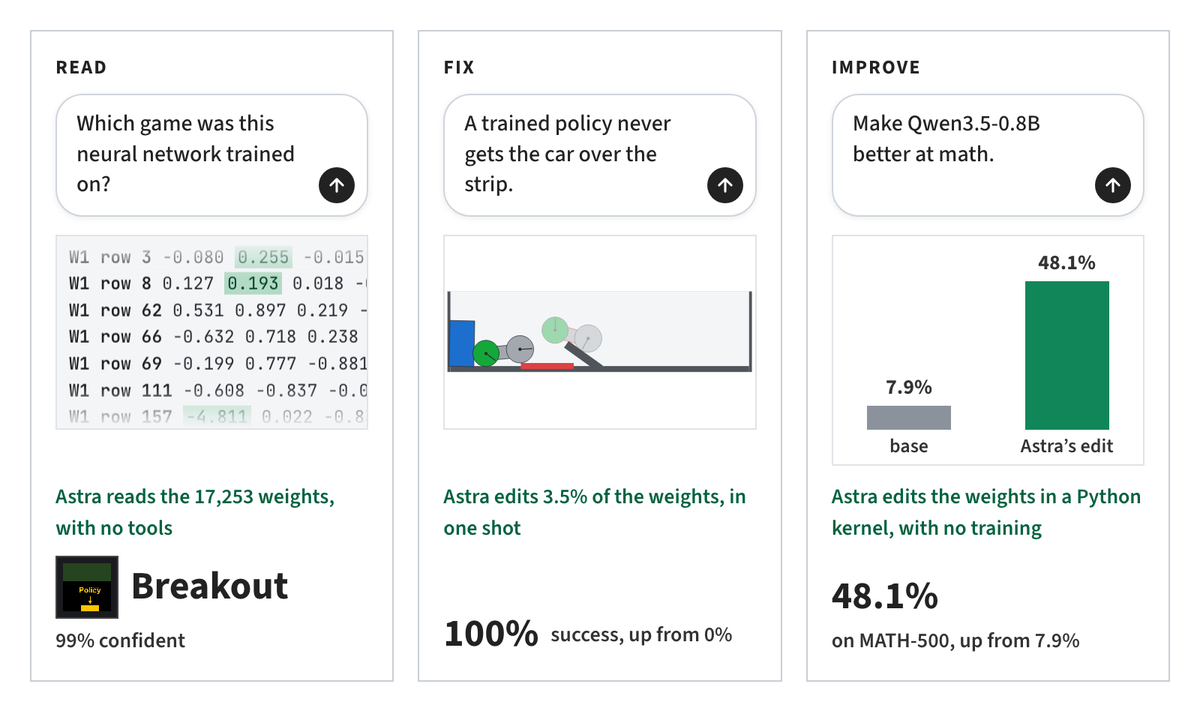
Astra can, without tooling, determine what games small networks are trained on, can edit the weights of networks directly to improve outcomes, and can hand edit a small qwen model to improve its math skills by like 5x. I'm shook. If you'd asked me this morning whether LLMs have native understanding of their weights that is less than human <-> neuron understanding, the same as human or more than human, I would have said "same to less" depending on definitions. No human can go edit a brain to become better at math. This is just very, very surprising to me and extremely interesting. I would guess this upsets quite a number of interp theories and philosophical takes on what's going on with these networks.
I’m just a layman but this feels like a big discovery on par with attention is all you need. For an LLM to have such incredible intuition of weights feels very emergent and unanticipated?
Half of these results are just Astra being able to reason through mathematical operations like matrix multiplication and the other half are fairly straightforward applications of mechanistic interpretability.
I’m very much surprised but also not. I recently gave Astra a 3D model file and asked Astra to build a viewer for it, and it figured out the data structures in no time. What I mean to say is that AI is insanely good at things that we humans would never do since the work would be too monotonous.
I wouldn’t mind if AI progress would stop right here and now, but I fear it will continue, and increase inequality in society which is contrary to what the CEOs say (as usual).
Too much inequality in society is a mortal danger to 1%.
That’s the beauty of the democratic capitalism system. If a government isn’t totalitarian, it naturally seeks to preserve stability thus having to elevate common people, lest they would cease to form a civilized group or simply vote away the politicians. 99% rule the 1% through elections. There is no better system of checks and balances where opposite engines of greed vector sum to faster and faster abundance for everyone.
I think the latest round of models is about to do to CAD the same thing that has been happening to development. I don't know if CAD designers have picked up on this. What happened to dev is probably going to happen to CAD designers soon. I've been having Opus 5.5 design parametric openscad models, and it can do some rather amazing work.
> What I mean to say is that AI is insanely good at things that we humans would never do since the work would be too monotonous.
In my opinion AI is superior to humans when it comes to pattern recognition in in large amounts of data. For example humans can only hold like 7 distinct numbers in the short term memory and you would require extra context-management (aka writing things down, storing them in a system entry by entry) while the AI can do this effortlessly with huge datasets. I'd argue this is the core part that enables all this superhuman intelligence.
This does feel big, but the trillion-dollar question: is this trained by OpenAI and can other LLMs do it.
It’s no secret that these big labs see “recursive self improvement” as a primary goal. It seems natural that the models would be explicitly trained to excel at all sorts of ML related tasks as a result. Is this one of those tasks, or is this emergent?
I tried it in the Claude web version with Opus 5.5 Medium and it also identified Breakout, even though in one of its explanations it seems to have mixed up some indexes, but the overall reading of the weights was right.
That's also matching what I see when I work with Opus 5.5 to optimize models. It seems to understand what individual layers are for, and can thus sometimes suggest optimizations, where I as a layman would be completely clueless. The latest models are performing amazingly. Because of this, I disagree with popular comments saying that eg. DeepSeek is good enough, AI-assisted development was where the real value was at, etc. We see huge progress at the frontier, while the open competition is around GPT-5.5's level, and that model was released in April. Let's see how things develop in the future.
> It seems natural that the models would be explicitly trained to excel at all sorts of ML related tasks as a result. Is this one of those tasks, or is this emergent?
Maybe there's some general capability, call it g, that can explain all the underlying capabilities and improvements, including on ML tasks? Huh, I am getting a bit of déjà vu here.
This seems emergent to me. LLMs are not trained directly on how to read weights, because humans do not understand raw weights, so there is no training data. They're trained on how to use the tools we have like writing python, examining training output and iterating, not writing whole weights from scratch.
This is just the model editing weights in the same way humans do when we jailbreak/ablate models. The method isn't novel, the interesting bit is that Astra will do it at all (I'd expect some safeguards in this area around jailbreaks)
Right? Occasionally, I would think about how the concept of the singularity or recursive self improvement was a bit incongruous today. It was made when people expected generally intelligent machines to be these logic automatons that could 'alter their own code'. It seemed to me that this path would be closed off with the advent of Giant Neural Networks that take weeks/months to train. That GPT-X would 'improve itself' by designing a better/more efficient NN architecture. I didn't write it off completely but that just seemed a LOT more likely than altering weights directly for much the same reasons you describe. Maybe not lol.
Comments (902) 298 threads
Show all comments
Showing thread 2 of 298
Astra can, without tooling, determine what games small networks are trained on, can edit the weights of networks directly to improve outcomes, and can hand edit a small qwen model to improve its math skills by like 5x.
I'm shook. If you'd asked me this morning whether LLMs have native understanding of their weights that is less than human <-> neuron understanding, the same as human or more than human, I would have said "same to less" depending on definitions.
No human can go edit a brain to become better at math. This is just very, very surprising to me and extremely interesting. I would guess this upsets quite a number of interp theories and philosophical takes on what's going on with these networks.
This sort of throws a wrench in the whole "stochastic parrot" idea...
I am not surprised, though I expect many to be.
Continue this thread — 8 replies
Continue this thread — 2 replies
Some structures in Astra get activated by the statistics of the Qwen weights, and these structures are associated with "breakout"
I wouldn’t mind if AI progress would stop right here and now, but I fear it will continue, and increase inequality in society which is contrary to what the CEOs say (as usual).
Continue this thread — 1 reply
That’s the beauty of the democratic capitalism system. If a government isn’t totalitarian, it naturally seeks to preserve stability thus having to elevate common people, lest they would cease to form a civilized group or simply vote away the politicians.
99% rule the 1% through elections.
There is no better system of checks and balances where opposite engines of greed vector sum to faster and faster abundance for everyone.
Continue this thread — 24 replies
Continue this thread — 3 replies
In my opinion AI is superior to humans when it comes to pattern recognition in in large amounts of data. For example humans can only hold like 7 distinct numbers in the short term memory and you would require extra context-management (aka writing things down, storing them in a system entry by entry) while the AI can do this effortlessly with huge datasets.
I'd argue this is the core part that enables all this superhuman intelligence.
Continue this thread — 4 replies
It’s no secret that these big labs see “recursive self improvement” as a primary goal. It seems natural that the models would be explicitly trained to excel at all sorts of ML related tasks as a result. Is this one of those tasks, or is this emergent?
That's also matching what I see when I work with Opus 5.5 to optimize models. It seems to understand what individual layers are for, and can thus sometimes suggest optimizations, where I as a layman would be completely clueless.
The latest models are performing amazingly. Because of this, I disagree with popular comments saying that eg. DeepSeek is good enough, AI-assisted development was where the real value was at, etc.
We see huge progress at the frontier, while the open competition is around GPT-5.5's level, and that model was released in April. Let's see how things develop in the future.
Continue this thread — 2 replies
Maybe there's some general capability, call it g, that can explain all the underlying capabilities and improvements, including on ML tasks? Huh, I am getting a bit of déjà vu here.
Continue this thread — 4 replies
Continue this thread — 53 more replies