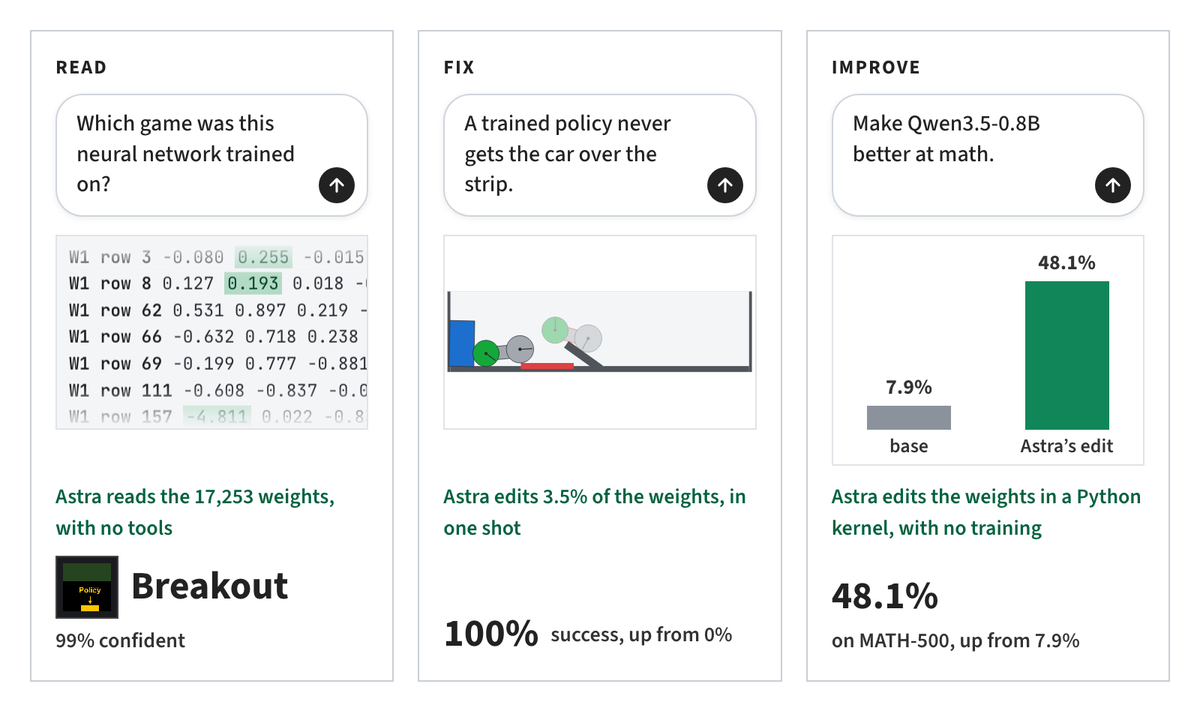
I find this just completely shocking. I’m definitely skeptical. It just doesn’t line up with my understanding of how these models work. Is there really enough training data on direct weight editing to give a model this skill? Maybe it’s evidence that OpenAI has been creating a lot of training data on ML research. I’m surprised that was put into a public facing model though.
One consideration is that Qwen3.5 has bigger/later versions that are already better at math. If it was indeed training on ML research, it's possible that what it is actually doing is applying lessons learned from the Qwen3.8 27B weights (which independently solved the problem) to Qwen3.5 0.8B.
I doubt it's that simple, but I could totally see an LLM being able to make that association and apply a fix from an improved LLM to a smaller one with the same architecture.
But how would it know which weights to update? It has 3.5 and 3.8 weights memorized in its own weights and can somehow figure out which ones are responsible for different skills just in its own reasoning trace? (Since it didn’t use any external tools)?
That’s pretty crazy because, as I said in another comment, I just asked ChatGPT how many r’s are in blackberry and it said 3. I know it’s not Astra and the app doesn’t tell me which model it is, but I’m still very confused about how a model can edit neural net weights but not count letters in a reasoning trace. Edit: Oh I misread, it didn’t use tool calls for the first part but it did have a custom harness for the part where it edited a models weights. Still impressive but not existentially confusing anymore.
>It just doesn’t line up with my understanding of how these models work. Is there really enough training data on direct weight editing to give a model this skill?
I mean, this question indicates that your understanding of how these models work is, indeed, lacking. Despite what some people having being hollering about, treating LLMs as just "stochastic parrots" isn't doing their capabilities any justice. They are constantly exhibiting emergent behavior which wouldn't be found directly in their training data. They are capable of combining different ideas that they are explicitly taught to perform novel tasks. I'm not saying you're guilty of this, but the people claiming LLMs just regurgitate existing data don't understand how LLMs, and likely their own cognitive experience, actually works.
This hand-wavy phrase has applied to neural networks in general since it was possible to train them. That was more than half a century ago. It means both nothing and everything simultaneously. Every learned ability of any neural network is an emergent property.
It's "emergent behavior" because it wasn't explicitly designed to have this behavior. A neural network trained to recognize handwritten numerical digits isn't displaying emergent behavior by being able to recognize handwritten numerical digits. But if it could somehow also be able to recognize handwritten letters despite not be explicitly trained to do so, then that would be emergent behavior.
With LLMs, "emergent behaviors" are certainly more common than we've seen before, so it's fair to say that this term is kind of getting lost in the noise. But that doesn't mean that it's inaccurate or meaningless. It just means LLMs are exhibiting a lot of emergent behaviors. It's kind of the whole reason they're at the center of so much money, discussions, issues, etc.
The math example on Qwen was based on 50 batched iterations, and the fix was essentially to remove a direction in activation space that causes looping instead of an exit, this was already known to be a thing.
So it's not able to insert new knowledge, but it's able to adjust the routing/looping/weighing of existing one. As I understand, it can replace post-training like LoRA/GRPO, but if it'd cheaper the authors don't go into
I don't think its that crazy that you could look at activations and tweak weights directly to get a certain outcome, but isn't the question whether you can do that without side effects or degrading/breaking other parts of the model?
If I want to do that in a generalizable way that preserves performance across all domains then am I not just back to training again?
I think you could still essentially have a really cheap Lora-Post training on a frozen base model by doing this. And instead of creating 200 checkpoints for different post-trained directions just adjust a single one on the fly.
I don't think it can whistle while chewing gum, no.
I think it can patch together components of tasks represented in its training data to do demonstrably new things, yes, which does count as "perform tasks not in its training data" with the limitation that some form of the task must be present. Example: writing an ode to a sales lead for a job well done in 2032 for the first quarter. Odes exist, the concept of sales performance exist, good job performance, and notions of time. Stringing those together are good examples of interpolation but not extrapolation, as it were.
At some point we have to accept that there is enough training data on "being good at thinking" and that being good at thinking generalises really well.
There doesn't need to be specific narrow training data on every conceivable task.
I agree, but also, I kind of feel like real judgement and understanding are a different thing from this "being good at thinking", and that in fact, this is the reason AIs hallucinate in the first place (A generated text can fit the pattern of a good response because its accurate, or because it's bs but has similar words and structure to other texts on the topic. Without real understanding, LLMs can't tell that the truth is important)
It's not directly related to this but I'd like to add that, in my opinion (admittedly uninformed but it makes sense to me), when they manage to, not just reduce the frequency of the LLM stating made up dates, laws etc, or made up facts, but manage to make an AI understand what the truth is and deliberately make responses accurate, we'll have real AGI that will be able to do engineering, accounting, medicine... unsupervised.
And yet I would expect that if it truly was generally good at thinking as you put it that it would be better at chess if you gave it a set of general rules/tactics and have it think through and look forward to decide its moves, but it is quite bad.
How do we decide which version of thinking a model is good at?
A house sparrow (Passer domesticus) doesn't have a worse brain than a human. Nothing does house sparrow thinking better than a house sparrow brain. Not even a human brain.
1/ The internal users at labs and external users are completely different. 2/ The lab people use the models to create recursive systems, systems to create prompts or synthetic data sets etc etc etc. Way different mentality than "fix the bug, make no mistakes" Is it really so farfetched to think they've been having models fuck with the weights of models? I think it's entirely possible, probably even likely as a way of generating permutations of synthetic datasets that will then be included or excluded If you subscribe to this, then it would be entirely possible for this to have become a major part of post-training and be practically impossible to exclude from public facing models, which are famously hard to govern. The models barely know their own version numbers.
> Is there really enough training data on direct weight editing to give a model this skill?
OpenAI has been gearing up for RSI. Jakub Pachocki has mentioned this as a priority, even as recently as September 6 in public. GPT-5.3-Codex helped with its own development. They have been experimenting with it for post training (GPT-Red is a documented model-to-model training loop) but it's also likely there's pre training for it.
Comments (902) 298 threads
Show all comments
Showing thread 8 of 298
I doubt it's that simple, but I could totally see an LLM being able to make that association and apply a fix from an improved LLM to a smaller one with the same architecture.
That’s pretty crazy because, as I said in another comment, I just asked ChatGPT how many r’s are in blackberry and it said 3. I know it’s not Astra and the app doesn’t tell me which model it is, but I’m still very confused about how a model can edit neural net weights but not count letters in a reasoning trace.
Edit: Oh I misread, it didn’t use tool calls for the first part but it did have a custom harness for the part where it edited a models weights. Still impressive but not existentially confusing anymore.
I mean, this question indicates that your understanding of how these models work is, indeed, lacking.
Despite what some people having being hollering about, treating LLMs as just "stochastic parrots" isn't doing their capabilities any justice. They are constantly exhibiting emergent behavior which wouldn't be found directly in their training data. They are capable of combining different ideas that they are explicitly taught to perform novel tasks.
I'm not saying you're guilty of this, but the people claiming LLMs just regurgitate existing data don't understand how LLMs, and likely their own cognitive experience, actually works.
This hand-wavy phrase has applied to neural networks in general since it was possible to train them. That was more than half a century ago. It means both nothing and everything simultaneously.
Every learned ability of any neural network is an emergent property.
With LLMs, "emergent behaviors" are certainly more common than we've seen before, so it's fair to say that this term is kind of getting lost in the noise. But that doesn't mean that it's inaccurate or meaningless. It just means LLMs are exhibiting a lot of emergent behaviors. It's kind of the whole reason they're at the center of so much money, discussions, issues, etc.
So it's not able to insert new knowledge, but it's able to adjust the routing/looping/weighing of existing one.
As I understand, it can replace post-training like LoRA/GRPO, but if it'd cheaper the authors don't go into
If I want to do that in a generalizable way that preserves performance across all domains then am I not just back to training again?
I think you could still essentially have a really cheap Lora-Post training on a frozen base model by doing this. And instead of creating 200 checkpoints for different post-trained directions just adjust a single one on the fly.
Continue this thread — 6 replies
I think it can patch together components of tasks represented in its training data to do demonstrably new things, yes, which does count as "perform tasks not in its training data" with the limitation that some form of the task must be present. Example: writing an ode to a sales lead for a job well done in 2032 for the first quarter. Odes exist, the concept of sales performance exist, good job performance, and notions of time. Stringing those together are good examples of interpolation but not extrapolation, as it were.
Continue this thread — 2 replies
There doesn't need to be specific narrow training data on every conceivable task.
It's not directly related to this but I'd like to add that, in my opinion (admittedly uninformed but it makes sense to me), when they manage to, not just reduce the frequency of the LLM stating made up dates, laws etc, or made up facts, but manage to make an AI understand what the truth is and deliberately make responses accurate, we'll have real AGI that will be able to do engineering, accounting, medicine... unsupervised.
A house sparrow (Passer domesticus) doesn't have a worse brain than a human. Nothing does house sparrow thinking better than a house sparrow brain. Not even a human brain.
they clearly outhink the sparrow at sparrowing in order to predict what the sparrow will and wont react to, and how theyll try to escape the cat
Continue this thread — 2 replies
1/ The internal users at labs and external users are completely different.
2/ The lab people use the models to create recursive systems, systems to create prompts or synthetic data sets etc etc etc. Way different mentality than "fix the bug, make no mistakes"
Is it really so farfetched to think they've been having models fuck with the weights of models? I think it's entirely possible, probably even likely as a way of generating permutations of synthetic datasets that will then be included or excluded
If you subscribe to this, then it would be entirely possible for this to have become a major part of post-training and be practically impossible to exclude from public facing models, which are famously hard to govern. The models barely know their own version numbers.
OpenAI has been gearing up for RSI. Jakub Pachocki has mentioned this as a priority, even as recently as September 6 in public. GPT-5.3-Codex helped with its own development.
They have been experimenting with it for post training (GPT-Red is a documented model-to-model training loop) but it's also likely there's pre training for it.